




Derive lens formula\[\dfrac{1}{v} - \dfrac{1}{u} = \dfrac{1}{f}\]
Answer
 Verified
660.3k+ views
Hint – Start by describing how a convex lens interacts with different incident rays and use this to draw a diagram as shown in the solution. Then use simple geometrical calculations to derive the lens formula.
Complete step by step answer:
Before deriving the lens formula, we have to know two properties of a convex lens:
(i)An incident ray perpendicular to the principal axis, after exiting the lens, will pass through the focus.
(ii)An incident light ray that passes through the optical center of the lens, will pass through without undergoing any refraction.
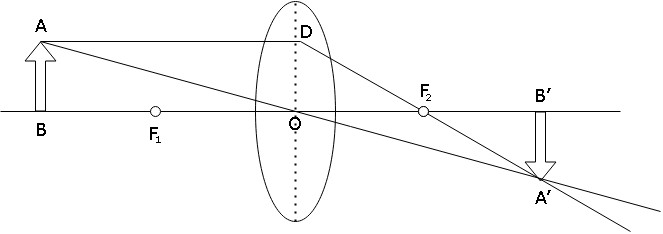
Using both of these conditions, we construct the following diagram and use it to derive the lens formula.The object is placed at a distance $u$from the optical center, $f$is the focal length of the lens and\[v\] is the distance of image formed from the optical center.
By Cartesian sign convention, we know:
Distance of object$(OB) = - u$
Distance of image$(OB') = + v$
Focal Length$(O{F_1} = O{F_2}) = + f$
Now,$\because \angle ABO = \angle A'B'O = 90^\circ $
And $\because \angle AOB = \angle A'OB' = 90^\circ $(Vertically Opposite Angles)
$\therefore \Delta ABO \sim \Delta A'B'O$
$\therefore \dfrac{{AB}}{{A'B'}} = \dfrac{{OB}}{{OB'}}$(Equation 1)
$\therefore \dfrac{{AB}}{{A'B'}} = \dfrac{{O{F_2}}}{{{F_2}B'}}$($becauseOD = AB,$ Opposite sides of $\square ABOD$ are equal)
$ \Rightarrow \dfrac{{AB}}{{A'B'}} = \dfrac{{O{F_2}}}{{OB' - O{F_2}}}$
$ \Rightarrow \dfrac{{AB}}{{A'B'}} = \dfrac{f}{{v - f}}$(Equation 2)
Substituting, the value of$\dfrac{{AB}}{{A'B'}}$ in equation 1 with Cartesian sign convention, we get
$ - \dfrac{u}{v} = \dfrac{v}{{v - f}}$
$ \Rightarrow - u(v - f) = vf$
$ \Rightarrow - uv + uf = vf$
Dividing both sides by$uvf$,
$ \Rightarrow - \dfrac{{uv}}{{uvf}} + \dfrac{{uf}}{{uvf}} = \dfrac{{vf}}{{uvf}}$
$ \Rightarrow - \dfrac{1}{f} + \dfrac{1}{v} = \dfrac{1}{u}$
$ \Rightarrow \dfrac{1}{v} - \dfrac{1}{u} = \dfrac{1}{f}$
This equation is known as the ‘lens formula’.
Lens formula is to obviously among other things make lenses. From spectacles to the contacts you wear, everything is designed keeping the lens formula in mind
Note - The lens formula can also be easily derived by using concave lens instead of convex lens. The process of making the diagram and using geometrical calculations to reach the solution. The only difference is that the image formed will be virtual instead of real that does not change anything.
Complete step by step answer:
Before deriving the lens formula, we have to know two properties of a convex lens:
(i)An incident ray perpendicular to the principal axis, after exiting the lens, will pass through the focus.
(ii)An incident light ray that passes through the optical center of the lens, will pass through without undergoing any refraction.
Using both of these conditions, we construct the following diagram and use it to derive the lens formula.The object is placed at a distance $u$from the optical center, $f$is the focal length of the lens and\[v\] is the distance of image formed from the optical center.
By Cartesian sign convention, we know:
Distance of object$(OB) = - u$
Distance of image$(OB') = + v$
Focal Length$(O{F_1} = O{F_2}) = + f$
Now,$\because \angle ABO = \angle A'B'O = 90^\circ $
And $\because \angle AOB = \angle A'OB' = 90^\circ $(Vertically Opposite Angles)
$\therefore \Delta ABO \sim \Delta A'B'O$
$\therefore \dfrac{{AB}}{{A'B'}} = \dfrac{{OB}}{{OB'}}$(Equation 1)
$\therefore \dfrac{{AB}}{{A'B'}} = \dfrac{{O{F_2}}}{{{F_2}B'}}$($becauseOD = AB,$ Opposite sides of $\square ABOD$ are equal)
$ \Rightarrow \dfrac{{AB}}{{A'B'}} = \dfrac{{O{F_2}}}{{OB' - O{F_2}}}$
$ \Rightarrow \dfrac{{AB}}{{A'B'}} = \dfrac{f}{{v - f}}$(Equation 2)
Substituting, the value of$\dfrac{{AB}}{{A'B'}}$ in equation 1 with Cartesian sign convention, we get
$ - \dfrac{u}{v} = \dfrac{v}{{v - f}}$
$ \Rightarrow - u(v - f) = vf$
$ \Rightarrow - uv + uf = vf$
Dividing both sides by$uvf$,
$ \Rightarrow - \dfrac{{uv}}{{uvf}} + \dfrac{{uf}}{{uvf}} = \dfrac{{vf}}{{uvf}}$
$ \Rightarrow - \dfrac{1}{f} + \dfrac{1}{v} = \dfrac{1}{u}$
$ \Rightarrow \dfrac{1}{v} - \dfrac{1}{u} = \dfrac{1}{f}$
This equation is known as the ‘lens formula’.
Lens formula is to obviously among other things make lenses. From spectacles to the contacts you wear, everything is designed keeping the lens formula in mind
Note - The lens formula can also be easily derived by using concave lens instead of convex lens. The process of making the diagram and using geometrical calculations to reach the solution. The only difference is that the image formed will be virtual instead of real that does not change anything.
Recently Updated Pages
Master Class 12 Economics: Engaging Questions & Answers for Success

Master Class 12 Social Science: Engaging Questions & Answers for Success
Master Class 12 English: Engaging Questions & Answers for Success
Master Class 12 Maths: Engaging Questions & Answers for Success
Master Class 12 Physics: Engaging Questions & Answers for Success
Master Class 12 Biology: Engaging Questions & Answers for Success
Trending doubts
Draw a labelled sketch of the human eye class 12 physics CBSE
Which are the Top 10 Largest Countries of the World?
Draw ray diagrams each showing i myopic eye and ii class 12 physics CBSE
Which is the correct genotypic ratio of mendel dihybrid class 12 biology CBSE
Differentiate between homogeneous and heterogeneous class 12 chemistry CBSE
Which animal never drinks water in its entire life class 12 biology CBSE