




Dental caries is due to
A. Hereditary abnormalities
B. Bacterial Infections
C. Viral infection
D. Contaminated water
Answer
 Verified
651k+ views
Hint: Tooth decay (dental caries) refers to damage of the structure of the tooth enamel. Untreated cavities can cause toothache, infection, tooth loss. The symptoms of tooth decay include pain and difficulty with eating.
Step by step answer:The teeth play an important role in chewing and also helps us to speak. The tooth is made up of four different tissues namely, enamel, dentine, pulp, and cementum. The enamel, dentine, and cementum are hard calcified tissue whereas pulp is soft non-calcified tissue. The pulp is the center of the tooth and it contains blood vessels and nerves. When we eat something sugary, bacteria in our mouth attack and make acid that damages the tooth surface, and enamel forms the cavity. The demineralization of the tooth begins. Tooth decay can be stopped or reversed cause enamel repair itself using minerals from saliva and toothpaste. If the decaying of the tooth continues enamel weakens and thus it gets destroyed and results in caries.
Acids are released due to the metabolic activities of bacteria. Dental caries initially looks like discoloration of the tooth over time it darkens and forms a dark black spot.
Hence, the correct option is option B, Bacterial Infections
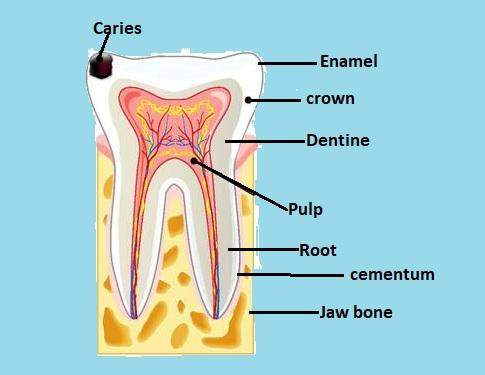
Note: Dental caries vary from plaque. Plaque is a sticky pale yellow film on teeth. This is the bacterial colonies that live in the mouth and survive on the food stuck to teeth. The metabolic product of these bacterias results in the formation of caries. Plaque can be removed by proper brushing and dental clean-up.
Step by step answer:The teeth play an important role in chewing and also helps us to speak. The tooth is made up of four different tissues namely, enamel, dentine, pulp, and cementum. The enamel, dentine, and cementum are hard calcified tissue whereas pulp is soft non-calcified tissue. The pulp is the center of the tooth and it contains blood vessels and nerves. When we eat something sugary, bacteria in our mouth attack and make acid that damages the tooth surface, and enamel forms the cavity. The demineralization of the tooth begins. Tooth decay can be stopped or reversed cause enamel repair itself using minerals from saliva and toothpaste. If the decaying of the tooth continues enamel weakens and thus it gets destroyed and results in caries.
Acids are released due to the metabolic activities of bacteria. Dental caries initially looks like discoloration of the tooth over time it darkens and forms a dark black spot.
Hence, the correct option is option B, Bacterial Infections
Note: Dental caries vary from plaque. Plaque is a sticky pale yellow film on teeth. This is the bacterial colonies that live in the mouth and survive on the food stuck to teeth. The metabolic product of these bacterias results in the formation of caries. Plaque can be removed by proper brushing and dental clean-up.
Recently Updated Pages
If x a + bt + ct2 where x is in meters and t is in class 11 physics CBSE

A car covers the first half distance between two places class 11 physics CBSE
The resultant of two vectors overrightarrow P and overrightarrow class 11 physics CBSE
Find the value of cos 135 class 11 maths CBSE
A mass M is held in place by an applied force F and class 11 physics CBSE
A solution of glucose in water is labelled as 10 dfracwv class 11 chemistry CBSE
Trending doubts
One Metric ton is equal to kg A 10000 B 1000 C 100 class 11 physics CBSE
Find the value of the expression given below sin 30circ class 11 maths CBSE
What do you mean by retardation What is its SI uni class 11 physics CBSE
Draw a diagram of nephron and explain its structur class 11 biology CBSE
10 examples of friction in our daily life
Difference between physical and chemical change class 11 chemistry CBSE