



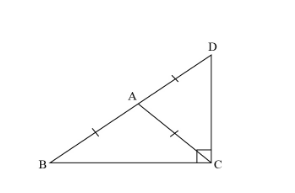
\[\Delta ABC\] is an isosceles triangle in which\[AB = AC\]. Sides BA is produced to D such that\[AD = AB\](see figure). Show that \[\angle BCD\] is a right angle.
Answer
 Verified
607.8k+ views
Hint: A triangle is shape that consists of 3 sides, 3 vertices and 3 angles, the properties of the triangle is that the sum of the three angles of a triangle is \[180^\circ \], and if the any two sides of a triangle is same, then the angles of those two sides will be automatically same according to the opposite angles process.
Complete step-by-step answer:
The triangle is an isosceles triangle and\[AB = AC\] and \[AD = AB\].
So if \[AD = AB\] then we can say that,
\[AD = AC\]
We know from the triangle ABC, the angle \[\angle ACB = \angle ABC\] because of the property of the triangle which states that the two sides AC and AB are equal so both angles are also equal.
\[\angle ACB = \angle ABC\]……(1)
Similarly, we know from the triangle ADC the angle \[\angle ACD = \angle ADC\] because they are also the angles of equal sides.
\[\angle ACD = \angle ADC\]……(2)
Now, we will add the equations 1 and 2, we get,
\[\angle ACB + \angle ACD = \angle ABC + \angle ADC\]
It can be observe from the figure that, sum of both angles \[\angle ACB\] and \[\,\angle ACD\] is equal to \[\angle BCD\] and \[\angle ADC\] is equal to the \[\angle BDC\] because they are same angle.
\[\angle ACB + \angle ACD = \angle BCD\]
On further substituting \[\angle ACB = \angle ABC\] and \[\angle ACD = \angle ADC = \angle BDC\] the above equation will become,
\[\angle BCD = \angle ABC + \angle BDC\]
Now, on adding\[\angle BCD\] on both sides then, we get,
\[\angle BCD + \angle BCD = \angle ABC + \angle BDC + \angle BCD\]
So, sum of the angles of a triangle is \[180^\circ \], that is \[\angle ABC + \angle BDC + \angle BCD = 180^\circ \]. Then from the equation it can be observe that,
\[\begin{array}{c}
2\angle BCD = 180^\circ \\
\angle BCD = 90^\circ
\end{array}\]
Therefore, it is shown that the \[\angle BCD = 90^\circ \], so it is a right angled triangle.
Note: Here, it can be see that we added \[\angle BCD\] on the both sides that will makes a triangle of \[180^\circ \] in the given figure, so we should not struck at any point of the solution, we can go with the process to prove the triangle is a right angled triangle.
Complete step-by-step answer:
The triangle is an isosceles triangle and\[AB = AC\] and \[AD = AB\].
So if \[AD = AB\] then we can say that,
\[AD = AC\]
We know from the triangle ABC, the angle \[\angle ACB = \angle ABC\] because of the property of the triangle which states that the two sides AC and AB are equal so both angles are also equal.
\[\angle ACB = \angle ABC\]……(1)
Similarly, we know from the triangle ADC the angle \[\angle ACD = \angle ADC\] because they are also the angles of equal sides.
\[\angle ACD = \angle ADC\]……(2)
Now, we will add the equations 1 and 2, we get,
\[\angle ACB + \angle ACD = \angle ABC + \angle ADC\]
It can be observe from the figure that, sum of both angles \[\angle ACB\] and \[\,\angle ACD\] is equal to \[\angle BCD\] and \[\angle ADC\] is equal to the \[\angle BDC\] because they are same angle.
\[\angle ACB + \angle ACD = \angle BCD\]
On further substituting \[\angle ACB = \angle ABC\] and \[\angle ACD = \angle ADC = \angle BDC\] the above equation will become,
\[\angle BCD = \angle ABC + \angle BDC\]
Now, on adding\[\angle BCD\] on both sides then, we get,
\[\angle BCD + \angle BCD = \angle ABC + \angle BDC + \angle BCD\]
So, sum of the angles of a triangle is \[180^\circ \], that is \[\angle ABC + \angle BDC + \angle BCD = 180^\circ \]. Then from the equation it can be observe that,
\[\begin{array}{c}
2\angle BCD = 180^\circ \\
\angle BCD = 90^\circ
\end{array}\]
Therefore, it is shown that the \[\angle BCD = 90^\circ \], so it is a right angled triangle.
Note: Here, it can be see that we added \[\angle BCD\] on the both sides that will makes a triangle of \[180^\circ \] in the given figure, so we should not struck at any point of the solution, we can go with the process to prove the triangle is a right angled triangle.
Recently Updated Pages
Three beakers labelled as A B and C each containing 25 mL of water were taken A small amount of NaOH anhydrous CuSO4 and NaCl were added to the beakers A B and C respectively It was observed that there was an increase in the temperature of the solutions contained in beakers A and B whereas in case of beaker C the temperature of the solution falls Which one of the following statements isarecorrect i In beakers A and B exothermic process has occurred ii In beakers A and B endothermic process has occurred iii In beaker C exothermic process has occurred iv In beaker C endothermic process has occurred

Master Class 9 Social Science: Engaging Questions & Answers for Success
Master Class 9 Science: Engaging Questions & Answers for Success
Master Class 9 Maths: Engaging Questions & Answers for Success
Master Class 9 General Knowledge: Engaging Questions & Answers for Success
Class 9 Question and Answer - Your Ultimate Solutions Guide
Three beakers labelled as A B and C each containing 25 mL of water were taken A small amount of NaOH anhydrous CuSO4 and NaCl were added to the beakers A B and C respectively It was observed that there was an increase in the temperature of the solutions contained in beakers A and B whereas in case of beaker C the temperature of the solution falls Which one of the following statements isarecorrect i In beakers A and B exothermic process has occurred ii In beakers A and B endothermic process has occurred iii In beaker C exothermic process has occurred iv In beaker C endothermic process has occurred
Master Class 9 Social Science: Engaging Questions & Answers for Success
Master Class 9 Science: Engaging Questions & Answers for Success
Trending doubts
Find the sum of series 1 + 2 + 3 + 4 + 5 + + 100 class 9 maths CBSE
Fill the blanks with the suitable prepositions 1 The class 9 english CBSE
Difference Between Plant Cell and Animal Cell
What is pollution? How many types of pollution? Define it
Name 10 Living and Non living things class 9 biology CBSE
Which are the Top 10 Largest States of India?