




Define Translatory motion.
Answer
 Verified
687k+ views
- Hint: Translatory motion can be defined as a uniform motion where the different parts of the body do not change orientation with respect to each other.
Complete step-by-step solution -
Simply motion can be defined as the change of position concerning time. More broadly, motion can be defined as of three types :
Translatory motion
Rotational motion
Vibrational motion
There are many cases where the motion is described by one, two, or all of these in a single system.
Translational motion can be defined as the motion in which all points of a moving body move uniformly in the same line or direction. In due course of translation motion, the different points of an object do not change orientation to each other. Alternatively, in simple words, the body will not rotate or vibrate.
Examples: a ball moving in a parabolic path, a man walking in a straight road, etc
Translatory motion can be further classified into two types:
Curvilinear Motion
Rectilinear motion
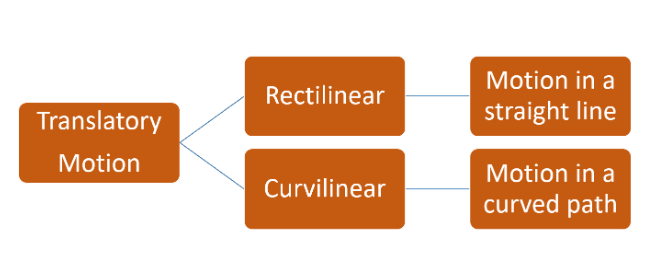
The motion is said to be curvilinear when the body is on a curved path. It is also motion in two-three dimensions. So pure translational motion does not always have to be in a straight line. This scenario is viable if an object moves in a curved path without changing its orientation.
Whereas the motion is said to be rectilinear when the body moves in a straight path. In this scenario, all the points of the moving system move parallel to each other, which ensures that there is no change in the orientation of the points that is no rotational motion.
Few more examples of translatory motion for better understanding:
Man walking
Car or bus moving.
Boat sailing in the sea.
Cat walking.
A stone falling straight towards the surface of the earth
A coin moving over a carrom board
Note: Student maximum times confuses translator motion with the motion in a straight line, but remember this is not necessary. Translation motion can be in a curved path also.
Complete step-by-step solution -
Simply motion can be defined as the change of position concerning time. More broadly, motion can be defined as of three types :
Translatory motion
Rotational motion
Vibrational motion
There are many cases where the motion is described by one, two, or all of these in a single system.
Translational motion can be defined as the motion in which all points of a moving body move uniformly in the same line or direction. In due course of translation motion, the different points of an object do not change orientation to each other. Alternatively, in simple words, the body will not rotate or vibrate.
Examples: a ball moving in a parabolic path, a man walking in a straight road, etc
Translatory motion can be further classified into two types:
Curvilinear Motion
Rectilinear motion
The motion is said to be curvilinear when the body is on a curved path. It is also motion in two-three dimensions. So pure translational motion does not always have to be in a straight line. This scenario is viable if an object moves in a curved path without changing its orientation.
Whereas the motion is said to be rectilinear when the body moves in a straight path. In this scenario, all the points of the moving system move parallel to each other, which ensures that there is no change in the orientation of the points that is no rotational motion.
Few more examples of translatory motion for better understanding:
Man walking
Car or bus moving.
Boat sailing in the sea.
Cat walking.
A stone falling straight towards the surface of the earth
A coin moving over a carrom board
Note: Student maximum times confuses translator motion with the motion in a straight line, but remember this is not necessary. Translation motion can be in a curved path also.
Recently Updated Pages
Which will be the least stable resonating structure class 11 chemistry CBSE

How many 5 digit telephone numbers can be construc-class-11-maths-CBSE
How do you find the angle of the resultant vector class 11 physics CBSE
Draw labelled diagram of the following i Gram seed class 11 biology CBSE
1 Quintal is equal to a 110 kg b 10 kg c 100kg d 1000 class 11 physics CBSE
What is the need and importance of classification class 11 biology CBSE
Trending doubts
Find the value of the expression given below sin 30circ class 11 maths CBSE
One Metric ton is equal to kg A 10000 B 1000 C 100 class 11 physics CBSE
10 examples of friction in our daily life
Draw a diagram of a plant cell and label at least eight class 11 biology CBSE
Difference between physical and chemical change class 11 chemistry CBSE
Proton was discovered by A Thomson B Rutherford C Chadwick class 11 chemistry CBSE