




Define the term hyperconjugation.
Answer
 Verified
622.8k+ views
Hint: Proceed this question using the concept of hyperconjugation, which is a special case of resonance that involves the delocalization of the sigma electrons of the carbon hydrogen bond of any alkyl group.
Complete step by step solution:
Hyperconjugation is the interaction of the electrons present in the sigma bond with an adjacent empty or the partially filled non-bonding p-orbitals. The partially filled non-bonding p-orbitals can be antibonding $\alpha \text{ or }\pi \text{ }$orbitals or the filled $\pi $orbitals which gives the extended molecular orbital that increases the stability of the system.
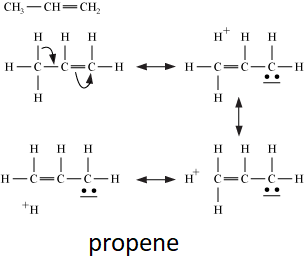
Let’s take an example of propene, hyperconjugation arises due to the partial overlapping of the $s{{p}^{3}}$sigma bond and the empty p-orbital of the adjacent carbon atom.
The hyperconjugation structure of propene are mentioned below:
Additional information:
The hyperconjugation and inductive effect are quite opposite, because the inductive effect is through sigma bond and the hyperconjugation is through the charge transfer. Hyperconjugation is very useful in explaining the physical and the chemical properties of the organic molecules which includes the shortening of carbon-carbon single chain which is adjacent to multiple bonds. Hyperconjugation also defines the stability of carbocations, free radicals and the relative stability of alkenes.
Note: In this particular question we should also know that the hyperconjugation is also known as no bond resonance. We know that the resonance involves delocalization of $\pi $electrons but in hyperconjugation the $\alpha $ electrons are delocalized not the$\pi $. The normal length of the carbon- carbon single bond is around 1.54 Angstrom. But in some of the compounds like propene, it is a little bit shorter because of the presence of the double bond character in the carbon-carbon single bond due to hyperconjugation.
Complete step by step solution:
Hyperconjugation is the interaction of the electrons present in the sigma bond with an adjacent empty or the partially filled non-bonding p-orbitals. The partially filled non-bonding p-orbitals can be antibonding $\alpha \text{ or }\pi \text{ }$orbitals or the filled $\pi $orbitals which gives the extended molecular orbital that increases the stability of the system.
Let’s take an example of propene, hyperconjugation arises due to the partial overlapping of the $s{{p}^{3}}$sigma bond and the empty p-orbital of the adjacent carbon atom.
The hyperconjugation structure of propene are mentioned below:
Additional information:
The hyperconjugation and inductive effect are quite opposite, because the inductive effect is through sigma bond and the hyperconjugation is through the charge transfer. Hyperconjugation is very useful in explaining the physical and the chemical properties of the organic molecules which includes the shortening of carbon-carbon single chain which is adjacent to multiple bonds. Hyperconjugation also defines the stability of carbocations, free radicals and the relative stability of alkenes.
Note: In this particular question we should also know that the hyperconjugation is also known as no bond resonance. We know that the resonance involves delocalization of $\pi $electrons but in hyperconjugation the $\alpha $ electrons are delocalized not the$\pi $. The normal length of the carbon- carbon single bond is around 1.54 Angstrom. But in some of the compounds like propene, it is a little bit shorter because of the presence of the double bond character in the carbon-carbon single bond due to hyperconjugation.
Recently Updated Pages
Master Class 12 Economics: Engaging Questions & Answers for Success

Master Class 12 Biology: Engaging Questions & Answers for Success
Master Class 11 English: Engaging Questions & Answers for Success
Master Class 11 Physics: Engaging Questions & Answers for Success
Master Class 11 Computer Science: Engaging Questions & Answers for Success
Master Class 11 Chemistry: Engaging Questions & Answers for Success
Trending doubts
Which are the Top 10 Largest Countries of the World?
Draw a labelled sketch of the human eye class 12 physics CBSE
Why is the cell called the structural and functional class 12 biology CBSE
Derive an expression for the electric field intensity class 12 physics CBSE
Which alcohol is used in cough syrups and tonics class 12 chemistry CBSE
Consider three charges q1 q2 q3 q at the vertices of class 12 physics CBSE