




Define the process of convection.
Answer
 Verified
658.8k+ views
Hint: In general, there are three types of heat transfer. They are conduction, convection and radiation. So, the heat is transferred from hot body to cold body by these three types. And these three types of heat transfer are different from one another.
Complete step by step solution:
Convection is the process of heat transfer from hot body to cold body by the bulk movement of the molecules within fluids such as gases and liquids. The initial heat transfer from the hot body to the fluid takes place through conduction, but the bulk heat transfer happens due to the motion of the fluid. Convection is the process of heat transfer in fluids by the actual motion of molecules in the fluids. It happens in liquids as well as gases. It may be natural or forced. It involves a bulk transfer of portions of the fluid.
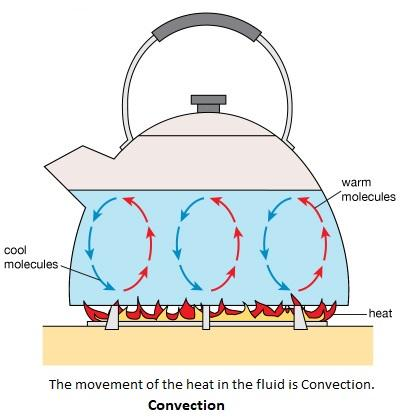
There are two types of convection, and they are natural convection and forced convection. In natural convection, when the convection takes place due to the buoyant force as there is a difference in densities between the hot body and cold body caused by the difference in temperatures between the hot body and cold body it is known as natural convection. The examples of the natural convection are oceanic winds. In forced convection, when external sources such as fans and pumps are used to cool the hot body, it is known as forced convection.
Note: The phenomenon when the fluid particle of a medium moves to the source of heat energy and absorbs the heat energy and moves away from the heat body, so the next fluid particle of a medium moves to the source of heat energy. Convection is the phenomenon where the particle of matter moves and carries the heat.
Complete step by step solution:
Convection is the process of heat transfer from hot body to cold body by the bulk movement of the molecules within fluids such as gases and liquids. The initial heat transfer from the hot body to the fluid takes place through conduction, but the bulk heat transfer happens due to the motion of the fluid. Convection is the process of heat transfer in fluids by the actual motion of molecules in the fluids. It happens in liquids as well as gases. It may be natural or forced. It involves a bulk transfer of portions of the fluid.
There are two types of convection, and they are natural convection and forced convection. In natural convection, when the convection takes place due to the buoyant force as there is a difference in densities between the hot body and cold body caused by the difference in temperatures between the hot body and cold body it is known as natural convection. The examples of the natural convection are oceanic winds. In forced convection, when external sources such as fans and pumps are used to cool the hot body, it is known as forced convection.
Note: The phenomenon when the fluid particle of a medium moves to the source of heat energy and absorbs the heat energy and moves away from the heat body, so the next fluid particle of a medium moves to the source of heat energy. Convection is the phenomenon where the particle of matter moves and carries the heat.
Recently Updated Pages
Which will be the least stable resonating structure class 11 chemistry CBSE

How many 5 digit telephone numbers can be construc-class-11-maths-CBSE
How do you find the angle of the resultant vector class 11 physics CBSE
Draw labelled diagram of the following i Gram seed class 11 biology CBSE
1 Quintal is equal to a 110 kg b 10 kg c 100kg d 1000 class 11 physics CBSE
What is the need and importance of classification class 11 biology CBSE
Trending doubts
Find the value of the expression given below sin 30circ class 11 maths CBSE
One Metric ton is equal to kg A 10000 B 1000 C 100 class 11 physics CBSE
10 examples of friction in our daily life
Draw a diagram of a plant cell and label at least eight class 11 biology CBSE
Difference between physical and chemical change class 11 chemistry CBSE
Proton was discovered by A Thomson B Rutherford C Chadwick class 11 chemistry CBSE