




Define phenotypic adaptation. Give one example.
Answer
 Verified
657.6k+ views
Hint: This adaptation relates to the changes in the body of an organism that are produced by the interaction of the genotype and the environment.
Complete answer:
Julian Huxley has mentioned about adaptation in his book Evolution: The Modern Synthesis. He wanted to say that the importance of an adaptation of any species can only be understood unless we will understand the total biology of that species.
Phenotypic adaptations refer to changes in the appearance of an organism as a result of genetic mutation and environmental conditions. These adjustments on which the organism responds positively, occur in them to cope with environmental conditions present in their natural habitats.
For example:
1) evolution of light-coloured moths in dark-coloured populations is a phenotypic adaptation that imparts a survival advantage in polluted areas.
2) Presence of thick cuticle and sunken stomata on the leaf surface of desert plants to prevent loss of water during transpiration.
3)Elephants have long ears that work similarly to that of a hand fan we use during summer when the temperature is high. Thus we can say that it acts as a thermoregulator.
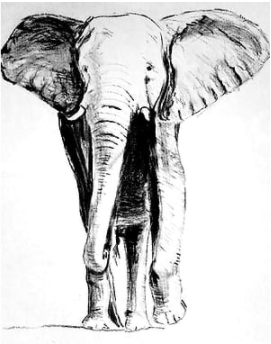
long ears in Elephants
Note:
In biology, adaptation has three related meanings.
1. At first, we can say that it is a dynamic evolutionary process that helps the organism to fit into their environment, by improving their evolutionary fitness.
2. Secondly, it is the state where the population reached during the process of adaptation.
3. Finally, it is a phenotypic trait or adaptive trait, which plays a very important role that is functional in each il organism. That is retained or maintained through generations and has evolved through natural selection.
Complete answer:
Julian Huxley has mentioned about adaptation in his book Evolution: The Modern Synthesis. He wanted to say that the importance of an adaptation of any species can only be understood unless we will understand the total biology of that species.
Phenotypic adaptations refer to changes in the appearance of an organism as a result of genetic mutation and environmental conditions. These adjustments on which the organism responds positively, occur in them to cope with environmental conditions present in their natural habitats.
For example:
1) evolution of light-coloured moths in dark-coloured populations is a phenotypic adaptation that imparts a survival advantage in polluted areas.
2) Presence of thick cuticle and sunken stomata on the leaf surface of desert plants to prevent loss of water during transpiration.
3)Elephants have long ears that work similarly to that of a hand fan we use during summer when the temperature is high. Thus we can say that it acts as a thermoregulator.
long ears in Elephants
Note:
In biology, adaptation has three related meanings.
1. At first, we can say that it is a dynamic evolutionary process that helps the organism to fit into their environment, by improving their evolutionary fitness.
2. Secondly, it is the state where the population reached during the process of adaptation.
3. Finally, it is a phenotypic trait or adaptive trait, which plays a very important role that is functional in each il organism. That is retained or maintained through generations and has evolved through natural selection.
Recently Updated Pages
Explain the structure of megasporangium class 12 biology CBSE

Why is chloroform kept in dark coloured bottles class 12 chemistry CBSE
Derive the balancing condition of a Wheatstone bri class 12 physics CBSE
Draw VI characteristics of a pn junction diode Explain class 12 physics CBSE
Is it possible to carry pride in ones language too class 12 english CBSE
In a population at Hardy Weinberg equilibrium the allele class 12 biology CBSE
Trending doubts
Draw a labelled sketch of the human eye class 12 physics CBSE
Which are the Top 10 Largest Countries of the World?
Draw ray diagrams each showing i myopic eye and ii class 12 physics CBSE
Which is the correct genotypic ratio of mendel dihybrid class 12 biology CBSE
Differentiate between homogeneous and heterogeneous class 12 chemistry CBSE
Which animal never drinks water in its entire life class 12 biology CBSE