




Define Peltier coefficient.
Answer
 Verified
597.6k+ views
Hint: The thermocouple is a sensor which is used to measure the temperature. This sensor consists of two non-similar metal wires, joined at one end, and connected to another thermocouple capable device at the other end. There is some amount of heat absorbed or evolved at the junctions on flow of current and its rate is Peltier coefficient.
Complete step by step answer:
Peltier coefficient- This is the amount of heat energy absorbed or evolved at one of the junctions of a thermocouple when one ampere current flows for one second. A thermocouple is a sensor that is used for measuring the temperature. Thermocouples consist of two wire legs made from different metals. The wires legs are wedded together at one end, for creating a junction. This junction is a point where the temperature is measured. When the junction experiences a change in temperature, a voltage is created. Let us consider a thermocouple formed by two types of wire, `Type A wire’ and `Type B wire’ with hot junction (H) and cold junction (C and
 ).
).
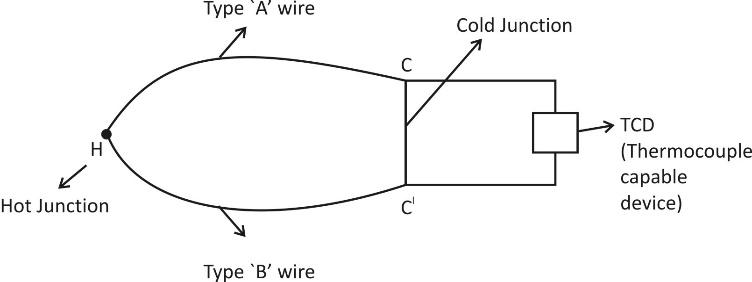
If `I’ ampere current is flowing throughout the thermocouple for time `t’ and due to this, the heat evolved or absorbed at one of the junctions in thermocouple is `Q’, then the Peltier coefficient `P’ is given by the relation:
$P = \dfrac{Q}{{It}}$
Note:
1. The thermocouple is used for both the AC (alternating current) and DC (direct current) measurements.
2. The Peltier coefficient is the phenomenon that a potential difference applied across the TC (Thermocouple) causes a temperature difference between the junctions of the different materials in the TC (Thermocouple). This effect is opposite to the seebeck effect.
Complete step by step answer:
Peltier coefficient- This is the amount of heat energy absorbed or evolved at one of the junctions of a thermocouple when one ampere current flows for one second. A thermocouple is a sensor that is used for measuring the temperature. Thermocouples consist of two wire legs made from different metals. The wires legs are wedded together at one end, for creating a junction. This junction is a point where the temperature is measured. When the junction experiences a change in temperature, a voltage is created. Let us consider a thermocouple formed by two types of wire, `Type A wire’ and `Type B wire’ with hot junction (H) and cold junction (C and
If `I’ ampere current is flowing throughout the thermocouple for time `t’ and due to this, the heat evolved or absorbed at one of the junctions in thermocouple is `Q’, then the Peltier coefficient `P’ is given by the relation:
$P = \dfrac{Q}{{It}}$
Note:
1. The thermocouple is used for both the AC (alternating current) and DC (direct current) measurements.
2. The Peltier coefficient is the phenomenon that a potential difference applied across the TC (Thermocouple) causes a temperature difference between the junctions of the different materials in the TC (Thermocouple). This effect is opposite to the seebeck effect.
Recently Updated Pages
How is Abiogenesis Theory Disproved Experimentally?

In a plane electromagnetic wave the electric field class 12 physics CBSE
A plane electromagnetic wave travels in vacuum along class 12 physics CBSE
The branch of science which deals with nature and natural class 10 physics CBSE
Understanding the Sun's Density: Exploring the Mass Density of a Hot Plasma - FAQs and Data Analysis
Where is the Centre for Environmental Education Located?
Trending doubts
Which are the Top 10 Largest Countries of the World?
Draw a labelled sketch of the human eye class 12 physics CBSE
Which state in the country is at the forefront in controlling class 12 social science CBSE
Mention the role of cyanobacteria as a biofertiliz class 12 biology ICSE
Where is the largest hydroelectric power station located class 12 biology CBSE
An example of C4 plant is A Maize B Rice C Wheat D class 12 biology CBSE