




Define Glancing angle.
Answer
 Verified
562.8k+ views
Hint: Here in order to answer the question we will learn about the concepts of glancing angle, relation between glancing angle and angle of incidence and how it is useful to us.
Complete step by step solution:
The glancing angle is the angle formed by the incident ray on a plane surface and the surface itself. A ray of electrons striking the crystal is an example of a glancing angle.
A glancing angle of reflection and a glance of incidence are also present.
The angle formed by a surface and a beam of particles is known as the glancing angle of reflection. It's the angle of reflection's part.
The angle formed by an incident beam and the surface is known as the glancing angle of incidence. It's the angle of incidence's part.
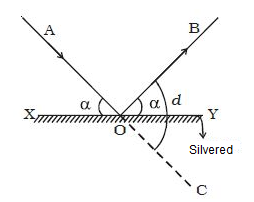
Consider the incident of a ray of light, AO, on a plane mirror, XY (Figure) at O. It's mirrored all the way down OB. The glancing angle with the mirror is the angle AOX made by AO with XY.
Note:
The distinction between angle of incidence and glancing angle must be understood. The angle of incidence is the angle established between the normal and the incident ray at the point of incidence. The angle between the beam and the surface, rather than the angle between the beam and the surface usually, is also more useful, i.e. 90° minus the angle of incidence, known as glancing angle.
Complete step by step solution:
The glancing angle is the angle formed by the incident ray on a plane surface and the surface itself. A ray of electrons striking the crystal is an example of a glancing angle.
A glancing angle of reflection and a glance of incidence are also present.
The angle formed by a surface and a beam of particles is known as the glancing angle of reflection. It's the angle of reflection's part.
The angle formed by an incident beam and the surface is known as the glancing angle of incidence. It's the angle of incidence's part.
Consider the incident of a ray of light, AO, on a plane mirror, XY (Figure) at O. It's mirrored all the way down OB. The glancing angle with the mirror is the angle AOX made by AO with XY.
Note:
The distinction between angle of incidence and glancing angle must be understood. The angle of incidence is the angle established between the normal and the incident ray at the point of incidence. The angle between the beam and the surface, rather than the angle between the beam and the surface usually, is also more useful, i.e. 90° minus the angle of incidence, known as glancing angle.
Recently Updated Pages
Master Class 12 Business Studies: Engaging Questions & Answers for Success

Master Class 12 Chemistry: Engaging Questions & Answers for Success
Master Class 12 Biology: Engaging Questions & Answers for Success
Class 12 Question and Answer - Your Ultimate Solutions Guide
Master Class 11 English: Engaging Questions & Answers for Success
Master Class 11 Social Science: Engaging Questions & Answers for Success
Trending doubts
The end of compass needle which points towards north class 12 physics CBSE
In order to find out the different types of gametes class 12 biology NEET_UG
Hormone responsible for the secretion of milk after class 12 biology CBSE
Yeast reproduces by A Spore formation B Multiple fission class 12 biology CBSE
Draw a well labelled diagram of LS of the human ki class 12 biology CBSE
Draw a diagram of a flower and name the parts class 12 biology ICSE