




Define electric flux. Write its S.I. unit.
“Gauss’s law in electrostatics is true for any closed surface, no matter what its shape or size is”. Justify this statement with the help of a suitable example.
Answer
 Verified
560.3k+ views
Hint:- Electric field, electric field lines and the electric flux are all linked with each other and are defined and used in different forms to understand the concept of electrostatics more deeply and easily. We will see their definitions and units as we proceed further.
Step By Step Answer:
Electric flux - Electric flux is the measure of number of electric field lines passing through any surface .It is a scalar quantity.
It's S.I unit is volt meters.
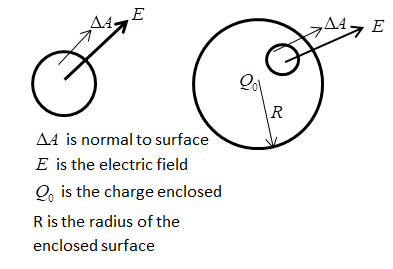
Gauss Law- It is defined as the total flux linked within a closed surface is equal to the $\dfrac{1}{{{\varepsilon _0}}}$ times the total charge enclosed by that surface.
Mathematically it is defined as
$\phi = \dfrac{q}{{{\varepsilon _0}}}$
Where
$q = $ Charge enclosed in the surface
${\varepsilon _0} = $permittivity of the vacuum.
The Gaussian surface can be of any shape and size because it’s only the amount of flux coming out of the charge distribution on which we have to concentrate and these will be the same if allowed to pass through any shape and size of surface. It's like a cloud coming out from any three dimensional surface.We use this gauss law in order to find the magnitude of the electric field at any point due to charge distribution.
Note- We mostly choose a surface on which the rays of flux remain either parallel or perpendicular and identical at all points that will be easy to carry integration easily and thus we mostly choose cylindrical or spherical surfaces . We are free to choose any type of Gaussian surface but integration of cylindrical and spherical surfaces becomes very easy.
Step By Step Answer:
Electric flux - Electric flux is the measure of number of electric field lines passing through any surface .It is a scalar quantity.
It's S.I unit is volt meters.
Gauss Law- It is defined as the total flux linked within a closed surface is equal to the $\dfrac{1}{{{\varepsilon _0}}}$ times the total charge enclosed by that surface.
Mathematically it is defined as
$\phi = \dfrac{q}{{{\varepsilon _0}}}$
Where
$q = $ Charge enclosed in the surface
${\varepsilon _0} = $permittivity of the vacuum.
The Gaussian surface can be of any shape and size because it’s only the amount of flux coming out of the charge distribution on which we have to concentrate and these will be the same if allowed to pass through any shape and size of surface. It's like a cloud coming out from any three dimensional surface.We use this gauss law in order to find the magnitude of the electric field at any point due to charge distribution.
Note- We mostly choose a surface on which the rays of flux remain either parallel or perpendicular and identical at all points that will be easy to carry integration easily and thus we mostly choose cylindrical or spherical surfaces . We are free to choose any type of Gaussian surface but integration of cylindrical and spherical surfaces becomes very easy.
Recently Updated Pages
Master Class 12 Business Studies: Engaging Questions & Answers for Success

Master Class 12 Chemistry: Engaging Questions & Answers for Success
Master Class 12 Biology: Engaging Questions & Answers for Success
Class 12 Question and Answer - Your Ultimate Solutions Guide
Master Class 11 English: Engaging Questions & Answers for Success
Master Class 11 Social Science: Engaging Questions & Answers for Success
Trending doubts
Which are the Top 10 Largest Countries of the World?
Draw a labelled sketch of the human eye class 12 physics CBSE
The end of compass needle which points towards north class 12 physics CBSE
Differentiate between homogeneous and heterogeneous class 12 chemistry CBSE
In order to find out the different types of gametes class 12 biology NEET_UG
Why is the cell called the structural and functional class 12 biology CBSE