




Define binary fission.
Answer
 Verified
659.7k+ views
Hint:Asexual reproduction is a type of reproduction in which a new offspring is formed without fusion of gametes. Binary fission is a type of asexual reproduction.
Complete answer:
Binary fission can be defined as a mode of reproduction in which the organism divides into two and the offspring carries one copy of the genetic material.
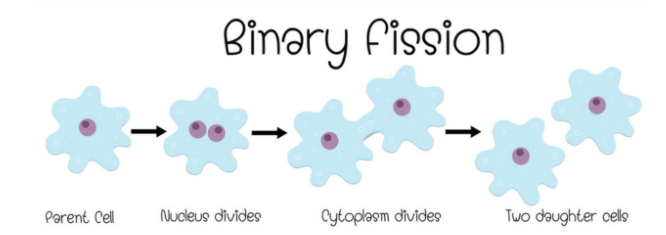
The steps involved in binary fission seen in amoeba are,
Initially, the pseudopodia is pulled back and the body of amoeba becomes coiled and round.
Then the nucleus divides via amitosis, i.e. the nucleus is divided first and then cytoplasm divides
Now, a constriction is seen in the body of amoeba
The constriction starts getting deeper and finally results in the formation of two daughter cells
Additional information: Even in bacteria binary fission is seen. The following steps are seen,
The bacterium uncoils and replication of chromosome occurs
After replication, the bacterium starts to grow and along with that cytoplasmic content also increases
Now, at this point, the cell elongates and has a septum in the middle and the chromosomes are also separated
A new cell wall is formed and the cell splits into two daughter cells.
Each daughter cell has one copy of nuclear material as necessary organelles
Note:Advantages of binary fission are as follows,
->The reproduction rate is high as the process of binary fission is extremely fast.
->It requires only a single organism, i.e. either the mother or father is enough.
->It is a very simple process.
Complete answer:
Binary fission can be defined as a mode of reproduction in which the organism divides into two and the offspring carries one copy of the genetic material.
The steps involved in binary fission seen in amoeba are,
Initially, the pseudopodia is pulled back and the body of amoeba becomes coiled and round.
Then the nucleus divides via amitosis, i.e. the nucleus is divided first and then cytoplasm divides
Now, a constriction is seen in the body of amoeba
The constriction starts getting deeper and finally results in the formation of two daughter cells
Additional information: Even in bacteria binary fission is seen. The following steps are seen,
The bacterium uncoils and replication of chromosome occurs
After replication, the bacterium starts to grow and along with that cytoplasmic content also increases
Now, at this point, the cell elongates and has a septum in the middle and the chromosomes are also separated
A new cell wall is formed and the cell splits into two daughter cells.
Each daughter cell has one copy of nuclear material as necessary organelles
Note:Advantages of binary fission are as follows,
->The reproduction rate is high as the process of binary fission is extremely fast.
->It requires only a single organism, i.e. either the mother or father is enough.
->It is a very simple process.
Recently Updated Pages
Explain the structure of megasporangium class 12 biology CBSE

Why is chloroform kept in dark coloured bottles class 12 chemistry CBSE
Derive the balancing condition of a Wheatstone bri class 12 physics CBSE
Draw VI characteristics of a pn junction diode Explain class 12 physics CBSE
Is it possible to carry pride in ones language too class 12 english CBSE
In a population at Hardy Weinberg equilibrium the allele class 12 biology CBSE
Trending doubts
Draw a labelled sketch of the human eye class 12 physics CBSE
Which are the Top 10 Largest Countries of the World?
Draw ray diagrams each showing i myopic eye and ii class 12 physics CBSE
One megawatt is equal to how many units of electri class 12 physics CBSE
Which is the correct genotypic ratio of mendel dihybrid class 12 biology CBSE
Give 10 examples of unisexual and bisexual flowers