




Define angular dispersion.
Answer
 Verified
683.1k+ views
- Hint: It is the angle of dispersion between extreme colours (Red and Violet) of the spectrum of white light when a beam white light is passed through a prism. White light is composed of 7 colours (VIBGYOR) of different wavelengths.
Complete step-by-step solution -
Angular Dispersion is defined as the difference in the angles of deviation of two extreme colours of the spectrum of white light. The angle of dispersion contains all the colours in it that are obtained by dispersion of white light. This phenomenon can be easily observed through a glass prism, or in the formation of a rainbow in the sky.
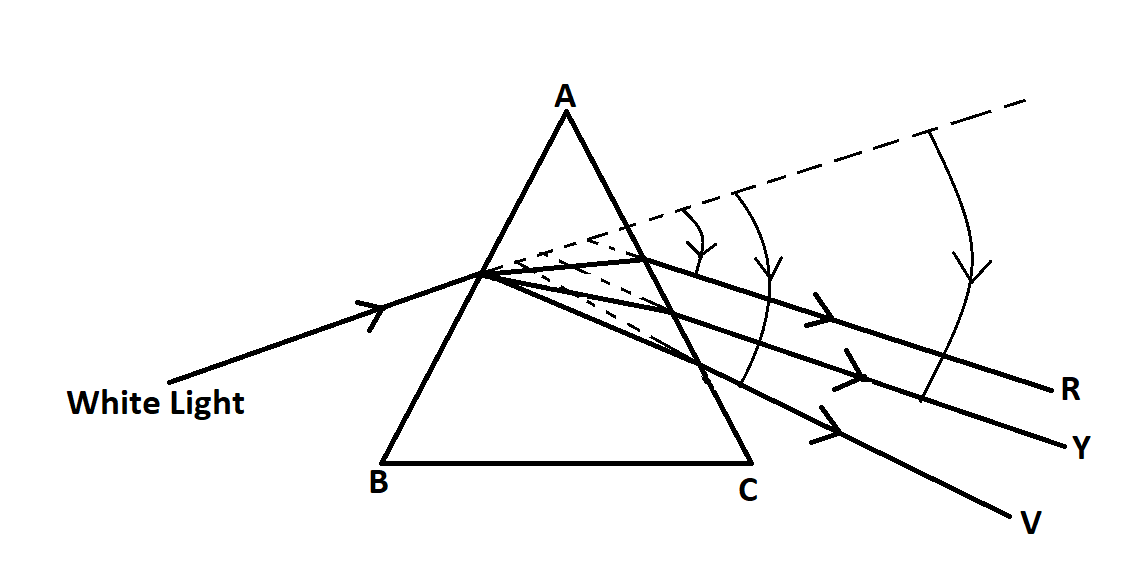
Dispersion phenomenon results in splitting of light in seven colours. The order of colours is Violet, Indigo, Blue, Green, Yellow, Orange, Red where Violet colour deviates the most and hence it has the maximum angle and Red colour deviates the least and hence it has the minimum angle of deviation.
The angular dispersion is given by:
\[{\delta _v} - {\delta _r} = \left( {{\mu _v} - {\mu _r}} \right)A\]
\[{\delta _v}\] is the deviation angle of violet colour
\[{\delta _r}\] is the deviation angle of red colour
\[{\delta _v} - {\delta _r}\] will give the angular dispersion
\[{{\mu _v}}\] is refractive index of the prism for violet light
\[{{\mu _r}}\]is the refractive index of prism for red light
A is the refracting angle of the prism.
Note: Angular dispersion phenomenon is not seen in the case of a beam of light passing through a glass slab as the refracted ray emerges parallel to the direction of the incident ray and since dispersion is caused due to difference in angle of deviation of different colours it can’t be seen in a glass slab.
Complete step-by-step solution -
Angular Dispersion is defined as the difference in the angles of deviation of two extreme colours of the spectrum of white light. The angle of dispersion contains all the colours in it that are obtained by dispersion of white light. This phenomenon can be easily observed through a glass prism, or in the formation of a rainbow in the sky.
Dispersion phenomenon results in splitting of light in seven colours. The order of colours is Violet, Indigo, Blue, Green, Yellow, Orange, Red where Violet colour deviates the most and hence it has the maximum angle and Red colour deviates the least and hence it has the minimum angle of deviation.
The angular dispersion is given by:
\[{\delta _v} - {\delta _r} = \left( {{\mu _v} - {\mu _r}} \right)A\]
\[{\delta _v}\] is the deviation angle of violet colour
\[{\delta _r}\] is the deviation angle of red colour
\[{\delta _v} - {\delta _r}\] will give the angular dispersion
\[{{\mu _v}}\] is refractive index of the prism for violet light
\[{{\mu _r}}\]is the refractive index of prism for red light
A is the refracting angle of the prism.
Note: Angular dispersion phenomenon is not seen in the case of a beam of light passing through a glass slab as the refracted ray emerges parallel to the direction of the incident ray and since dispersion is caused due to difference in angle of deviation of different colours it can’t be seen in a glass slab.
Recently Updated Pages
Master Class 12 Physics: Engaging Questions & Answers for Success

Master Class 12 Social Science: Engaging Questions & Answers for Success
Master Class 12 English: Engaging Questions & Answers for Success
Master Class 12 Maths: Engaging Questions & Answers for Success
Master Class 12 Business Studies: Engaging Questions & Answers for Success
Master Class 12 Chemistry: Engaging Questions & Answers for Success
Trending doubts
Draw a labelled sketch of the human eye class 12 physics CBSE
Which are the Top 10 Largest Countries of the World?
Draw ray diagrams each showing i myopic eye and ii class 12 physics CBSE
One megawatt is equal to how many units of electri class 12 physics CBSE
Which is the correct genotypic ratio of mendel dihybrid class 12 biology CBSE
Give 10 examples of unisexual and bisexual flowers