




Define allergy or hypersensitivity.
Answer
 Verified
640.8k+ views
Hint: Hyper means exaggerated or increased, the sensitivity means susceptibility or response. In an allergic response, there is an exaggerated response in our immune system.
Complete answer: Our immune system is designed to distinguish between self and non-self cells. Whenever some foreign cells or substance enters our body, our immune system recognizes it as non-self and then removes it. Sometimes, this system of immune response fails to function properly. It recognizes the self as non-self and starts destroying them, causing severe unnecessary reactions. These extra reactions are called hypersensitivity. Different allergic reactions occur due to different types of hypersensitivity.
The different types of hypersensitivity and their features are as follows:
Type I hypersensitivity- It is an allergen-induced hypersensitivity causing the allergy. Small molecules called allergens enter the body and bind to specific antibodies in our bodies. The binding causes activation of immune cells causing anaphylaxis which further results in airway restriction or vasodilation, itching, or inflammation.
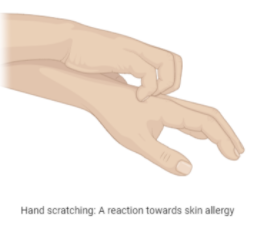
Type II hypersensitivity- It is antibody-mediated hypersensitivity or cytotoxic hypersensitivity. In this, the cytotoxic immune cells over-reacts and kill the normal body cells.
Type III hypersensitivity- It is called immune complex-mediated hypersensitivity. The complement system of our body activates over the entry of foreign factors and releases anaphylactic factors. These secretions activate neutrophils to start destroying self cells.
Type IV hypersensitivity- This is also called delayed hypersensitivity. This type of hypersensitivity works in two stages. In the first stage, the T-helper cells get activated in large numbers. Once activated, in the second stage the T-helper cells will stimulate a huge number of macrophage immune cells to act in self cells.
Note: The allergens are the chemical molecules that enter our body from the environment. An allergen can be dust, soil particles, pollen grains, some chemical aerosols, etc. allergens cause serious inflammations and itchiness over skin surfaces due to increased reactivity of immune cells. Anaphylaxis is a serious symptom of an allergic reaction. It includes nausea, skin rash, difficulty breathing, etc.
Complete answer: Our immune system is designed to distinguish between self and non-self cells. Whenever some foreign cells or substance enters our body, our immune system recognizes it as non-self and then removes it. Sometimes, this system of immune response fails to function properly. It recognizes the self as non-self and starts destroying them, causing severe unnecessary reactions. These extra reactions are called hypersensitivity. Different allergic reactions occur due to different types of hypersensitivity.
The different types of hypersensitivity and their features are as follows:
Type I hypersensitivity- It is an allergen-induced hypersensitivity causing the allergy. Small molecules called allergens enter the body and bind to specific antibodies in our bodies. The binding causes activation of immune cells causing anaphylaxis which further results in airway restriction or vasodilation, itching, or inflammation.
Type II hypersensitivity- It is antibody-mediated hypersensitivity or cytotoxic hypersensitivity. In this, the cytotoxic immune cells over-reacts and kill the normal body cells.
Type III hypersensitivity- It is called immune complex-mediated hypersensitivity. The complement system of our body activates over the entry of foreign factors and releases anaphylactic factors. These secretions activate neutrophils to start destroying self cells.
Type IV hypersensitivity- This is also called delayed hypersensitivity. This type of hypersensitivity works in two stages. In the first stage, the T-helper cells get activated in large numbers. Once activated, in the second stage the T-helper cells will stimulate a huge number of macrophage immune cells to act in self cells.
Note: The allergens are the chemical molecules that enter our body from the environment. An allergen can be dust, soil particles, pollen grains, some chemical aerosols, etc. allergens cause serious inflammations and itchiness over skin surfaces due to increased reactivity of immune cells. Anaphylaxis is a serious symptom of an allergic reaction. It includes nausea, skin rash, difficulty breathing, etc.
Recently Updated Pages
Master Class 12 Economics: Engaging Questions & Answers for Success

Master Class 12 Social Science: Engaging Questions & Answers for Success
Master Class 12 English: Engaging Questions & Answers for Success
Master Class 12 Maths: Engaging Questions & Answers for Success
Master Class 12 Physics: Engaging Questions & Answers for Success
Master Class 12 Biology: Engaging Questions & Answers for Success
Trending doubts
Draw a labelled sketch of the human eye class 12 physics CBSE
Which are the Top 10 Largest Countries of the World?
Draw ray diagrams each showing i myopic eye and ii class 12 physics CBSE
Which is the correct genotypic ratio of mendel dihybrid class 12 biology CBSE
Differentiate between homogeneous and heterogeneous class 12 chemistry CBSE
Give 10 examples of unisexual and bisexual flowers