




Cytochrome which hands over electrons to oxygen during terminal oxidation
(a) Cyt b
(b) Cyt a
(c) Cyt c
(d) Cyt ${ a }_{ 3 }$
Answer
 Verified
640.2k+ views
Hint: The electron transport system consists of a group of electron and protein transporting enzymes embedded in the inner mitochondrial membrane. Cytochrome is one such protein that contains an Iron(Fe) core oscillating between reduced and oxidised forms to transport electrons.
Complete answer:
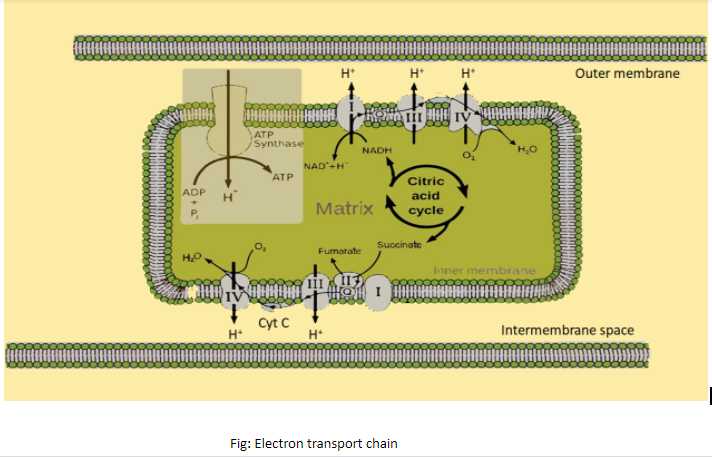
Electrons follow a downhill journey with a loss of energy whenever an electron is passed from one complex to another. A total of five complexes make up this chain. The first four ones are involved in only electron transport while the fifth and the last one is concerned with ATP synthesis. Fourth complex or cytochrome c oxidase complex contains cytochrome ${ a }_{ 3 }$ that is responsible for the transfer of the electrons to its ultimate acceptor i.e oxygen. Oxygen, upon accepting the electrons, becomes reactive and forms metabolic water when combined with protons.
Additional Information:
The four complexes involved in transporting electrons are as follows:
-Complex I or NADH-Q reductase or NADH-dehydrogenase complex is composed of FMN and FeS prosthetic groups.
-Complex II or Succinate-coenzyme Q reductase contains succinate dehydrogenase with FAD and FeS as prosthetic groups.
-Complex III or coenzyme Q-cytochrome c reductase has two b-type cytochromes, cytochrome c and FeS centre.
-Complex IV or cytochrome c oxidase receives electrons from cytochrome c of complex III. through cytochrome a, the electrons are passed on to the final acceptor i.e oxygen via cytochrome ${ a }_{ 3 }$.
So, the correct answer is ‘Cyt ${ a }_{ 3 }$.’
Note: -Cytochromes are proteins with heme as their prosthetic group. They are involved in redox reactions of respiratory pathways as electron donors and acceptors.
-The varieties of cytochromes are due to the different heme groups based on their light absorption spectra.
-Heme consists of an Iron or Fe centre bound covalently to four nitrogen atoms. The Fe centre exists in either ferric(reduced) form or ferrous(oxidised) form.
Complete answer:
Electrons follow a downhill journey with a loss of energy whenever an electron is passed from one complex to another. A total of five complexes make up this chain. The first four ones are involved in only electron transport while the fifth and the last one is concerned with ATP synthesis. Fourth complex or cytochrome c oxidase complex contains cytochrome ${ a }_{ 3 }$ that is responsible for the transfer of the electrons to its ultimate acceptor i.e oxygen. Oxygen, upon accepting the electrons, becomes reactive and forms metabolic water when combined with protons.
Additional Information:
The four complexes involved in transporting electrons are as follows:
-Complex I or NADH-Q reductase or NADH-dehydrogenase complex is composed of FMN and FeS prosthetic groups.
-Complex II or Succinate-coenzyme Q reductase contains succinate dehydrogenase with FAD and FeS as prosthetic groups.
-Complex III or coenzyme Q-cytochrome c reductase has two b-type cytochromes, cytochrome c and FeS centre.
-Complex IV or cytochrome c oxidase receives electrons from cytochrome c of complex III. through cytochrome a, the electrons are passed on to the final acceptor i.e oxygen via cytochrome ${ a }_{ 3 }$.
So, the correct answer is ‘Cyt ${ a }_{ 3 }$.’
Note: -Cytochromes are proteins with heme as their prosthetic group. They are involved in redox reactions of respiratory pathways as electron donors and acceptors.
-The varieties of cytochromes are due to the different heme groups based on their light absorption spectra.
-Heme consists of an Iron or Fe centre bound covalently to four nitrogen atoms. The Fe centre exists in either ferric(reduced) form or ferrous(oxidised) form.
Recently Updated Pages
Basicity of sulphurous acid and sulphuric acid are

Master Class 11 English: Engaging Questions & Answers for Success
Master Class 11 Physics: Engaging Questions & Answers for Success
Master Class 11 Computer Science: Engaging Questions & Answers for Success
Master Class 11 Chemistry: Engaging Questions & Answers for Success
Master Class 11 Social Science: Engaging Questions & Answers for Success
Trending doubts
Draw a diagram of a plant cell and label at least eight class 11 biology CBSE
Proton was discovered by A Thomson B Rutherford C Chadwick class 11 chemistry CBSE
What is the purity of pure gold in carat class 11 chemistry CBSE
Can anyone list 10 advantages and disadvantages of friction
Lysosomes are known as suicidal bags of cell why class 11 biology CBSE
Derive the equation of motion by the calculus method class 11 physics CBSE