




Cyanobacteria are classified under which of the following kingdoms?
(a)Monera
(b)Protista
(c)Algae
(d)Plantae
Answer
 Verified
662.4k+ views
Hint: Cyanobacteria do not have a well-defined nucleus and well-organized chromosomes. In that place, they have a single circular DNA. Also, the cell organelles like mitochondria, chloroplasts, Golgi complex, etc. are not found in these bacteria.
Complete answer:
In the five-kingdom system classification given by R. H. Whittaker, all the prokaryotic organisms were included in the kingdom Monera while all the eukaryotes were included in the other four kingdoms Protista, Fungi, Plantae, and Animalia. Since cyanobacteria are prokaryotes, they are classified with the other bacteria under the kingdom Monera. The kingdom includes small, microscopic, and primitive organisms with the simplest organization in the living word. A diagram of cyanobacteria has been given below –
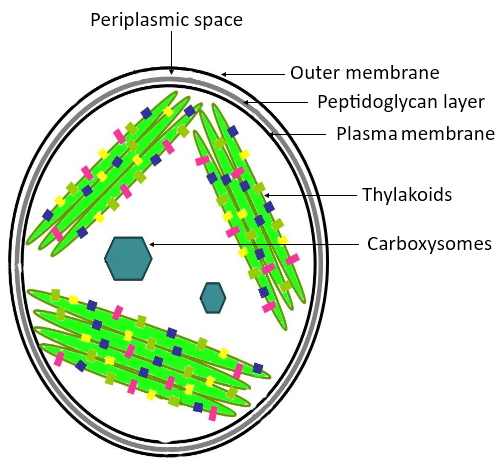
Additional Information: Cyanobacteria are also known as Blue-Green Algae because it can perform oxygenic photosynthesis as other plants do and thus they constitute a phylum of bacteria consisting of the free-living photosynthetic forms called Cyanophyta. Upon studying the pieces of evidence of evolution, these have been thought to be evolved either in water or on land. These are gram-negative prokaryotes considered to be the first organisms that made the earth atmosphere aerobic. They can be unicellular, filamentous, or colonial with heterocyst in the filamentous forms.
So, the correct answer is ‘Monera’.
Note: -Any organism which are bacteria, archaebacteria, cyanobacteria, mycobacteria, etc., will always be included in the kingdom Monera because all such organisms are prokaryotic organisms and Monera is the kingdom of prokaryotes only.
-Algae are included under the plant kingdom because they bear chlorophylls and are photosynthetic just like the other plants and also, they are eukaryotes.
Complete answer:
In the five-kingdom system classification given by R. H. Whittaker, all the prokaryotic organisms were included in the kingdom Monera while all the eukaryotes were included in the other four kingdoms Protista, Fungi, Plantae, and Animalia. Since cyanobacteria are prokaryotes, they are classified with the other bacteria under the kingdom Monera. The kingdom includes small, microscopic, and primitive organisms with the simplest organization in the living word. A diagram of cyanobacteria has been given below –
Additional Information: Cyanobacteria are also known as Blue-Green Algae because it can perform oxygenic photosynthesis as other plants do and thus they constitute a phylum of bacteria consisting of the free-living photosynthetic forms called Cyanophyta. Upon studying the pieces of evidence of evolution, these have been thought to be evolved either in water or on land. These are gram-negative prokaryotes considered to be the first organisms that made the earth atmosphere aerobic. They can be unicellular, filamentous, or colonial with heterocyst in the filamentous forms.
So, the correct answer is ‘Monera’.
Note: -Any organism which are bacteria, archaebacteria, cyanobacteria, mycobacteria, etc., will always be included in the kingdom Monera because all such organisms are prokaryotic organisms and Monera is the kingdom of prokaryotes only.
-Algae are included under the plant kingdom because they bear chlorophylls and are photosynthetic just like the other plants and also, they are eukaryotes.
Recently Updated Pages
If x a + bt + ct2 where x is in meters and t is in class 11 physics CBSE

A car covers the first half distance between two places class 11 physics CBSE
The resultant of two vectors overrightarrow P and overrightarrow class 11 physics CBSE
Find the value of cos 135 class 11 maths CBSE
A mass M is held in place by an applied force F and class 11 physics CBSE
A solution of glucose in water is labelled as 10 dfracwv class 11 chemistry CBSE
Trending doubts
One Metric ton is equal to kg A 10000 B 1000 C 100 class 11 physics CBSE
Find the value of the expression given below sin 30circ class 11 maths CBSE
What do you mean by retardation What is its SI uni class 11 physics CBSE
Draw a diagram of nephron and explain its structur class 11 biology CBSE
10 examples of friction in our daily life
Difference between physical and chemical change class 11 chemistry CBSE