




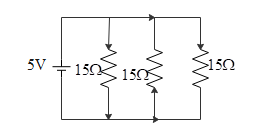
What is the current out of the battery?
Answer
 Verified
513k+ views
Hint : First of you must thoroughly observe the given circuit diagram. And analyze whether the circuit is connected in series or parallel. If the resistors are connected in parallel the effective resistance or the net resistance in a series connection is the sum of resistances used and the net resistance in a parallel connection, the reciprocal of equivalent resistance is the sum of reciprocals of the individual resistances. After that by applying Ohm’s law we will get current out of the battery.
Complete step-by-step solution:
Here the resistors are connected in parallel. Hence the effective resistance in parallel combination can be calculated by,
$\dfrac{1}{{{R}_{net}}}=\dfrac{1}{{{R}_{1}}}+\dfrac{1}{{{R}_{2}}}+\dfrac{1}{{{R}_{3}}}$……………(1)
Given that,
$\begin{align}
& {{R}_{1}}=15\Omega \\
& {{R}_{2}}=15\Omega \\
& {{R}_{3}}=15\Omega \\
\end{align}$
Thus substituting the values in the above equation we get,
$\dfrac{1}{{{R}_{net}}}=\dfrac{1}{15}+\dfrac{1}{15}+\dfrac{1}{15}$
$\Rightarrow \dfrac{1}{{{R}_{net}}}=\dfrac{3}{15}$
${{R}_{net}}=\dfrac{15}{3}$
$\therefore {{R}_{net}}=5\Omega $
Then to calculate the current out of the battery can be calculated using Ohm’s law.
That is,
V=IR
Where, V is the potential difference
I is the current through the conductor
R a constant known as resistance
Also given that,
V=5V
Thus rearranging the equation for current I we get,
$I=\dfrac{V}{{{R}_{net}}}$
Then by substituting the values we get,
$I=\dfrac{5}{5}=1A$
Therefore the current out of the battery is 1 ampere.
Note: Since this is the simplest circuit and explaining a simplest concept, ohm's law can be considered as one of the fundamental laws of physics. This law can be applied to many electrical circuits. Using Ohm’s law we can also calculate the power delivered in the circuit. This law could also give an empirical relation which describes conductivity. There are some materials which doesn’t obeys Ohm’s law and known as non-ohmic.
Complete step-by-step solution:
Here the resistors are connected in parallel. Hence the effective resistance in parallel combination can be calculated by,
$\dfrac{1}{{{R}_{net}}}=\dfrac{1}{{{R}_{1}}}+\dfrac{1}{{{R}_{2}}}+\dfrac{1}{{{R}_{3}}}$……………(1)
Given that,
$\begin{align}
& {{R}_{1}}=15\Omega \\
& {{R}_{2}}=15\Omega \\
& {{R}_{3}}=15\Omega \\
\end{align}$
Thus substituting the values in the above equation we get,
$\dfrac{1}{{{R}_{net}}}=\dfrac{1}{15}+\dfrac{1}{15}+\dfrac{1}{15}$
$\Rightarrow \dfrac{1}{{{R}_{net}}}=\dfrac{3}{15}$
${{R}_{net}}=\dfrac{15}{3}$
$\therefore {{R}_{net}}=5\Omega $
Then to calculate the current out of the battery can be calculated using Ohm’s law.
That is,
V=IR
Where, V is the potential difference
I is the current through the conductor
R a constant known as resistance
Also given that,
V=5V
Thus rearranging the equation for current I we get,
$I=\dfrac{V}{{{R}_{net}}}$
Then by substituting the values we get,
$I=\dfrac{5}{5}=1A$
Therefore the current out of the battery is 1 ampere.
Note: Since this is the simplest circuit and explaining a simplest concept, ohm's law can be considered as one of the fundamental laws of physics. This law can be applied to many electrical circuits. Using Ohm’s law we can also calculate the power delivered in the circuit. This law could also give an empirical relation which describes conductivity. There are some materials which doesn’t obeys Ohm’s law and known as non-ohmic.
Recently Updated Pages
Master Class 12 Economics: Engaging Questions & Answers for Success

Master Class 12 Physics: Engaging Questions & Answers for Success
Master Class 12 English: Engaging Questions & Answers for Success
Master Class 12 Social Science: Engaging Questions & Answers for Success
Master Class 12 Maths: Engaging Questions & Answers for Success
Master Class 12 Business Studies: Engaging Questions & Answers for Success
Trending doubts
Which are the Top 10 Largest Countries of the World?
What are the major means of transport Explain each class 12 social science CBSE
Draw a labelled sketch of the human eye class 12 physics CBSE
Why cannot DNA pass through cell membranes class 12 biology CBSE
Differentiate between insitu conservation and exsitu class 12 biology CBSE
Draw a neat and well labeled diagram of TS of ovary class 12 biology CBSE