




Covalency for central atom is maximum in:
A.\[B{F_3}\]
B.\[S{O_2}C{l_2}\]
C.\[POC{l_3}\]
D.\[BeC{l_2}\]
Answer
 Verified
547.5k+ views
Hint: First we have to know the covalency of an atom is the number of bonds an atom forms within a given molecule or compound. To find the covalency, we need to draw the Lewis structure (Chemical structure) of the given molecule and count the number of bonds or the number of shared electron pairs.
Complete answer:
The chemical structure of \[B{F_3}\] is
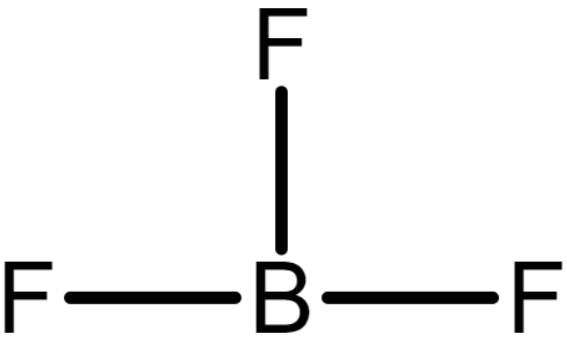
In \[B{F_3}\], the boron atom forms \[3\] bonds with Fluorine. So, covalency \[B{F_3}\] is \[3\].
The chemical structure of \[S{O_2}C{l_2}\] is
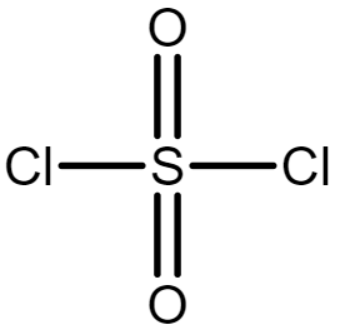
In \[S{O_2}C{l_2}\], the sulphur atom forms \[4\] bonds with oxygen and \[2\] bonds with chlorine. So, covalency \[S{O_2}C{l_2}\] is \[6\].
The chemical structure of \[POC{l_3}\] is
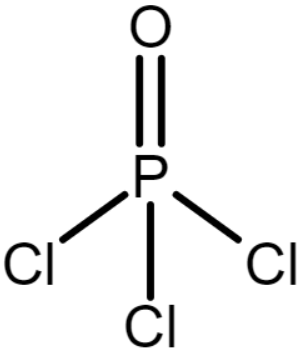
In \[POC{l_3}\], the phosphorus atom forms \[2\] bonds with oxygen and \[3\] bonds with chlorine. So, covalency \[POC{l_3}\] is \[5\].
The chemical structure of \[BeC{l_2}\] is

In \[BeC{l_2}\], the beryllium atom forms \[2\] bonds with chlorine. So, covalency \[BeC{l_2}\] is \[2\].
Hence the correct option is (B) $SO_2Cl_2$.
Note:
Note that the combining capacity of an atom or a molecule is known as its valency. The valency of an element in a molecule is equal to the number of electrons present in the outermost shell and if it is greater than 4, then the valency of an element is determined by subtracting the total number of electrons present in the outermost shell from eight. If the number of electrons in the outer shell is between one to four, the compound is said to have positive valency.
Complete answer:
The chemical structure of \[B{F_3}\] is
In \[B{F_3}\], the boron atom forms \[3\] bonds with Fluorine. So, covalency \[B{F_3}\] is \[3\].
The chemical structure of \[S{O_2}C{l_2}\] is
In \[S{O_2}C{l_2}\], the sulphur atom forms \[4\] bonds with oxygen and \[2\] bonds with chlorine. So, covalency \[S{O_2}C{l_2}\] is \[6\].
The chemical structure of \[POC{l_3}\] is
In \[POC{l_3}\], the phosphorus atom forms \[2\] bonds with oxygen and \[3\] bonds with chlorine. So, covalency \[POC{l_3}\] is \[5\].
The chemical structure of \[BeC{l_2}\] is
In \[BeC{l_2}\], the beryllium atom forms \[2\] bonds with chlorine. So, covalency \[BeC{l_2}\] is \[2\].
Hence the correct option is (B) $SO_2Cl_2$.
Note:
Note that the combining capacity of an atom or a molecule is known as its valency. The valency of an element in a molecule is equal to the number of electrons present in the outermost shell and if it is greater than 4, then the valency of an element is determined by subtracting the total number of electrons present in the outermost shell from eight. If the number of electrons in the outer shell is between one to four, the compound is said to have positive valency.
Recently Updated Pages
Basicity of sulphurous acid and sulphuric acid are

Master Class 12 Economics: Engaging Questions & Answers for Success
Master Class 12 Biology: Engaging Questions & Answers for Success
Master Class 11 English: Engaging Questions & Answers for Success
Master Class 11 Physics: Engaging Questions & Answers for Success
Master Class 11 Computer Science: Engaging Questions & Answers for Success
Trending doubts
Draw a labelled sketch of the human eye class 12 physics CBSE
The chemical formula of tear gas is A CO Cl 2 B C 10 class 12 chemistry CBSE
Draw ray diagrams each showing i myopic eye and ii class 12 physics CBSE
Which are the Top 10 Largest Countries of the World?
Differentiate between homogeneous and heterogeneous class 12 chemistry CBSE
Which is the correct genotypic ratio of mendel dihybrid class 12 biology CBSE