




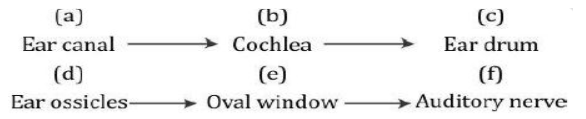
Correct the mistakes and rearrange the given flow chart of hearing process
Answer
 Verified
586.2k+ views
Hint:Hearing is defined as a process by which our ear transforms the sound vibrations into nerve impulses that are carried to the brain. In the brain the nerve impulses are interpreted as sounds.
Complete answer:
Ear is a very sensitive organ of the human body. Parts of ear include-External ear that consists of pinna.
Tympanic membrane is also called an eardrum,Middle ear consists of ossicles and the inner ear has cochlea.
Mechanism of hearing is:-
The sound waves enter the outer ear and reach the eardrum through the ear canal Eardrum sends it to the three tiny bones called ear ossicles in the middle ear.
The amplification of the sound is done by the bones in the middle ear. Then it is sent to the inner ear or cochlea through the oval window.
The vibration activates the tiny hair in the ear. The hair cells of the organ of Corti convert the sound vibrations to nerve impulses in the fibres of the cochlear nerve.
The auditory nerve carries the electrical signal to the brain.
The electrical signals are interpreted by the optic lobe of the forebrain.
So the correct answer is
Ear canal → Eardrum → Ear ossicles → Oval window → Cochlea → Auditory nerve
Note: The human ear is most sensitive to frequencies of 1000-4000Hz. The human ear can distinguish the different aspects of sound such as pitch and loudness. Sounds are produced when vibrating objects produce the pressure pulses of vibrating air molecules called sound waves.
Complete answer:
Ear is a very sensitive organ of the human body. Parts of ear include-External ear that consists of pinna.
Tympanic membrane is also called an eardrum,Middle ear consists of ossicles and the inner ear has cochlea.
Mechanism of hearing is:-
The sound waves enter the outer ear and reach the eardrum through the ear canal Eardrum sends it to the three tiny bones called ear ossicles in the middle ear.
The amplification of the sound is done by the bones in the middle ear. Then it is sent to the inner ear or cochlea through the oval window.
The vibration activates the tiny hair in the ear. The hair cells of the organ of Corti convert the sound vibrations to nerve impulses in the fibres of the cochlear nerve.
The auditory nerve carries the electrical signal to the brain.
The electrical signals are interpreted by the optic lobe of the forebrain.
So the correct answer is
Ear canal → Eardrum → Ear ossicles → Oval window → Cochlea → Auditory nerve
Note: The human ear is most sensitive to frequencies of 1000-4000Hz. The human ear can distinguish the different aspects of sound such as pitch and loudness. Sounds are produced when vibrating objects produce the pressure pulses of vibrating air molecules called sound waves.
Recently Updated Pages
Master Class 12 Economics: Engaging Questions & Answers for Success

Master Class 12 Physics: Engaging Questions & Answers for Success
Master Class 12 English: Engaging Questions & Answers for Success
Master Class 12 Social Science: Engaging Questions & Answers for Success
Master Class 12 Maths: Engaging Questions & Answers for Success
Master Class 12 Business Studies: Engaging Questions & Answers for Success
Trending doubts
Which are the Top 10 Largest Countries of the World?
What are the major means of transport Explain each class 12 social science CBSE
Draw a labelled sketch of the human eye class 12 physics CBSE
Why cannot DNA pass through cell membranes class 12 biology CBSE
Differentiate between insitu conservation and exsitu class 12 biology CBSE
Draw a neat and well labeled diagram of TS of ovary class 12 biology CBSE