




Correct order of percentage of enol content is ?
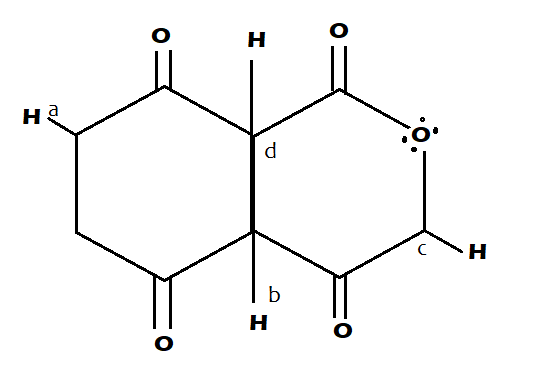
A.$b > d > c > a$
B.$d > b > c > a$
C.$b > d > a > c$
D.$a > b > d > c$
Answer
 Verified
619.2k+ views
Hint:
Firstly we have to simplify and mention what exactly is enol. Then in the next step we have to define the existence and the reason for the keto-enol tautomerism. Then we have to mention the reasons we use to determine the stability of these states in order to obtain the right amount of enol content. Then to conclude we have to give the answer and the reason we have used for the stability of the given states.
Complete step by step answer:
Enol refers to an organic compound that contains a hydroxyl group bonded to a carbon atom having a double bond and that is usually characterized by the grouping $C = C(OH)$ . They generally exist in the constant tautomeric state with the ketones. ( A condition where the interconversion takes place to achieve most stable state of the compound referred to the chemical structure and bonding )
This is also called keto-enol tautomerism. This is determined by various factors which participates in determining the stability of the compound like :
i.Resonance
ii.Aromaticity
iii.Hyperconjugation
iv.Polarization and many others.
The amount of keto or enol content depends on the stability of the state.
In the given question, the order of the enol content is drawn by using this logic:
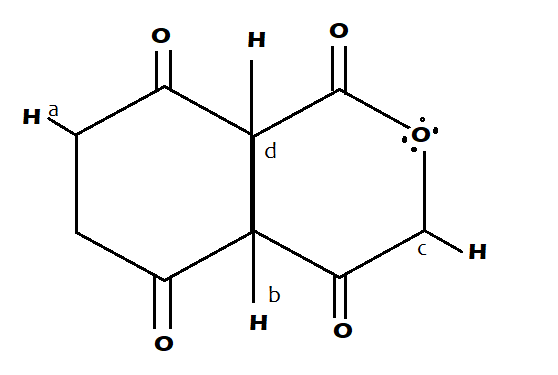
carbon with electron withdrawing groups > carbonyl carbons > no. of alpha hydrogens.
Therefore the correct answer would be B, $d > b > c > a$.
Note:
When the keto and the enol form exist, although both are stable, but they constantly interconvert in each other to gain much stability and the correct amount of saturation. Even if one form is more stable doesn’t mean that every molecule converts in it. Constant interconversion stables the content.
Firstly we have to simplify and mention what exactly is enol. Then in the next step we have to define the existence and the reason for the keto-enol tautomerism. Then we have to mention the reasons we use to determine the stability of these states in order to obtain the right amount of enol content. Then to conclude we have to give the answer and the reason we have used for the stability of the given states.
Complete step by step answer:
Enol refers to an organic compound that contains a hydroxyl group bonded to a carbon atom having a double bond and that is usually characterized by the grouping $C = C(OH)$ . They generally exist in the constant tautomeric state with the ketones. ( A condition where the interconversion takes place to achieve most stable state of the compound referred to the chemical structure and bonding )
This is also called keto-enol tautomerism. This is determined by various factors which participates in determining the stability of the compound like :
i.Resonance
ii.Aromaticity
iii.Hyperconjugation
iv.Polarization and many others.
The amount of keto or enol content depends on the stability of the state.
In the given question, the order of the enol content is drawn by using this logic:
carbon with electron withdrawing groups > carbonyl carbons > no. of alpha hydrogens.
Therefore the correct answer would be B, $d > b > c > a$.
Note:
When the keto and the enol form exist, although both are stable, but they constantly interconvert in each other to gain much stability and the correct amount of saturation. Even if one form is more stable doesn’t mean that every molecule converts in it. Constant interconversion stables the content.
Recently Updated Pages
Master Class 12 Business Studies: Engaging Questions & Answers for Success

Master Class 12 Biology: Engaging Questions & Answers for Success
Master Class 12 Chemistry: Engaging Questions & Answers for Success
Class 12 Question and Answer - Your Ultimate Solutions Guide
Master Class 11 English: Engaging Questions & Answers for Success
Master Class 11 Social Science: Engaging Questions & Answers for Success
Trending doubts
Which are the Top 10 Largest Countries of the World?
Draw a labelled sketch of the human eye class 12 physics CBSE
Differentiate between homogeneous and heterogeneous class 12 chemistry CBSE
Why is the cell called the structural and functional class 12 biology CBSE
Draw ray diagrams each showing i myopic eye and ii class 12 physics CBSE
Which is the correct genotypic ratio of mendel dihybrid class 12 biology CBSE