




Corpus luteum is developed from
A) Leftover oocyte.
B) Nephrostome.
C) Leftover Graafian follicle after the release of ovum
D) None of these
Answer
 Verified
538.8k+ views
Hint: Corpus luteum is a structure that is formed inside the ovary . The ovary is the female reproductive part of the reproductive system which produces ova or egg cells. The Corpus luteum is responsible for the secretion of progesterone.
Complete answer:
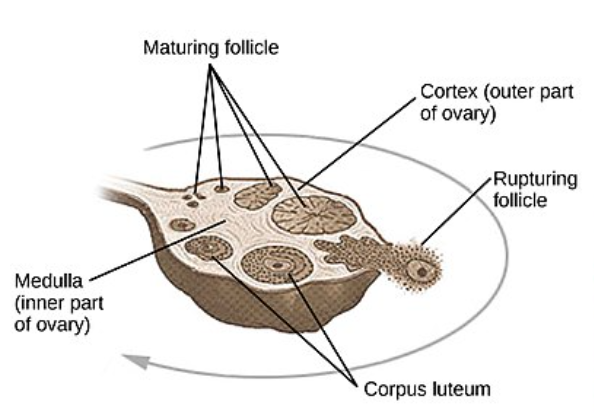
To answer this question we will start by knowing the structure of the ovary. So internally, the ovary consists of an outer context and an inner medulla. The stroma of the cortical region is composed of a spindle-shaped fibroblast. Tunica albuginea, a dense connective tissue layer that covers the cortex. It imparts a whitish colour to the ovary. Outside this is the germinal epithelium, which covers the surface of the ovary.
The female gametes egg or ova, in various stages of maturation, remain enclosed in the scattered ovarian follicles that are embedded in the stroma of the cortex. A follicle consists of an oocyte surrounded by one or more layers of follicular cells or granulosa cells, which are derived from the germinal epithelium.
The mature ovarian follicle is called the Graafian follicle. It is about 2.5 cm in diameter. As the follicle develops, the follicle cells secrete fluid, which collects in the antrum between them.
The ovary contains a large mass of yellowish cells, called Corpus luteum. It is formed from a ruptured graafian follicle after the release of its ovum. It releases progesterone and estrogen.
Nephrostome- It is a funnel-like structure present in the metanephridia of earthworms. It is associated with the excretory system.
So from the above discussion we can come to the conclusion that option (C) is our right answer.
Note:
- The fluid of the antrum is termed liquor folliculi.
- The corpus luteum produces hormones that help in sustaining the pregnancy. Many follicles do not develop fully but degenerate and are called atretic follicles.
Complete answer:
To answer this question we will start by knowing the structure of the ovary. So internally, the ovary consists of an outer context and an inner medulla. The stroma of the cortical region is composed of a spindle-shaped fibroblast. Tunica albuginea, a dense connective tissue layer that covers the cortex. It imparts a whitish colour to the ovary. Outside this is the germinal epithelium, which covers the surface of the ovary.
The female gametes egg or ova, in various stages of maturation, remain enclosed in the scattered ovarian follicles that are embedded in the stroma of the cortex. A follicle consists of an oocyte surrounded by one or more layers of follicular cells or granulosa cells, which are derived from the germinal epithelium.
The mature ovarian follicle is called the Graafian follicle. It is about 2.5 cm in diameter. As the follicle develops, the follicle cells secrete fluid, which collects in the antrum between them.
The ovary contains a large mass of yellowish cells, called Corpus luteum. It is formed from a ruptured graafian follicle after the release of its ovum. It releases progesterone and estrogen.
Nephrostome- It is a funnel-like structure present in the metanephridia of earthworms. It is associated with the excretory system.
So from the above discussion we can come to the conclusion that option (C) is our right answer.
Note:
- The fluid of the antrum is termed liquor folliculi.
- The corpus luteum produces hormones that help in sustaining the pregnancy. Many follicles do not develop fully but degenerate and are called atretic follicles.
Recently Updated Pages
Master Class 11 English: Engaging Questions & Answers for Success

Master Class 11 Maths: Engaging Questions & Answers for Success
Class 11 Question and Answer - Your Ultimate Solutions Guide
Master Class 11 Biology: Engaging Questions & Answers for Success
Master Class 11 Physics: Engaging Questions & Answers for Success
Master Class 11 Accountancy: Engaging Questions & Answers for Success
Trending doubts
Differentiate between an exothermic and an endothermic class 11 chemistry CBSE
One Metric ton is equal to kg A 10000 B 1000 C 100 class 11 physics CBSE
Difference Between Prokaryotic Cells and Eukaryotic Cells
There are 720 permutations of the digits 1 2 3 4 5 class 11 maths CBSE
Draw a diagram of a plant cell and label at least eight class 11 biology CBSE
1 Quintal is equal to a 110 kg b 10 kg c 100kg d 1000 class 11 physics CBSE