




Corpus albicans are found in ovaries. It is also found in
a. Liver
b. Brain
c. Kidney
d. None of the above
Answer
 Verified
672.6k+ views
Hint: A scar or remnant left after the process of luteolysis. A band of white matter that forms borders at the lateral edge in the lower cornu of the lateral ventricle.
Complete answer:

The corpus albicans or "whitening body" is also known as atretic corpus luteum, corpus candicans, or simply as albicans. It is the regressed form of the corpus luteum formed after Luteolysis. During the luteolysis the corpus luteum is broken down by macrophages & Type I collagen is shed off by fibroblasts that form the corpus albicans. So, this structure remains as scar on the surface of the ovary.
The corpus luteum normal size measures to about 1.5 cm in diameter, after 7 to 8 days of ovulation. Then it involute and eventually loses secretory function and its yellowish, lipid characteristic after 12 days of ovulation, forming the corpus albicans.
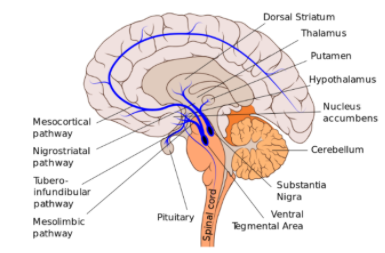
The Corpus albicans of the brain is known as the Mammillary bodies. It is connected to other parts of the brain and acts as a relay for impulses coming from other parts of the brain.
Mammillary bodies, and its projections in the anterior thalamus via the mammillothalamic tract, are involved in recollective memory. Spatial memory deficit occurs when the mammillary bodies medial mammillary nucleus is damaged.
Thiamine deficiency can lead to damage in the mammillary bodies resulting in Wernicke–Korsakoff syndrome.
Mammillary body atrophy can occur in several other conditions, such as, Alzheimer’s disease, schizophrenia, heart failure, and sleep apnoea.
So, the correct answer is (B) Brain
Note: The formation, function, and regression of the CL involve a wide variety of highly complex and multifaceted biological processes. Deletion of genes previously known to be involved in these processes has added more support to established theories, whereas many of the novel discoveries and knowledge, especially in the area of luteinization and CL formation, were serendipitously discovered when genes, not necessarily known to be involved with ovarian function, were either deleted or overexpressed. The expression and regulation of a great number of genes in luteal, immune, and endothelial cells of the CL are profoundly affected, leading to either the survival or demise of this gland. How these genes are regulated, the signalling pathways of the multiple hormones and cytokines involved, and their actions and interactions are presently under intense investigation in several laboratories. In this review, we have summarized the information presently available to shed some light on the control of the life and death of this transient endocrine gland.
The mammillary bodies are a pair of small round bodies, located on the under surface of the brain that, as part of the diencephalon, form part of the limbic system. The mammillary bodies are located in the anterior arches of the fornix. It consists of two groups of nuclei
> Medial mammillary nuclei
> Lateral mammillary nuclei
Complete answer:
The corpus albicans or "whitening body" is also known as atretic corpus luteum, corpus candicans, or simply as albicans. It is the regressed form of the corpus luteum formed after Luteolysis. During the luteolysis the corpus luteum is broken down by macrophages & Type I collagen is shed off by fibroblasts that form the corpus albicans. So, this structure remains as scar on the surface of the ovary.
The corpus luteum normal size measures to about 1.5 cm in diameter, after 7 to 8 days of ovulation. Then it involute and eventually loses secretory function and its yellowish, lipid characteristic after 12 days of ovulation, forming the corpus albicans.
The Corpus albicans of the brain is known as the Mammillary bodies. It is connected to other parts of the brain and acts as a relay for impulses coming from other parts of the brain.
Mammillary bodies, and its projections in the anterior thalamus via the mammillothalamic tract, are involved in recollective memory. Spatial memory deficit occurs when the mammillary bodies medial mammillary nucleus is damaged.
Thiamine deficiency can lead to damage in the mammillary bodies resulting in Wernicke–Korsakoff syndrome.
Mammillary body atrophy can occur in several other conditions, such as, Alzheimer’s disease, schizophrenia, heart failure, and sleep apnoea.
So, the correct answer is (B) Brain
Note: The formation, function, and regression of the CL involve a wide variety of highly complex and multifaceted biological processes. Deletion of genes previously known to be involved in these processes has added more support to established theories, whereas many of the novel discoveries and knowledge, especially in the area of luteinization and CL formation, were serendipitously discovered when genes, not necessarily known to be involved with ovarian function, were either deleted or overexpressed. The expression and regulation of a great number of genes in luteal, immune, and endothelial cells of the CL are profoundly affected, leading to either the survival or demise of this gland. How these genes are regulated, the signalling pathways of the multiple hormones and cytokines involved, and their actions and interactions are presently under intense investigation in several laboratories. In this review, we have summarized the information presently available to shed some light on the control of the life and death of this transient endocrine gland.
The mammillary bodies are a pair of small round bodies, located on the under surface of the brain that, as part of the diencephalon, form part of the limbic system. The mammillary bodies are located in the anterior arches of the fornix. It consists of two groups of nuclei
> Medial mammillary nuclei
> Lateral mammillary nuclei
Recently Updated Pages
Explain the structure of megasporangium class 12 biology CBSE

Why is chloroform kept in dark coloured bottles class 12 chemistry CBSE
Derive the balancing condition of a Wheatstone bri class 12 physics CBSE
Draw VI characteristics of a pn junction diode Explain class 12 physics CBSE
Is it possible to carry pride in ones language too class 12 english CBSE
In a population at Hardy Weinberg equilibrium the allele class 12 biology CBSE
Trending doubts
Draw a labelled sketch of the human eye class 12 physics CBSE
Which are the Top 10 Largest Countries of the World?
Draw ray diagrams each showing i myopic eye and ii class 12 physics CBSE
One megawatt is equal to how many units of electri class 12 physics CBSE
Which is the correct genotypic ratio of mendel dihybrid class 12 biology CBSE
Give 10 examples of unisexual and bisexual flowers