




How to convert propan-2-ol to propan-1-ol?
Answer
 Verified
602.7k+ views
Hint: Firstly it could be Convert the propan-2-ol to propanone by using potassium dichromate and then convert propanone to propan by using Wolff kishner reaction and finally it can be converted to propan-1-ol.
Complete step by step answer:
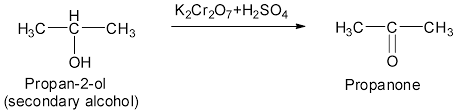
1 Propan-2-ol to propanone
On controlled oxidation, alcohols give aldehyde or ketones. Primary alcohols on controlled oxidation give aldehydes and secondary alcohols on controlled oxidation give ketones
The common oxidizing agent used for alcohols to produce ketones or aldehydes is acidified potassium dichromate
Now, therefore oxidation of propan-2-ol with its oxidizing agent potassium dichromate will give its resultant ketone which is propanone.
2 Propanone to propane-
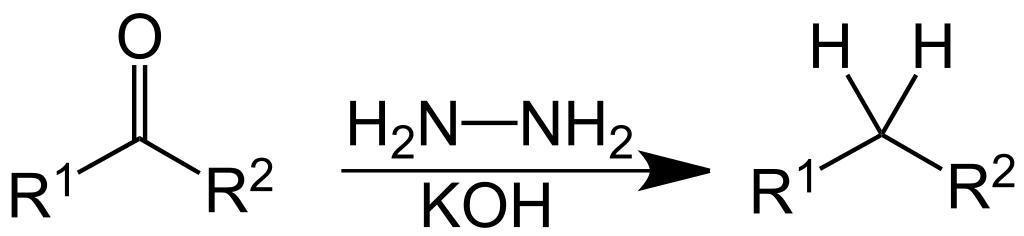
Propanone Is converted to propane by the help of . Wollf kishner reduction- Wolff Kishner reduction mechanism begins with the formation of a hydrazone anion which then releases the nitrogen atom to form a carbanion. This carbanion then reacts with the water in the system to give a hydrocarbon. Typically, diethylene glycol is used as a solvent for this method.
This reduction is an organic reaction as aldehydes and ketones are reduced to alkanes. Some carbonyl compounds are stable in strongly basic conditions
The Clemmensen reduction is a reaction that is used to reduce aldehydes or ketones to alkanes using hydrochloric acid and zinc amalgam. Now, converting propanone to propane by wolff kishner reduction
3 Propane to Propanol
Propane Can be converted into propanol by following these steps:
It is treated with bromine gas (or any halogen in presence of UV light) which converts it into 2- bromo propane .
\[C{H_3}C{H_2}C{H_3} + B{r_2} \to C{H_3}CH\left( {Br} \right)C{H_3}\]
2- bromopropane is treated with alcoholic KOH which converts it into propene.
\[C{H_3}CH\left( {Br} \right)C{H_3} + KOH\left( {alc} \right) \to C{H_3} - CH = C{H_2}\]
Propene is treated with H-Br in presence of peroxide which converts it into 1- bromopropane
\[C{H_3} - CH = C{H_2} + H - Br\to C{H_3}C{H_2}C{H_2}Br\]
1- bromopropane is treated with aqueous \[KOH\] which converts it into (propanol).
\[C{H_3}C{H_2}C{H_2}Br+ KOH\left( {aq} \right) \to C{H_3}C{H_2}C{H_2}OH\]
Note: Clemmensen reduction is a naming reaction in which reduction of ketones to alkanes using zinc amalgam and concentrated hydrochloric acid. This reaction is named after Erik Christian Clemmensen, a Danish chemist.
Complete step by step answer:
1 Propan-2-ol to propanone
On controlled oxidation, alcohols give aldehyde or ketones. Primary alcohols on controlled oxidation give aldehydes and secondary alcohols on controlled oxidation give ketones
The common oxidizing agent used for alcohols to produce ketones or aldehydes is acidified potassium dichromate
Now, therefore oxidation of propan-2-ol with its oxidizing agent potassium dichromate will give its resultant ketone which is propanone.
2 Propanone to propane-
Propanone Is converted to propane by the help of . Wollf kishner reduction- Wolff Kishner reduction mechanism begins with the formation of a hydrazone anion which then releases the nitrogen atom to form a carbanion. This carbanion then reacts with the water in the system to give a hydrocarbon. Typically, diethylene glycol is used as a solvent for this method.
This reduction is an organic reaction as aldehydes and ketones are reduced to alkanes. Some carbonyl compounds are stable in strongly basic conditions
The Clemmensen reduction is a reaction that is used to reduce aldehydes or ketones to alkanes using hydrochloric acid and zinc amalgam. Now, converting propanone to propane by wolff kishner reduction
3 Propane to Propanol
Propane Can be converted into propanol by following these steps:
It is treated with bromine gas (or any halogen in presence of UV light) which converts it into 2- bromo propane .
\[C{H_3}C{H_2}C{H_3} + B{r_2} \to C{H_3}CH\left( {Br} \right)C{H_3}\]
2- bromopropane is treated with alcoholic KOH which converts it into propene.
\[C{H_3}CH\left( {Br} \right)C{H_3} + KOH\left( {alc} \right) \to C{H_3} - CH = C{H_2}\]
Propene is treated with H-Br in presence of peroxide which converts it into 1- bromopropane
\[C{H_3} - CH = C{H_2} + H - Br\to C{H_3}C{H_2}C{H_2}Br\]
1- bromopropane is treated with aqueous \[KOH\] which converts it into (propanol).
\[C{H_3}C{H_2}C{H_2}Br+ KOH\left( {aq} \right) \to C{H_3}C{H_2}C{H_2}OH\]
Note: Clemmensen reduction is a naming reaction in which reduction of ketones to alkanes using zinc amalgam and concentrated hydrochloric acid. This reaction is named after Erik Christian Clemmensen, a Danish chemist.
Recently Updated Pages
Onehalf of a convex lens is covered with a black paper class 12 physics CBSE

Differentiate between lanthanoids and actinoids class 12 chemistry CBSE
An object 5 cm in length is held 25 cm away from a class 12 physics CBSE
Name the following halides according to the IUPAC system class 12 chemistry CBSE
What is the Full Form of PVC, PET, HDPE, LDPE, PP and PS ?
An infinite ladder network of resistances is constructed class 12 physics CBSE
Trending doubts
Draw a labelled sketch of the human eye class 12 physics CBSE
Which are the Top 10 Largest Countries of the World?
Draw ray diagrams each showing i myopic eye and ii class 12 physics CBSE
Which is the correct genotypic ratio of mendel dihybrid class 12 biology CBSE
Differentiate between homogeneous and heterogeneous class 12 chemistry CBSE
Give 10 examples of unisexual and bisexual flowers