



Convert Chlorobenzene to p−chloroaniline.
Answer
 Verified
633k+ views
Hint:In order to answer this question, you must recall the concepts and reaction of halo-benzenes. Use the correct steps for conversion of Chlorobenzene into p-chloroaniline. For further explanation of the process, refer to the solution.
Complete answer:
Chlorobenzene is a colorless, flammable liquid with an aromatic, almond-like odor. Some of it will dissolve in water, but it readily evaporates into air. It does not occur naturally in the environment. Chlorobenzene production in the United States has declined by more than $60\% $ from its peak in $1960$. It was used in the past to make other chemicals, such as phenol and DDT. Now chlorobenzene is used as a solvent for some pesticide formulations, to degrease automobile parts, and as a chemical intermediate to make several other chemicals.
The following describe the conversion process:
Step 1: Firstly, we have to treat Chlorobenzene with $HN{O_3}$ , ${H_2}S{O_4}$ , It gives para chloronitrobenzene .
Step 2: Now in the second step, p-chloronitrobenzene is further treated with $Sn/HCl$ , known as Reduction gives p-chloroaniline.
The complete reaction is:
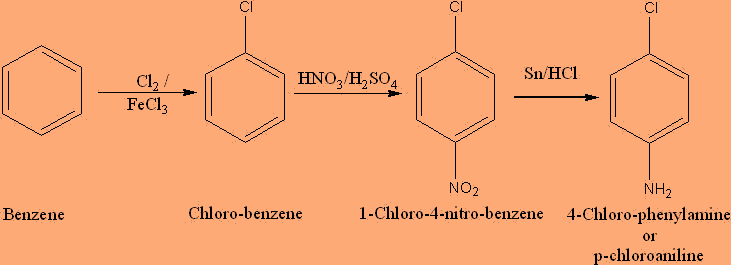
And hence, we got our required product.
Note:p-Chloroaniline is used in the industrial production of pesticides, drugs, and dyestuffs. It is a precursor to the widely used antimicrobial and bactericide chlorhexidine and is used in the manufacture of pesticides, including pyraclostrobin, anilofos, monolinuron, and chlorphthalim. It can be also used in the manufacture of some benzodiazepine drugs as well as the antihistamine dorastine, the antiarrhythmic and the antifungal ontianil. It can exhibit antimicrobial action against some bacteria and molds.
Complete answer:
Chlorobenzene is a colorless, flammable liquid with an aromatic, almond-like odor. Some of it will dissolve in water, but it readily evaporates into air. It does not occur naturally in the environment. Chlorobenzene production in the United States has declined by more than $60\% $ from its peak in $1960$. It was used in the past to make other chemicals, such as phenol and DDT. Now chlorobenzene is used as a solvent for some pesticide formulations, to degrease automobile parts, and as a chemical intermediate to make several other chemicals.
The following describe the conversion process:
Step 1: Firstly, we have to treat Chlorobenzene with $HN{O_3}$ , ${H_2}S{O_4}$ , It gives para chloronitrobenzene .
Step 2: Now in the second step, p-chloronitrobenzene is further treated with $Sn/HCl$ , known as Reduction gives p-chloroaniline.
The complete reaction is:
And hence, we got our required product.
Note:p-Chloroaniline is used in the industrial production of pesticides, drugs, and dyestuffs. It is a precursor to the widely used antimicrobial and bactericide chlorhexidine and is used in the manufacture of pesticides, including pyraclostrobin, anilofos, monolinuron, and chlorphthalim. It can be also used in the manufacture of some benzodiazepine drugs as well as the antihistamine dorastine, the antiarrhythmic and the antifungal ontianil. It can exhibit antimicrobial action against some bacteria and molds.
Recently Updated Pages
Which of the following graphs shows the variation of class 12 physics CBSE

Draw a labelled diagram of the human male reproductive class 12 biology CBSE
Describe the experiment to compare the emf of two cells class 12 physics CBSE
What is standard hydrogen electrode
What is conventional current and electric current class 12 physics CBSE
2Bromopentane is treated with an alcoholic KOH solution class 12 chemistry CBSE
Trending doubts
Draw a labelled sketch of the human eye class 12 physics CBSE
Which are the Top 10 Largest Countries of the World?
Differentiate between homogeneous and heterogeneous class 12 chemistry CBSE
Draw ray diagrams each showing i myopic eye and ii class 12 physics CBSE
Which is the correct genotypic ratio of mendel dihybrid class 12 biology CBSE
What is the Full Form of PVC, PET, HDPE, LDPE, PP and PS ?