




How do you convert a moving coil galvanometer into voltmeter?
Answer
 Verified
629.7k+ views
Hint: Moving coil galvanometer is a very sensitive device that works on the principle of how torque changes when the current varies and this change is indicated on the scale. To convert a moving coil galvanometer into voltmeter, a high resistance is connected with it in series. Let’s see in brief.
Complete Step by Step Answer:
Let us first see Moving Coil Galvanometer,
Moving Coil Galvanometer: It is an instrument which is used to detect the current in the circuit.
Principle: The principle of moving coil galvanometer depends on the fact that when a coil is placed in a uniform magnetic field then the torque act is directly proportional to the current, area of the coil and magnetic field which deflects the needle i.e. pointed on scale.
Conversion of galvanometer into voltmeter:
Voltmeter is the instrument which measures the potential difference between two points of the circuit. A high resistance is connected in series with a coil of galvanometer to convert into voltmeter.
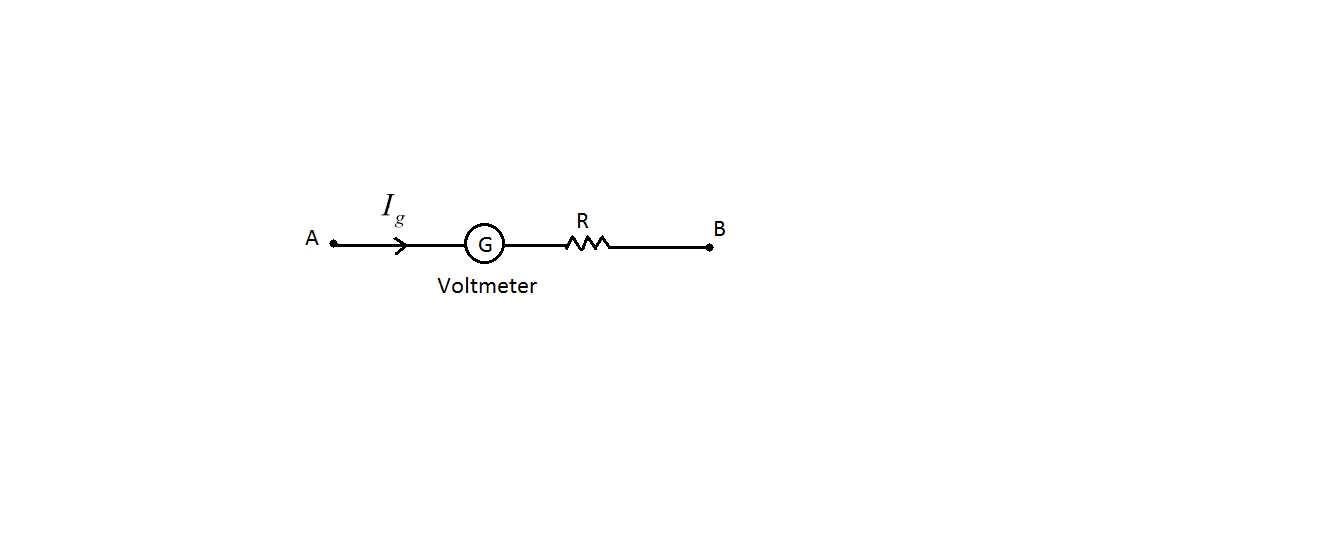
A voltmeter is connected in parallel to the circuit because of its high resistance. In parallel it does not affect the current. An ideal voltmeter has infinite resistance.
Calculation for Resistance:
Let resistance of galvanometer \[=G\]
Full scale deflection \[={{I}_{g}}\]
Then, potential difference in AB of the circuit
\[\begin{align}
& V={{I}_{g}}(R+G) \\
& \dfrac{V}{{{I}_{g}}}=R+G \\
& R=\dfrac{V}{{{I}_{g}}}-G \\
\end{align}\]
This resistance is to be connected in series with a galvanometer to convert it into voltmeter.
Note: Moving Coil Galvanometer be used to detect alternating current in the circuit because on changing the polarity of the current, the torque also changes its direction. Therefore, during a complete cycle the average torque will be zero.
Complete Step by Step Answer:
Let us first see Moving Coil Galvanometer,
Moving Coil Galvanometer: It is an instrument which is used to detect the current in the circuit.
Principle: The principle of moving coil galvanometer depends on the fact that when a coil is placed in a uniform magnetic field then the torque act is directly proportional to the current, area of the coil and magnetic field which deflects the needle i.e. pointed on scale.
Conversion of galvanometer into voltmeter:
Voltmeter is the instrument which measures the potential difference between two points of the circuit. A high resistance is connected in series with a coil of galvanometer to convert into voltmeter.
A voltmeter is connected in parallel to the circuit because of its high resistance. In parallel it does not affect the current. An ideal voltmeter has infinite resistance.
Calculation for Resistance:
Let resistance of galvanometer \[=G\]
Full scale deflection \[={{I}_{g}}\]
Then, potential difference in AB of the circuit
\[\begin{align}
& V={{I}_{g}}(R+G) \\
& \dfrac{V}{{{I}_{g}}}=R+G \\
& R=\dfrac{V}{{{I}_{g}}}-G \\
\end{align}\]
This resistance is to be connected in series with a galvanometer to convert it into voltmeter.
Note: Moving Coil Galvanometer be used to detect alternating current in the circuit because on changing the polarity of the current, the torque also changes its direction. Therefore, during a complete cycle the average torque will be zero.
Recently Updated Pages
Master Class 12 Economics: Engaging Questions & Answers for Success

Master Class 12 English: Engaging Questions & Answers for Success
Master Class 12 Social Science: Engaging Questions & Answers for Success
Master Class 12 Maths: Engaging Questions & Answers for Success
Master Class 12 Physics: Engaging Questions & Answers for Success
Master Class 12 Business Studies: Engaging Questions & Answers for Success
Trending doubts
Which are the Top 10 Largest Countries of the World?
Draw a labelled sketch of the human eye class 12 physics CBSE
Differentiate between homogeneous and heterogeneous class 12 chemistry CBSE
Why is the cell called the structural and functional class 12 biology CBSE
Draw ray diagrams each showing i myopic eye and ii class 12 physics CBSE
Which is the correct genotypic ratio of mendel dihybrid class 12 biology CBSE