




How can you convert a galvanometer into a voltmeter?
Answer
 Verified
558.9k+ views
Hint: First let us understand for what purpose galvanometer and voltmeter are used. A Galvanometer is used to detect the amount of current flowing in the circuit. While the voltmeter is used to measure the potential difference between two points in a circuit. The galvanometer is used as a voltmeter by connecting the high resistance in series with the circuit.
Complete solution:
The galvanometer works on the principle of a torque experienced by a current sustaining coil kept in a fixed magnetic field. The main principle of the voltmeter is that it must be connected in parallel in which we want to measure the voltage. Parallel connection is used because a voltmeter is constructed in such a way that it has a very high value of resistance. So, if that high resistance is connected in series then the current flow will be almost zero which means the circuit has become open.
Consider the following diagram.
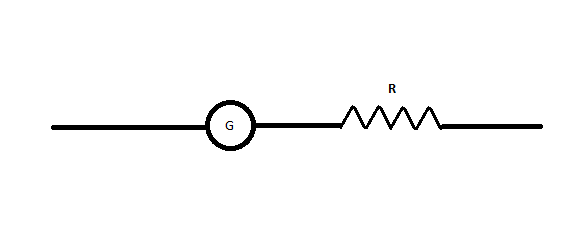
In the above diagram, a resistor is connected in series with the galvanometer in the circuit. Let $G$ be the resistance of the galvanometer and ${I_G}$ the maximum deflection in the galvanometer. To measure the maximum voltage \[V\] by the voltmeter, the high resistance $R$ is connected in series. Therefore,
$\therefore V = {I_G}(R + G)$
$ \Rightarrow {I_G}R = V - {I_G}G$
$ \Rightarrow R = \dfrac{V}{{{I_G}}} - G$
This equation gives the value of resistance $R$ which is connected in series to the galvanometer, is converted into a voltmeter of range 0 – V volts. The effective resistance of the voltmeter ${R_V} = R + G$ .
Since the resistor $R$ is high, the resistance of the voltmeter ${R_V}$ is high and it will not draw much current from the circuit.
Note: The resistor of very high resistance in the circuit should be connected in series not in a parallel manner. If the resistor is connected in a parallel manner then there will be no effect on the galvanometer. The very important equation used to calculate the resistance of the resultant voltmeter is Ohm’s law. Ohm's law states that the voltage or potential difference between two points is directly proportional to the current or electricity passing through the resistance, and directly proportional to the resistance of the circuit.
Complete solution:
The galvanometer works on the principle of a torque experienced by a current sustaining coil kept in a fixed magnetic field. The main principle of the voltmeter is that it must be connected in parallel in which we want to measure the voltage. Parallel connection is used because a voltmeter is constructed in such a way that it has a very high value of resistance. So, if that high resistance is connected in series then the current flow will be almost zero which means the circuit has become open.
Consider the following diagram.
In the above diagram, a resistor is connected in series with the galvanometer in the circuit. Let $G$ be the resistance of the galvanometer and ${I_G}$ the maximum deflection in the galvanometer. To measure the maximum voltage \[V\] by the voltmeter, the high resistance $R$ is connected in series. Therefore,
$\therefore V = {I_G}(R + G)$
$ \Rightarrow {I_G}R = V - {I_G}G$
$ \Rightarrow R = \dfrac{V}{{{I_G}}} - G$
This equation gives the value of resistance $R$ which is connected in series to the galvanometer, is converted into a voltmeter of range 0 – V volts. The effective resistance of the voltmeter ${R_V} = R + G$ .
Since the resistor $R$ is high, the resistance of the voltmeter ${R_V}$ is high and it will not draw much current from the circuit.
Note: The resistor of very high resistance in the circuit should be connected in series not in a parallel manner. If the resistor is connected in a parallel manner then there will be no effect on the galvanometer. The very important equation used to calculate the resistance of the resultant voltmeter is Ohm’s law. Ohm's law states that the voltage or potential difference between two points is directly proportional to the current or electricity passing through the resistance, and directly proportional to the resistance of the circuit.
Recently Updated Pages
Master Class 12 Economics: Engaging Questions & Answers for Success

Master Class 12 Physics: Engaging Questions & Answers for Success
Master Class 12 English: Engaging Questions & Answers for Success
Master Class 12 Social Science: Engaging Questions & Answers for Success
Master Class 12 Maths: Engaging Questions & Answers for Success
Master Class 12 Business Studies: Engaging Questions & Answers for Success
Trending doubts
Which are the Top 10 Largest Countries of the World?
What are the major means of transport Explain each class 12 social science CBSE
Draw a labelled sketch of the human eye class 12 physics CBSE
Why cannot DNA pass through cell membranes class 12 biology CBSE
Differentiate between insitu conservation and exsitu class 12 biology CBSE
Draw a neat and well labeled diagram of TS of ovary class 12 biology CBSE