




Conversion of glucose to glucose-6-phosphate, the first irreversible reaction of glycolysis, is catalyzed by?
(A)- Aldolase
(B)- Hexokinase
(C)- Enolase
(D)- Phosphofructokinase
Answer
 Verified
602.4k+ views
Hint: Glucose is a compound in which there are 6 carbon atoms and all the carbon atoms have a functional group and in glucose-6-phosphate, the functional group of the carbon atom is replaced with the phosphate group.
Complete step by step solution:
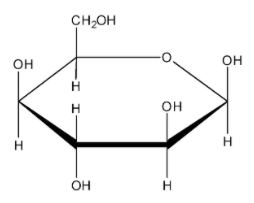
Glucose is a compound in which there are 6 carbon atoms and the terminal carbon atom has an aldehyde functional group and the rest all carbon atoms have an alcohol group and there is an oxygen atom present between the rings. The structure is given below:
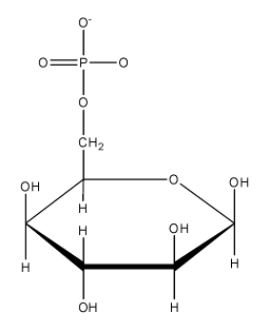
In glucose-6-phosphate, the 6th carbon atom has an alcohol group and the hydrogen of this group is replaced with a phosphate group. The structure is given below:
Glucose is present in our body and this is converted into glucose-6-phosphate by two major metabolic pathways: glycolysis and the pentose phosphate pathway.
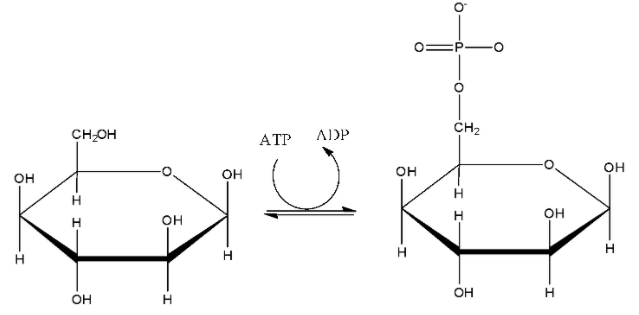
So by the glycolysis process, in the cell, the hydroxyl group at the 6th position of the glucose is converted into phosphate group by phosphorylation. This reaction can only occur in the presence of a catalyst, so this reaction is catalyzed by the enzyme Hexokinase. In each conversion, one ATP is used. The conversion is given below:
The difference between glucose and glucose-6-phosphate is that glucose can pass through the cell membrane but glucose-6-phosphate cannot pass through the cell membrane.
Therefore, the correct answer is option (B)- Hexokinase.
Note: The enzyme hexokinase is used in smaller animals, but in higher animals in certain cells glucokinase enzyme is used. But this enzyme is not used in liver cells.
Complete step by step solution:
Glucose is a compound in which there are 6 carbon atoms and the terminal carbon atom has an aldehyde functional group and the rest all carbon atoms have an alcohol group and there is an oxygen atom present between the rings. The structure is given below:
In glucose-6-phosphate, the 6th carbon atom has an alcohol group and the hydrogen of this group is replaced with a phosphate group. The structure is given below:
Glucose is present in our body and this is converted into glucose-6-phosphate by two major metabolic pathways: glycolysis and the pentose phosphate pathway.
So by the glycolysis process, in the cell, the hydroxyl group at the 6th position of the glucose is converted into phosphate group by phosphorylation. This reaction can only occur in the presence of a catalyst, so this reaction is catalyzed by the enzyme Hexokinase. In each conversion, one ATP is used. The conversion is given below:
The difference between glucose and glucose-6-phosphate is that glucose can pass through the cell membrane but glucose-6-phosphate cannot pass through the cell membrane.
Therefore, the correct answer is option (B)- Hexokinase.
Note: The enzyme hexokinase is used in smaller animals, but in higher animals in certain cells glucokinase enzyme is used. But this enzyme is not used in liver cells.
Recently Updated Pages
Master Class 12 Business Studies: Engaging Questions & Answers for Success

Master Class 12 Biology: Engaging Questions & Answers for Success
Master Class 12 Chemistry: Engaging Questions & Answers for Success
Class 12 Question and Answer - Your Ultimate Solutions Guide
Master Class 11 Social Science: Engaging Questions & Answers for Success
Master Class 11 English: Engaging Questions & Answers for Success
Trending doubts
Which is more stable and why class 12 chemistry CBSE
Which are the Top 10 Largest Countries of the World?
Draw a labelled sketch of the human eye class 12 physics CBSE
Differentiate between homogeneous and heterogeneous class 12 chemistry CBSE
What are the major means of transport Explain each class 12 social science CBSE
Sulphuric acid is known as the king of acids State class 12 chemistry CBSE