




Construct vector diagrams?
Answer
 Verified
556.8k+ views
Hint: Vector diagrams must always have accurate magnitude and direction of vector as they are drawn to scale. We can measure the magnitude with the help of a ruler and the angle of direction by using a protractor. Thus, we shall learn to draw the vector diagrams with great precision.
Complete step by step answer:
If a vector starts at point $\left( {{x}_{1}},{{y}_{1}} \right)$ and if it terminates at $\left( {{x}_{2}},{{y}_{2}} \right)$ , then to get its components we just simply subtract the $x$ coordinates and the $y$ coordinates. The order while subtraction is very important. We have to take the finishing point minus the starting point for both the $x$ and $y$ coordinates.
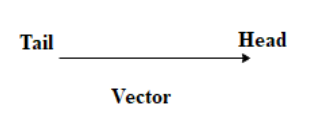
When we have to join vectors pointing in the same direction (let that be the same straight-line or some clockwise or anti-clockwise rotation), we connect the tail of one vector to the head of the other vector. Further, if there are more than two vectors then we shall be joining the vectors from head to tail. However, when we have to join vectors in opposite directions, we join the head of one vector to the head of the other or we join the tail of one vector to the tail of the other.
Note: We represent all vectors with little arrows and they represent quantities that have both a magnitude and a direction associated with them. To indicate a vector quantity, a small arrow is put at the head of the symbol or character representing that vector quantity or we can also put the symbol or character in double bars.
Complete step by step answer:
If a vector starts at point $\left( {{x}_{1}},{{y}_{1}} \right)$ and if it terminates at $\left( {{x}_{2}},{{y}_{2}} \right)$ , then to get its components we just simply subtract the $x$ coordinates and the $y$ coordinates. The order while subtraction is very important. We have to take the finishing point minus the starting point for both the $x$ and $y$ coordinates.
When we have to join vectors pointing in the same direction (let that be the same straight-line or some clockwise or anti-clockwise rotation), we connect the tail of one vector to the head of the other vector. Further, if there are more than two vectors then we shall be joining the vectors from head to tail. However, when we have to join vectors in opposite directions, we join the head of one vector to the head of the other or we join the tail of one vector to the tail of the other.
Note: We represent all vectors with little arrows and they represent quantities that have both a magnitude and a direction associated with them. To indicate a vector quantity, a small arrow is put at the head of the symbol or character representing that vector quantity or we can also put the symbol or character in double bars.
Recently Updated Pages
Master Class 11 Computer Science: Engaging Questions & Answers for Success

Master Class 11 Business Studies: Engaging Questions & Answers for Success
Master Class 11 Economics: Engaging Questions & Answers for Success
Master Class 11 English: Engaging Questions & Answers for Success
Master Class 11 Maths: Engaging Questions & Answers for Success
Master Class 11 Biology: Engaging Questions & Answers for Success
Trending doubts
There are 720 permutations of the digits 1 2 3 4 5 class 11 maths CBSE
Discuss the various forms of bacteria class 11 biology CBSE
Explain zero factorial class 11 maths CBSE
What organs are located on the left side of your body class 11 biology CBSE
Draw a labelled diagram of the human heart and label class 11 biology CBSE
What is 1s 2s 2p 3s 3p class 11 chemistry CBSE