



Construct the following quadrilaterals
A) Quadrilateral LIFT
\[{\text{LI}} = 4{\text{ cm}}\]
\[{\text{IF}} = 3{\text{ cm}}\]
\[{\text{TL}} = 2.5{\text{ cm}}\]
\[{\text{LF}} = 4.5{\text{ cm}}\]
\[{\text{IT}} = 4{\text{ cm}}\]
B) Quadrilateral GOLD
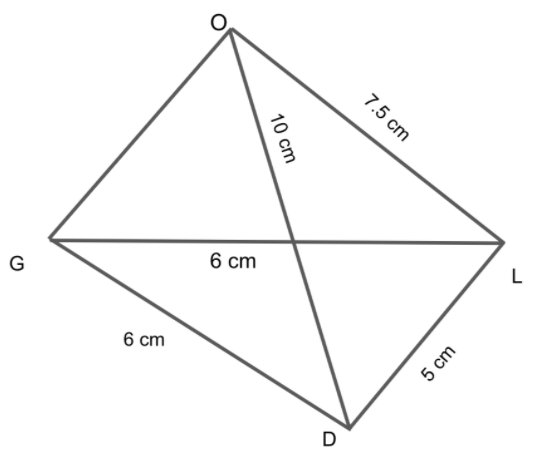
\[{\text{OL}} = 7.5{\text{ cm}}\]
\[{\text{GL}} = 6{\text{ cm}}\]
\[{\text{GD}} = 6{\text{ cm}}\]
\[{\text{LD}} = 5{\text{ cm}}\]
\[{\text{OD}} = 10{\text{ cm}}\]
Answer
 Verified
631.5k+ views
Hint: First we will draw side EA of length 5 cm and then we will mark point I, take 4 cm as radius and L as the centre, draw an arc on top of LF and then we will take 3 cm as the radius, F as the centre, draw an arc on top of LF and then mark point T, take 4 cm as radius and I as the centre, draw an arc on bottom of LF and then we will take \[2.5\] cm as the radius, L as the centre, draw an arc on bottom of LF and then join LI, IF, FT, LT, IT for part (i). Follow similar steps for the part (ii) and (iii).
Complete step by step solution:
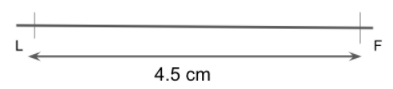
First, we will draw side LF of length \[4.5\] cm, we get
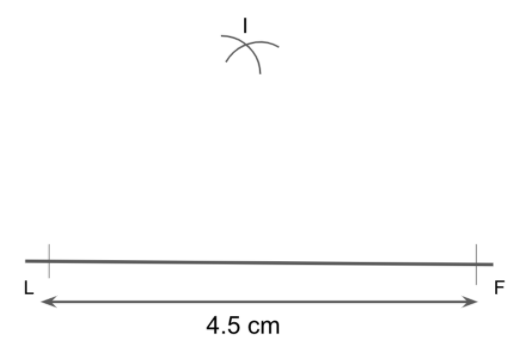
Now, we will mark point I, take 4 cm as radius and L as the centre, draw an arc on top of LF and then we will take 3 cm as the radius, F as the centre, draw an arc on top of LF, we get
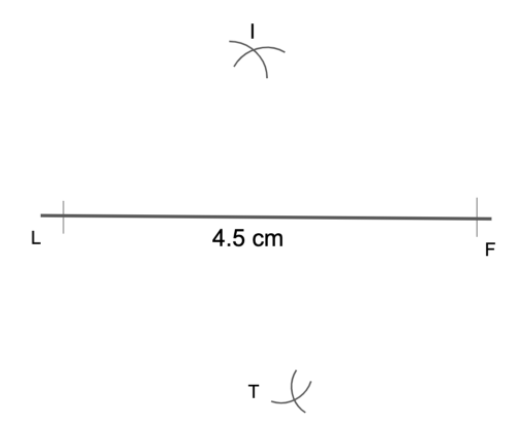
We will now mark point T, take 4 cm as radius and I as the centre, draw an arc on bottom of LF and then we will take \[2.5\] cm as the radius, L as the centre, draw an arc on bottom of LF, we get
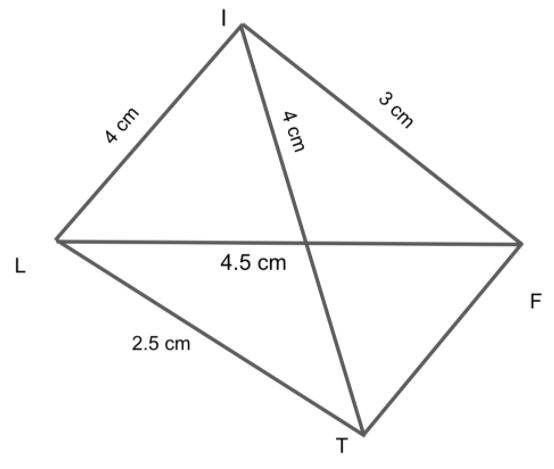
Joining LI, IF, FT, LT, IT and then labelling the sides, we get
B) First, we will draw side GL of length 6 cm, we get
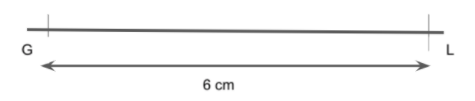
Now, we will mark point O, take \[7.5\] cm as radius and L as the centre, draw an arc on top of GL and then we will take 10 cm as the radius, D as the centre, draw an arc on top of GL, we get
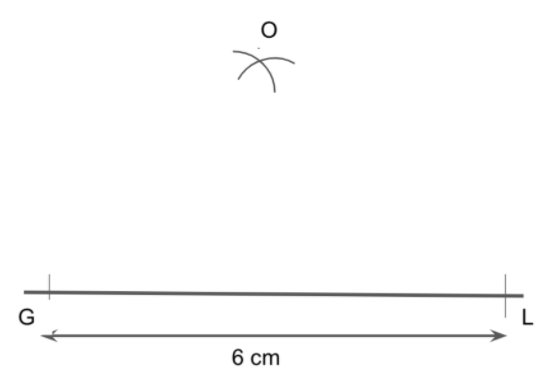
We will now mark point D, take 6 cm as radius and G as the centre, draw an arc on bottom of GL and then we will take 5 cm as the radius, L as the centre, draw an arc on bottom of GL, we get
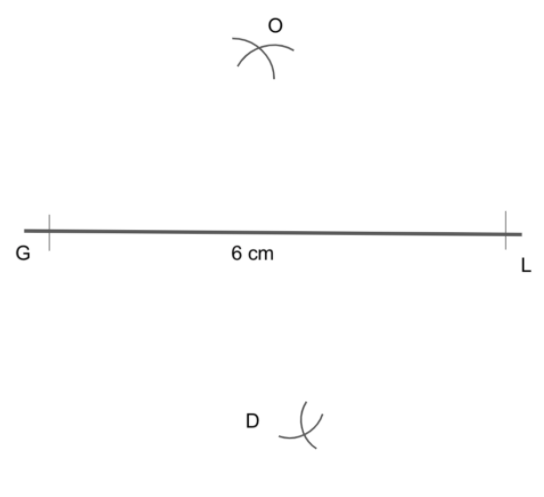
Joining GO, OL, LD, GD, OD and then labelling the sides, we get
Note: In solving these types of questions, students need to read the question properly before writing. Students have to be precise while drawing the lengths and angles properly as this is a crucial part of the problem. Remembering the steps for the construction problem is important.
Complete step by step solution:
First, we will draw side LF of length \[4.5\] cm, we get
Now, we will mark point I, take 4 cm as radius and L as the centre, draw an arc on top of LF and then we will take 3 cm as the radius, F as the centre, draw an arc on top of LF, we get
We will now mark point T, take 4 cm as radius and I as the centre, draw an arc on bottom of LF and then we will take \[2.5\] cm as the radius, L as the centre, draw an arc on bottom of LF, we get
Joining LI, IF, FT, LT, IT and then labelling the sides, we get
B) First, we will draw side GL of length 6 cm, we get
Now, we will mark point O, take \[7.5\] cm as radius and L as the centre, draw an arc on top of GL and then we will take 10 cm as the radius, D as the centre, draw an arc on top of GL, we get
We will now mark point D, take 6 cm as radius and G as the centre, draw an arc on bottom of GL and then we will take 5 cm as the radius, L as the centre, draw an arc on bottom of GL, we get
Joining GO, OL, LD, GD, OD and then labelling the sides, we get
Note: In solving these types of questions, students need to read the question properly before writing. Students have to be precise while drawing the lengths and angles properly as this is a crucial part of the problem. Remembering the steps for the construction problem is important.

Recently Updated Pages
Master Class 11 English: Engaging Questions & Answers for Success

Master Class 11 Social Science: Engaging Questions & Answers for Success
Master Class 11 Maths: Engaging Questions & Answers for Success
Master Class 11 Biology: Engaging Questions & Answers for Success
Master Class 11 Physics: Engaging Questions & Answers for Success
Master Class 11 Chemistry: Engaging Questions & Answers for Success
Trending doubts
What is the Full Form of ICSE / ISC ?
The president of the constituent assembly was A Dr class 9 social science CBSE
What comes after 10 crore in Indian system class 9 maths CBSE
Write all prime numbers between 1 to 50 class 9 maths CBSE
The Indo Gangetic Plains of India are fertile due to class 9 social science CBSE
What is the importance of natural resources? Why is it necessary to conserve them?