



Construct an equilateral triangle, given its side of length of 4.5 cm and justify the construction.
Answer
 Verified
641.7k+ views
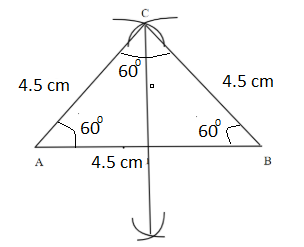
Hint: An equilateral triangle whose all the three sides are equal and all the angles are of ${60^\circ}$. We will first draw a line segment AB of length 4.5 cm.
Complete step-by-step answer:
Now, to draw an equilateral triangle, we have to follow the steps given below:
1. We will first draw a line segment AB of length 4.5 cm.

2. After drawing the line segment, with the help of compass we had to draw the perpendicular bisector of line segment AB. So, for that we measure the length of AB with compass and put the compass at point A, draw an arc on above and below the line segment AB.
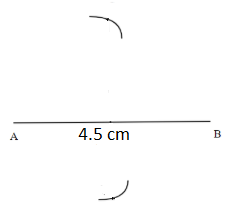
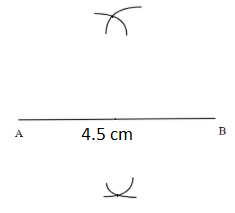
3. Similarly draw the arc by placing compass on point B such that it cuts the arc drawn from point
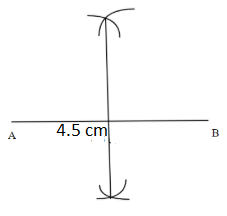
4. Now, with the help of a ruler, join the intersection point of arcs to both points A and B that are above and below the line segment AB.
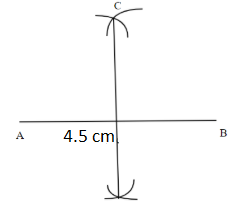
5. Name the intersection point of arcs above the line segment AB as C.
6. Now join point C with point A and point B with the help of the ruler.
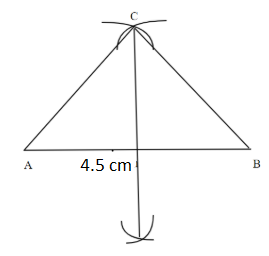
7. Now, the equilateral triangle is ready. You can check each angle with the help of a protector and can also measure the length of all sides with the help of a ruler. It is the same for all sides and is equal to 4.5 cm.
Note: While doing construction, you should have a ruler, a compass, a protector. Also, do the construction carefully. Lack of concentration leads to improper construction. Always use a pencil to do construction because if in doing construction there is a mistake you can erase it easily, but while using a pen you can’t correct the mistake.
Complete step-by-step answer:
Now, to draw an equilateral triangle, we have to follow the steps given below:
1. We will first draw a line segment AB of length 4.5 cm.
2. After drawing the line segment, with the help of compass we had to draw the perpendicular bisector of line segment AB. So, for that we measure the length of AB with compass and put the compass at point A, draw an arc on above and below the line segment AB.
3. Similarly draw the arc by placing compass on point B such that it cuts the arc drawn from point
4. Now, with the help of a ruler, join the intersection point of arcs to both points A and B that are above and below the line segment AB.
5. Name the intersection point of arcs above the line segment AB as C.
6. Now join point C with point A and point B with the help of the ruler.
7. Now, the equilateral triangle is ready. You can check each angle with the help of a protector and can also measure the length of all sides with the help of a ruler. It is the same for all sides and is equal to 4.5 cm.
Note: While doing construction, you should have a ruler, a compass, a protector. Also, do the construction carefully. Lack of concentration leads to improper construction. Always use a pencil to do construction because if in doing construction there is a mistake you can erase it easily, but while using a pen you can’t correct the mistake.
Recently Updated Pages
Master Class 12 Business Studies: Engaging Questions & Answers for Success

Master Class 12 Biology: Engaging Questions & Answers for Success
Master Class 12 Chemistry: Engaging Questions & Answers for Success
Class 12 Question and Answer - Your Ultimate Solutions Guide
Master Class 11 Social Science: Engaging Questions & Answers for Success
Master Class 11 English: Engaging Questions & Answers for Success
Trending doubts
What is the situation called when no party gets the class 9 social science CBSE
What is the Full Form of ICSE / ISC ?
Find the sum of series 1 + 2 + 3 + 4 + 5 + + 100 class 9 maths CBSE
Fill the blanks with the suitable prepositions 1 The class 9 english CBSE
Difference Between Plant Cell and Animal Cell
What is pollution? How many types of pollution? Define it