



Construct a triangle having perimeter $6.4{\text{ cm}}$ and its basic angle are ${60^ \circ }$ and ${45^ \circ }$.
Answer
 Verified
584.1k+ views
Hint: First, draw a line segment. Then using a protractor draw $\angle XPQ = {60^ \circ }$and $\angle YQP = {45^ \circ }$. Now draw angle bisectors of these angles AP and AQ respectively. Then draw perpendicular bisectors of AP and AQ which intersects the line segment PQ at point B and C respectively. Then join point A and C, and A and B.
Complete step-by-step answer:
We have to construct a triangle with perimeter $6.4{\text{ cm}}$ and with basic angles ${60^ \circ }$ and ${45^ \circ }$.
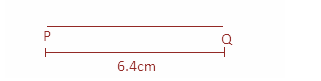
Step 1: Draw a line segment PQ of length $6.4{\text{ cm}}$ using a scale.
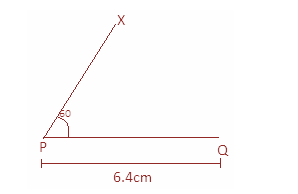
Step 2: At point P draw an angle of ${60^ \circ }$ using a protractor so that $\angle XPQ = {60^ \circ }$
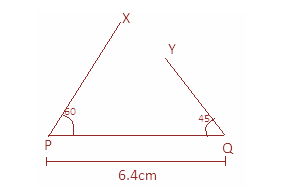
Step 3: Now draw an angle of ${45^ \circ }$ at point Q so that $\angle YQP = {45^ \circ }$
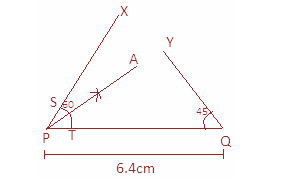
Step 4: Now, we will draw the angle bisector of $\angle XPQ$ by first marking points S and T. Then by taking S and T as centers, draw an arc. Then joint the point of their intersection with point P.
Step 5: Now, we will draw the angle bisector of $\angle YQP$ by first marking points M and N. Then by taking M and N as centers, draw an arc. Then joint the point of their intersection with point Q.
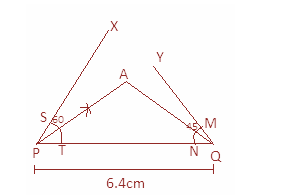
Step 6: Now draw perpendicular bisectors of AP and AQ which intersects the line segment PQ at points B and C respectively.
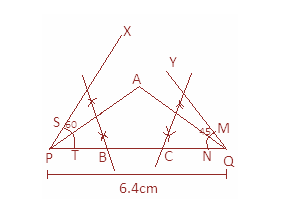
Step 7: Now join AB and Ac to get the required triangle.
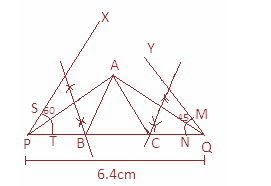
$\vartriangle ABC$ is the required triangle.
Note: Here the student may make mistake if he or she draws the angles facing in the same direction as this-
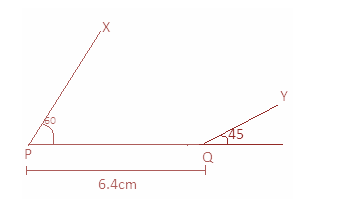
This is wrong because in the first step we have written that PQ is a line segment which means it cannot be extended in any direction. So if we draw the angles like given above then we are contradicting our own statement. Since it is bounded by two distinct points P and Q, hence we make the angle of ${45^ \circ }$ at point Q facing towards the angle drawn at point P.
Complete step-by-step answer:
We have to construct a triangle with perimeter $6.4{\text{ cm}}$ and with basic angles ${60^ \circ }$ and ${45^ \circ }$.
Step 1: Draw a line segment PQ of length $6.4{\text{ cm}}$ using a scale.
Step 2: At point P draw an angle of ${60^ \circ }$ using a protractor so that $\angle XPQ = {60^ \circ }$
Step 3: Now draw an angle of ${45^ \circ }$ at point Q so that $\angle YQP = {45^ \circ }$
Step 4: Now, we will draw the angle bisector of $\angle XPQ$ by first marking points S and T. Then by taking S and T as centers, draw an arc. Then joint the point of their intersection with point P.
Step 5: Now, we will draw the angle bisector of $\angle YQP$ by first marking points M and N. Then by taking M and N as centers, draw an arc. Then joint the point of their intersection with point Q.
Step 6: Now draw perpendicular bisectors of AP and AQ which intersects the line segment PQ at points B and C respectively.
Step 7: Now join AB and Ac to get the required triangle.
$\vartriangle ABC$ is the required triangle.
Note: Here the student may make mistake if he or she draws the angles facing in the same direction as this-
This is wrong because in the first step we have written that PQ is a line segment which means it cannot be extended in any direction. So if we draw the angles like given above then we are contradicting our own statement. Since it is bounded by two distinct points P and Q, hence we make the angle of ${45^ \circ }$ at point Q facing towards the angle drawn at point P.

Recently Updated Pages
Complete reduction of benzene diazonium chloride with class 12 chemistry CBSE

How can you identify optical isomers class 12 chemistry CBSE
The coating formed on the metals such as iron silver class 12 chemistry CBSE
Metals are refined by using different methods Which class 12 chemistry CBSE
What do you understand by denaturation of proteins class 12 chemistry CBSE
Assertion Nitrobenzene is used as a solvent in FriedelCrafts class 12 chemistry CBSE
Trending doubts
What is BLO What is the full form of BLO class 8 social science CBSE
What are the 12 elements of nature class 8 chemistry CBSE
Citizens of India can vote at the age of A 18 years class 8 social science CBSE
Full form of STD, ISD and PCO
Convert 40circ C to Fahrenheit A 104circ F B 107circ class 8 maths CBSE
Advantages and disadvantages of science