




Construct a rectangle \[ABCD\], when its sides are \[6cm\] and \[7.2cm\]. Then, relation between diag. \[AC\] and diag. \[BD\] is
A). \[AC = BD\]
B). \[AC < BD\]
C). \[AC > BC\]
D). Cannot say
Answer
 Verified
528.3k+ views
Hint: Here we are asked to construct a rectangle \[ABCD\] with the measurements \[6cm\] & \[7.2cm\] and also we have to find the relation between \[AC\] and \[BD\]. First, we will construct the rectangle with the given measurements then by using the properties of the rectangle we will find the relation between \[AC\] and \[BD\].
Formula: The property that we need to know before solving this problem:
If \[ABCD\] be a rectangle then their opposite sides are equal, that is \[AB = CD\] and \[AD = CB\].
Then \[AC\] and \[BD\] will be equal in length which are the diagonal of the rectangle.
Complete step-by-step solution:
Here we aim to find the relation between the diag. \[AC\] and diag. \[BD\] in the rectangle \[ABCD\] with the sides \[6cm\] and \[7.2cm\]. First, let us construct the rectangle with the given measurements.
Construction:
> Let us draw a line segment \[AB\] of measure \[7.2cm\] using a ruler.
> From the point \[A\] and \[B\] draw two perpendicular lines of measure \[6cm\] each with the help of protractor and ruler and mark the endpoints as \[D\] and \[C\] respectively.
> Join the points \[D\] and \[C\] by a line segment using the ruler which will have the measure \[7.2cm\].
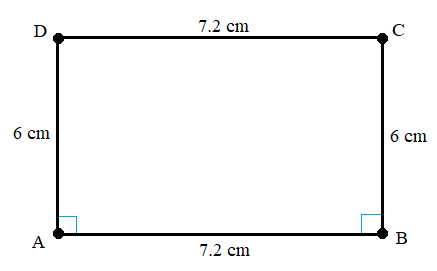
Therefore, we have constructed a rectangle \[ABCD\] with the sides \[6cm\] and \[7.2cm\].
Now we can see that the lines \[AC\] and \[BD\] are the diagonals of the rectangle from the diagram above.
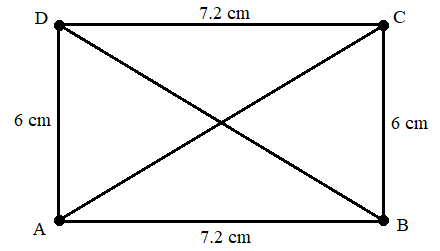
By the property of a rectangle, we know that the diagonals of a rectangle will be the same (equal in measure). Thus, we get that diagonal \[AC\] and diagonal \[BD\] are equal. Now let us find the correct answer from the option.
Option (a) \[AC = BD\] is the correct option as we got the diagonals \[AC\] and \[BD\] are equal.
Option (b) \[AC < BD\] is an incorrect answer as we got \[AC = BD\] from our solution.
Option (c) \[AC > BC\] is an incorrect answer as we got \[AC = BD\] from our solution.
Option (d) Cannot say is an incorrect answer as we got the answer as \[AC = BD\] from our solution.
Hence, option (a) \[AC = BD\] is the correct option.
Note: This problem can also be solved by the following method: After constructing the rectangle draw the diagonals. By drawing the diagonals, we are able to see two right-angle triangles (\[\Delta ABC\] and \[\Delta ABD\]) then by using the Pythagoras theorem we are able to find the measure of two diagonals. After finding their measure by comparing them we can find the relation between them.
Formula: The property that we need to know before solving this problem:
If \[ABCD\] be a rectangle then their opposite sides are equal, that is \[AB = CD\] and \[AD = CB\].
Then \[AC\] and \[BD\] will be equal in length which are the diagonal of the rectangle.
Complete step-by-step solution:
Here we aim to find the relation between the diag. \[AC\] and diag. \[BD\] in the rectangle \[ABCD\] with the sides \[6cm\] and \[7.2cm\]. First, let us construct the rectangle with the given measurements.
Construction:
> Let us draw a line segment \[AB\] of measure \[7.2cm\] using a ruler.
> From the point \[A\] and \[B\] draw two perpendicular lines of measure \[6cm\] each with the help of protractor and ruler and mark the endpoints as \[D\] and \[C\] respectively.
> Join the points \[D\] and \[C\] by a line segment using the ruler which will have the measure \[7.2cm\].
Therefore, we have constructed a rectangle \[ABCD\] with the sides \[6cm\] and \[7.2cm\].
Now we can see that the lines \[AC\] and \[BD\] are the diagonals of the rectangle from the diagram above.
By the property of a rectangle, we know that the diagonals of a rectangle will be the same (equal in measure). Thus, we get that diagonal \[AC\] and diagonal \[BD\] are equal. Now let us find the correct answer from the option.
Option (a) \[AC = BD\] is the correct option as we got the diagonals \[AC\] and \[BD\] are equal.
Option (b) \[AC < BD\] is an incorrect answer as we got \[AC = BD\] from our solution.
Option (c) \[AC > BC\] is an incorrect answer as we got \[AC = BD\] from our solution.
Option (d) Cannot say is an incorrect answer as we got the answer as \[AC = BD\] from our solution.
Hence, option (a) \[AC = BD\] is the correct option.
Note: This problem can also be solved by the following method: After constructing the rectangle draw the diagonals. By drawing the diagonals, we are able to see two right-angle triangles (\[\Delta ABC\] and \[\Delta ABD\]) then by using the Pythagoras theorem we are able to find the measure of two diagonals. After finding their measure by comparing them we can find the relation between them.

Recently Updated Pages
Master Class 12 Business Studies: Engaging Questions & Answers for Success

Master Class 12 Biology: Engaging Questions & Answers for Success
Master Class 12 Chemistry: Engaging Questions & Answers for Success
Class 12 Question and Answer - Your Ultimate Solutions Guide
Master Class 11 Social Science: Engaging Questions & Answers for Success
Master Class 11 English: Engaging Questions & Answers for Success
Trending doubts
What is BLO What is the full form of BLO class 8 social science CBSE
Citizens of India can vote at the age of A 18 years class 8 social science CBSE
Right to vote is a AFundamental Right BFundamental class 8 social science CBSE
10 slogans on organ donation class 8 english CBSE
Name the states through which the Tropic of Cancer class 8 social science CBSE
What are the methods of reducing friction. Explain