



Consider the waveform function \[\iota = f\left( \theta \right) = 5\sin \dfrac{\theta }{2}\] continuous between \[0\] and \[2\pi \] as shown in the following figure:
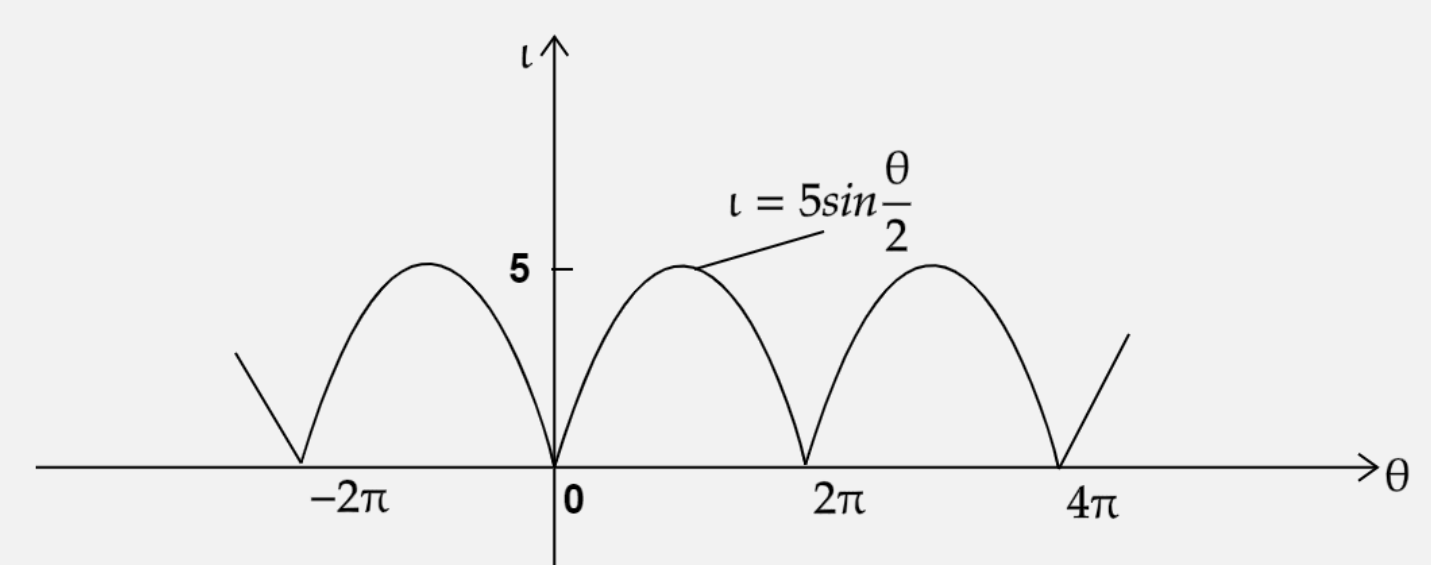
(i) Determine the Fourier series expansion for full wave rectified sine wave \[\iota \]
(ii) Use the above Fourier series to show that
\[5\pi = 20\left( {\dfrac{1}{2} + \dfrac{1}{3} - \dfrac{1}{{3\left( 5 \right)}} + \dfrac{1}{{5\left( 7 \right)}} - .......} \right)\]
Answer
 Verified
553.5k+ views
Hint: In order to solve this question, first of all we will use the formula of Fourier series expansion for \[f\left( x \right)\] in the interval \[c < x < c + 2l\] .After that we will find out the values of the Fourier coefficients used in the formula. And then we will substitute the obtained values in the formula to get the required Fourier series expansion for full wave rectified sine wave. And finally, we will replace \[\theta \] by \[\pi \] to get the required expansion asked in the second part.
Formulas used:
(1) Fourier series expansion for \[f\left( x \right)\] in the interval \[c < x < c + 2l\] is given by:\[f\left( x \right) = \dfrac{{{a_0}}}{2} + \sum\limits_{n = 1}^\infty {{a_n}\cos \dfrac{{n\pi x}}{l}} + \sum\limits_{n = 1}^\infty {{b_n}\sin \dfrac{{n\pi x}}{l}} \]
where \[{a_0},{\text{ }}{a_n},{\text{ }}{b_n}\] are called the Fourier coefficients.
(2) Values of the coefficients are given by:
\[{a_0} = \dfrac{1}{l}\int\limits_c^{c + 2l} {f\left( x \right)dx} \]
\[{a_n} = \dfrac{1}{l}\int\limits_c^{c + 2l} {f\left( x \right)\cos \dfrac{{n\pi x}}{l}dx} \]
\[{b_n} = \dfrac{1}{l}\int\limits_c^{c + 2l} {f\left( x \right)\sin \dfrac{{n\pi x}}{l}dx} \]
Complete step by step answer:
It is given that
\[f\left( \theta \right) = 5\sin \dfrac{\theta }{2}\]
and the period is \[2\pi \]
Now, we know that
Fourier series expansion for \[f\left( x \right)\] in the interval \[c < x < c + 2l\] is given by\[f\left( x \right) = \dfrac{{{a_0}}}{2} + \sum\limits_{n = 1}^\infty {{a_n}\cos \dfrac{{n\pi x}}{l}} + \sum\limits_{n = 1}^\infty {{b_n}\sin \dfrac{{n\pi x}}{l}} \]
According to our question,
\[c = 0\]
\[2l = 2\pi {\text{ }} \Rightarrow l = \pi \]
So, Fourier series expansion for \[f\left( \theta \right)\] in the interval \[0 < \theta < 2\pi \] will be:
\[f\left( \theta \right) = \dfrac{{{a_0}}}{2} + \sum\limits_{n = 1}^\infty {{a_n}\cos \dfrac{{n\pi \theta }}{\pi }} + \sum\limits_{n = 1}^\infty {{b_n}\sin \dfrac{{n\pi \theta }}{\pi }} {\text{ }}\]
\[ \Rightarrow f\left( \theta \right) = \dfrac{{{a_0}}}{2} + \sum\limits_{n = 1}^\infty {{a_n}\cos n\theta } + \sum\limits_{n = 1}^\infty {{b_n}\sin n\theta {\text{ }} - - - \left( A \right)} {\text{ }}\]
Now, we will find out the values of Fourier coefficients that are, \[{a_0},{\text{ }}{a_n},{\text{ }}{b_n}\]
We know that,
\[{a_0} = \dfrac{1}{l}\int\limits_c^{c + 2l} {f\left( x \right)dx} \]
Here, \[c = 0\] and \[l = \pi \]
Therefore, we get
\[{a_0} = \dfrac{1}{\pi }\int\limits_0^{2\pi } {f\left( \theta \right)d\theta } \]
Substitute the value of \[f\left( \theta \right)\] ,we get
\[{a_0} = \dfrac{1}{\pi }\int\limits_0^{2\pi } {5\sin \dfrac{\theta }{2}d\theta } \]
\[ \Rightarrow {a_0} = \dfrac{5}{\pi }\int\limits_0^{2\pi } {\sin \dfrac{\theta }{2}d\theta } \]
On integrating, we get
\[ \Rightarrow {a_0} = \dfrac{5}{\pi }\left[ { - 2\cos \dfrac{\theta }{2}} \right]_0^{2\pi }\]
\[ \Rightarrow {a_0} = \dfrac{{ - 10}}{\pi }\left[ {\cos \dfrac{\theta }{2}} \right]_0^{2\pi }\]
After putting the value of upper and lower limit, we get
\[ \Rightarrow {a_0} = \dfrac{{ - 10}}{\pi }\left[ {\cos \dfrac{{2\pi }}{2} - \cos \dfrac{0}{2}} \right]\]
\[ \Rightarrow {a_0} = \dfrac{{ - 10}}{\pi }\left[ {\cos \pi - \cos 0} \right]\]
We know, \[\cos 0 = 1\] and \[\cos \pi = - 1\]
Therefore, we get
\[ \Rightarrow {a_0} = \dfrac{{ - 10}}{\pi }\left[ { - 1 - 1} \right]\]
\[ \Rightarrow {a_0} = \dfrac{{20}}{\pi } - - - \left( 1 \right)\]
Now we will find out \[{a_n}\]
We know that,
\[{a_n} = \dfrac{1}{l}\int\limits_c^{c + 2l} {f\left( x \right)\cos \dfrac{{n\pi x}}{l}dx} \]
Here, \[c = 0\] and \[l = \pi \]
Therefore, we get
\[{a_n} = \dfrac{1}{\pi }\int\limits_0^{2\pi } {f\left( \theta \right)\cos \dfrac{{n\pi \theta }}{\pi }d\theta } \]
Substitute the value of \[f\left( \theta \right)\] ,we get
\[{a_n} = \dfrac{1}{\pi }\int\limits_0^{2\pi } {5\sin \dfrac{\theta }{2}\cos \dfrac{{n\pi \theta }}{\pi }d\theta } \]
\[ \Rightarrow {a_n} = \dfrac{5}{\pi }\int\limits_0^{2\pi } {\sin \left( {\dfrac{\theta }{2}} \right)\cos \left( {n\theta } \right)d\theta } \]
Now using, \[\dfrac{{\sin \left( {a + b} \right) + \sin \left( {a - b} \right)}}{2} = \sin a\cos b\] we get,
\[ \Rightarrow {a_n} = \dfrac{5}{{2\pi }}\int\limits_0^{2\pi } {\sin \left( {\dfrac{1}{2} + n} \right)\theta + \sin \left( {\dfrac{1}{2} - n} \right)\theta d\theta } \]
On integrating, we get
\[ \Rightarrow {a_n} = \dfrac{5}{{2\pi }}\left[ { - \cos \left( {\dfrac{1}{2} + n} \right)\theta \times \dfrac{1}{{\left( {\dfrac{1}{2} + n} \right)}} - \cos \left( {\dfrac{1}{2} - n} \right)\theta \times \dfrac{1}{{\left( {\dfrac{1}{2} - n} \right)}}} \right]_0^{2\pi }\]
On simplifying, we get
\[ \Rightarrow {a_n} = \dfrac{5}{{2\pi }}\left[ { - \dfrac{2}{{1 + 2n}}\cos \left( {\dfrac{1}{2} + n} \right)\theta - \dfrac{2}{{1 - 2n}}\cos \left( {\dfrac{1}{2} - n} \right)\theta } \right]_0^{2\pi }\]
After putting the value of upper and lower limit, we get
\[ \Rightarrow {a_n} = \dfrac{5}{{2\pi }}\left[ {\left( { - \dfrac{2}{{1 + 2n}}\cos \left( {\dfrac{1}{2} + n} \right)2\pi - \dfrac{2}{{1 - 2n}}\cos \left( {\dfrac{1}{2} - n} \right)2\pi } \right) - \left( { - \dfrac{2}{{1 + 2n}}\cos \left( {\dfrac{1}{2} + n} \right)0 - \dfrac{2}{{1 - 2n}}\cos \left( {\dfrac{1}{2} - n} \right)0} \right)} \right]\]
We know, \[\cos 0 = 1\]
Therefore, we get
\[ \Rightarrow {a_n} = \dfrac{5}{{2\pi }}\left[ {\left( { - \dfrac{2}{{1 + 2n}}\cos \left( {\dfrac{1}{2} + n} \right)2\pi - \dfrac{2}{{1 - 2n}}\cos \left( {\dfrac{1}{2} - n} \right)2\pi } \right) - \left( { - \dfrac{2}{{1 + 2n}} - \dfrac{2}{{1 - 2n}}} \right)} \right]\]
Now taking \[ - 2\] as common, we get
\[ \Rightarrow {a_n} = \dfrac{{5\left( { - 2} \right)}}{{2\pi }}\left[ {\left( {\dfrac{1}{{1 + 2n}}\cos \left( {\dfrac{1}{2} + n} \right)2\pi + \dfrac{1}{{1 - 2n}}\cos \left( {\dfrac{1}{2} - n} \right)2\pi } \right) - \left( {\dfrac{1}{{1 + 2n}} + \dfrac{1}{{1 - 2n}}} \right)} \right]\]
\[ \Rightarrow {a_n} = \dfrac{{ - 5}}{\pi }\left[ {\left( {\dfrac{1}{{1 + 2n}}\cos \left( {\dfrac{1}{2} + n} \right)2\pi + \dfrac{1}{{1 - 2n}}\cos \left( {\dfrac{1}{2} - n} \right)2\pi } \right) - \left( {\dfrac{1}{{1 + 2n}} + \dfrac{1}{{1 - 2n}}} \right)} \right]\]
Now, we can write
\[\cos \left( {\dfrac{1}{2} - n} \right)2\pi = - \cos 2n\pi = \cos \left( {\dfrac{1}{2} + n} \right)2\pi \]
And we know that
\[ - \cos 2n\pi = - 1\]
Therefore, above expression becomes,
\[ \Rightarrow {a_n} = \dfrac{{ - 5}}{\pi }\left[ {\left( {\dfrac{1}{{1 + 2n}}\left( { - 1} \right) + \dfrac{1}{{1 - 2n}}\left( { - 1} \right)} \right) - \left( {\dfrac{1}{{1 + 2n}} + \dfrac{1}{{1 - 2n}}} \right)} \right]\]
\[ \Rightarrow {a_n} = \dfrac{{ - 5}}{\pi }\left[ {\left( { - 2} \right)\left( {\dfrac{1}{{1 + 2n}} + \dfrac{1}{{1 - 2n}}} \right)} \right]\]
Now, on taking L.C.M we get
\[ \Rightarrow {a_n} = \dfrac{{ - 5}}{\pi }\left[ {\left( { - 2} \right)\left( {\dfrac{{1 - 2n + 1 + 2n}}{{1 - 4{n^2}}}} \right)} \right]\]
After simplification, we get
\[ \Rightarrow {a_n} = \dfrac{{ - 5}}{\pi }\left[ {\left( { - 2} \right)\left( {\dfrac{2}{{1 - 4{n^2}}}} \right)} \right]\]
\[ \Rightarrow {a_n} = \dfrac{{20}}{\pi }\left( {\dfrac{1}{{1 - 4{n^2}}}} \right){\text{ }} - - - \left( 2 \right)\]
Now similarly we will find out \[{b_n}\]
We know that,
\[{b_n} = \dfrac{1}{l}\int\limits_c^{c + 2l} {f\left( x \right)\sin \dfrac{{n\pi x}}{l}dx} \]
Here, \[c = 0\] and \[l = \pi \]
Therefore, we get
\[{b_n} = \dfrac{1}{\pi }\int\limits_0^{2\pi } {f\left( \theta \right)\sin \dfrac{{n\pi \theta }}{\pi }d\theta } \]
Substitute the value of \[f\left( \theta \right)\] ,we get
\[{b_n} = \dfrac{1}{\pi }\int\limits_0^{2\pi } {5\sin \dfrac{\theta }{2}\sin \dfrac{{n\pi \theta }}{\pi }d\theta } \]
\[ \Rightarrow {b_n} = \dfrac{5}{\pi }\int\limits_0^{2\pi } {\sin \left( {\dfrac{\theta }{2}} \right)\sin \left( {n\theta } \right)d\theta } \]
Now using, \[\dfrac{{\cos \left( {a - b} \right) - \cos \left( {a + b} \right)}}{2} = \sin a\sin b\] we get,
\[ \Rightarrow {b_n} = \dfrac{5}{{2\pi }}\int\limits_0^{2\pi } {\cos \left( {\dfrac{1}{2} - n} \right)\theta - \cos \left( {\dfrac{1}{2} + n} \right)\theta d\theta } \]
On integrating, we get
\[ \Rightarrow {b_n} = \dfrac{5}{{2\pi }}\left[ {\sin \left( {\dfrac{1}{2} - n} \right)\theta \times \dfrac{1}{{\left( {\dfrac{1}{2} - n} \right)}} - \sin \left( {\dfrac{1}{2} + n} \right)\theta \times \dfrac{1}{{\left( {\dfrac{1}{2} + n} \right)}}} \right]_0^{2\pi }\]
On simplifying, we get
\[ \Rightarrow {b_n} = \dfrac{5}{{2\pi }}\left[ {\dfrac{2}{{1 - 2n}}\sin \left( {\dfrac{1}{2} - n} \right)\theta - \dfrac{2}{{1 + 2n}}\sin \left( {\dfrac{1}{2} + n} \right)\theta } \right]_0^{2\pi }\]
After putting the value of upper and lower limit, we get
\[ \Rightarrow {b_n} = \dfrac{5}{{2\pi }}\left[ {\left( {\dfrac{2}{{1 - 2n}}\sin \left( {\dfrac{1}{2} - n} \right)2\pi - \dfrac{2}{{1 + 2n}}\sin \left( {\dfrac{1}{2} + n} \right)2\pi } \right) - \left( {\dfrac{2}{{1 - 2n}}\sin \left( {\dfrac{1}{2} - n} \right)0 - \dfrac{2}{{1 + 2n}}\sin \left( {\dfrac{1}{2} + n} \right)0} \right)} \right]\]
We know, \[\sin 0 = 0 = \sin 2\pi \]
Therefore, we get
\[ \Rightarrow {b_n} = \dfrac{5}{{2\pi }}\left[ 0 \right]\]
\[ \Rightarrow {b_n} = 0{\text{ }} - - - \left( 3 \right)\]
Now, substitute the values of \[{a_0},{\text{ }}{a_n},{\text{ }}{b_n}\] from equations \[\left( 1 \right),{\text{ }}\left( 2 \right),{\text{ }}\left( 3 \right)\] respectively in equation \[\left( A \right)\] we get,
\[f\left( \theta \right) = \dfrac{{20}}{{2\pi }} + \sum\limits_{n = 1}^\infty {\dfrac{{20}}{\pi }\left( {\dfrac{1}{{1 - 4{n^2}}}} \right)\cos n\theta } + \sum\limits_{n = 1}^\infty {0\sin n\theta } \]
\[ \Rightarrow f\left( \theta \right) = \dfrac{{10}}{\pi } + \sum\limits_{n = 1}^\infty {\dfrac{{20}}{\pi }\left( {\dfrac{1}{{1 - 4{n^2}}}} \right)\cos n\theta } \]
After applying summation, we get
\[ \Rightarrow f\left( \theta \right) = \dfrac{{10}}{\pi } + \dfrac{{20}}{\pi }\left( {\dfrac{1}{{ - 3}}\cos \theta + \dfrac{1}{{ - 15}}\cos 2\theta + \dfrac{1}{{ - 35}}\cos 3\theta + .....} \right)\]
Taking \[\dfrac{{10}}{\pi }\] as common, we get
\[ \Rightarrow f\left( \theta \right) = \dfrac{{10}}{\pi }\left( {1 - \dfrac{2}{3}\cos \theta - \dfrac{2}{{15}}\cos 2\theta - \dfrac{2}{{35}}\cos 3\theta - .....} \right){\text{ }} - - - \left( B \right)\]
Hence, we get the required Fourier series expansion for full wave rectified sine wave \[\iota \]
Now, we will solve the second part:
For this, replace \[\theta \] by \[\pi \] in equation \[\left( B \right)\] we get,
\[ \Rightarrow f\left( \pi \right) = \dfrac{{10}}{\pi }\left( {1 - \dfrac{2}{3}\cos \pi - \dfrac{2}{{15}}\cos 2\pi - \dfrac{2}{{35}}\cos 3\pi - .....} \right)\]
Now, \[f\left( \theta \right) = 5\sin \dfrac{\theta }{2}\]
\[ \Rightarrow f\left( \pi \right) = 5\sin \dfrac{\pi }{2} = 5\]
Therefore, we get
\[ \Rightarrow 5 = \dfrac{{10}}{\pi }\left( {1 - \dfrac{2}{3}\cos \pi - \dfrac{2}{{15}}\cos 2\pi - \dfrac{2}{{35}}\cos 3\pi - .....} \right)\]
We know that \[\cos n\pi = {\left( { - 1} \right)^n}\]
\[ \Rightarrow 5 = \dfrac{{10}}{\pi }\left( {1 - \dfrac{2}{3}\left( { - 1} \right) - \dfrac{2}{{15}}\left( 1 \right) - \dfrac{2}{{35}}\left( { - 1} \right) - .....} \right)\]
\[ \Rightarrow 5 = \dfrac{{10}}{\pi }\left( {1 + \dfrac{2}{3} - \dfrac{2}{{15}} + \dfrac{2}{{35}} - .....} \right)\]
Taking \[2\] as common, we get
\[ \Rightarrow 5 = \dfrac{{20}}{\pi }\left( {\dfrac{1}{2} + \dfrac{1}{3} - \dfrac{1}{{15}} + \dfrac{1}{{35}} - .....} \right)\]
\[ \Rightarrow 5\pi = 20\left( {\dfrac{1}{2} + \dfrac{1}{3} - \dfrac{1}{{3\left( 5 \right)}} + \dfrac{1}{{7\left( 5 \right)}} - .....} \right)\]
Hence, we get the required result.
Note:
Sometimes students get confused between Euler formulas like which formula contains sine term and which contains cosine term. So for this we can remember this by a short trick like in between $a_n $ and $b_n$, a comes first and in sine and cosine c comes first in comparison of s. So we can go for cosine for $a_n$.
Formulas used:
(1) Fourier series expansion for \[f\left( x \right)\] in the interval \[c < x < c + 2l\] is given by:\[f\left( x \right) = \dfrac{{{a_0}}}{2} + \sum\limits_{n = 1}^\infty {{a_n}\cos \dfrac{{n\pi x}}{l}} + \sum\limits_{n = 1}^\infty {{b_n}\sin \dfrac{{n\pi x}}{l}} \]
where \[{a_0},{\text{ }}{a_n},{\text{ }}{b_n}\] are called the Fourier coefficients.
(2) Values of the coefficients are given by:
\[{a_0} = \dfrac{1}{l}\int\limits_c^{c + 2l} {f\left( x \right)dx} \]
\[{a_n} = \dfrac{1}{l}\int\limits_c^{c + 2l} {f\left( x \right)\cos \dfrac{{n\pi x}}{l}dx} \]
\[{b_n} = \dfrac{1}{l}\int\limits_c^{c + 2l} {f\left( x \right)\sin \dfrac{{n\pi x}}{l}dx} \]
Complete step by step answer:
It is given that
\[f\left( \theta \right) = 5\sin \dfrac{\theta }{2}\]
and the period is \[2\pi \]
Now, we know that
Fourier series expansion for \[f\left( x \right)\] in the interval \[c < x < c + 2l\] is given by\[f\left( x \right) = \dfrac{{{a_0}}}{2} + \sum\limits_{n = 1}^\infty {{a_n}\cos \dfrac{{n\pi x}}{l}} + \sum\limits_{n = 1}^\infty {{b_n}\sin \dfrac{{n\pi x}}{l}} \]
According to our question,
\[c = 0\]
\[2l = 2\pi {\text{ }} \Rightarrow l = \pi \]
So, Fourier series expansion for \[f\left( \theta \right)\] in the interval \[0 < \theta < 2\pi \] will be:
\[f\left( \theta \right) = \dfrac{{{a_0}}}{2} + \sum\limits_{n = 1}^\infty {{a_n}\cos \dfrac{{n\pi \theta }}{\pi }} + \sum\limits_{n = 1}^\infty {{b_n}\sin \dfrac{{n\pi \theta }}{\pi }} {\text{ }}\]
\[ \Rightarrow f\left( \theta \right) = \dfrac{{{a_0}}}{2} + \sum\limits_{n = 1}^\infty {{a_n}\cos n\theta } + \sum\limits_{n = 1}^\infty {{b_n}\sin n\theta {\text{ }} - - - \left( A \right)} {\text{ }}\]
Now, we will find out the values of Fourier coefficients that are, \[{a_0},{\text{ }}{a_n},{\text{ }}{b_n}\]
We know that,
\[{a_0} = \dfrac{1}{l}\int\limits_c^{c + 2l} {f\left( x \right)dx} \]
Here, \[c = 0\] and \[l = \pi \]
Therefore, we get
\[{a_0} = \dfrac{1}{\pi }\int\limits_0^{2\pi } {f\left( \theta \right)d\theta } \]
Substitute the value of \[f\left( \theta \right)\] ,we get
\[{a_0} = \dfrac{1}{\pi }\int\limits_0^{2\pi } {5\sin \dfrac{\theta }{2}d\theta } \]
\[ \Rightarrow {a_0} = \dfrac{5}{\pi }\int\limits_0^{2\pi } {\sin \dfrac{\theta }{2}d\theta } \]
On integrating, we get
\[ \Rightarrow {a_0} = \dfrac{5}{\pi }\left[ { - 2\cos \dfrac{\theta }{2}} \right]_0^{2\pi }\]
\[ \Rightarrow {a_0} = \dfrac{{ - 10}}{\pi }\left[ {\cos \dfrac{\theta }{2}} \right]_0^{2\pi }\]
After putting the value of upper and lower limit, we get
\[ \Rightarrow {a_0} = \dfrac{{ - 10}}{\pi }\left[ {\cos \dfrac{{2\pi }}{2} - \cos \dfrac{0}{2}} \right]\]
\[ \Rightarrow {a_0} = \dfrac{{ - 10}}{\pi }\left[ {\cos \pi - \cos 0} \right]\]
We know, \[\cos 0 = 1\] and \[\cos \pi = - 1\]
Therefore, we get
\[ \Rightarrow {a_0} = \dfrac{{ - 10}}{\pi }\left[ { - 1 - 1} \right]\]
\[ \Rightarrow {a_0} = \dfrac{{20}}{\pi } - - - \left( 1 \right)\]
Now we will find out \[{a_n}\]
We know that,
\[{a_n} = \dfrac{1}{l}\int\limits_c^{c + 2l} {f\left( x \right)\cos \dfrac{{n\pi x}}{l}dx} \]
Here, \[c = 0\] and \[l = \pi \]
Therefore, we get
\[{a_n} = \dfrac{1}{\pi }\int\limits_0^{2\pi } {f\left( \theta \right)\cos \dfrac{{n\pi \theta }}{\pi }d\theta } \]
Substitute the value of \[f\left( \theta \right)\] ,we get
\[{a_n} = \dfrac{1}{\pi }\int\limits_0^{2\pi } {5\sin \dfrac{\theta }{2}\cos \dfrac{{n\pi \theta }}{\pi }d\theta } \]
\[ \Rightarrow {a_n} = \dfrac{5}{\pi }\int\limits_0^{2\pi } {\sin \left( {\dfrac{\theta }{2}} \right)\cos \left( {n\theta } \right)d\theta } \]
Now using, \[\dfrac{{\sin \left( {a + b} \right) + \sin \left( {a - b} \right)}}{2} = \sin a\cos b\] we get,
\[ \Rightarrow {a_n} = \dfrac{5}{{2\pi }}\int\limits_0^{2\pi } {\sin \left( {\dfrac{1}{2} + n} \right)\theta + \sin \left( {\dfrac{1}{2} - n} \right)\theta d\theta } \]
On integrating, we get
\[ \Rightarrow {a_n} = \dfrac{5}{{2\pi }}\left[ { - \cos \left( {\dfrac{1}{2} + n} \right)\theta \times \dfrac{1}{{\left( {\dfrac{1}{2} + n} \right)}} - \cos \left( {\dfrac{1}{2} - n} \right)\theta \times \dfrac{1}{{\left( {\dfrac{1}{2} - n} \right)}}} \right]_0^{2\pi }\]
On simplifying, we get
\[ \Rightarrow {a_n} = \dfrac{5}{{2\pi }}\left[ { - \dfrac{2}{{1 + 2n}}\cos \left( {\dfrac{1}{2} + n} \right)\theta - \dfrac{2}{{1 - 2n}}\cos \left( {\dfrac{1}{2} - n} \right)\theta } \right]_0^{2\pi }\]
After putting the value of upper and lower limit, we get
\[ \Rightarrow {a_n} = \dfrac{5}{{2\pi }}\left[ {\left( { - \dfrac{2}{{1 + 2n}}\cos \left( {\dfrac{1}{2} + n} \right)2\pi - \dfrac{2}{{1 - 2n}}\cos \left( {\dfrac{1}{2} - n} \right)2\pi } \right) - \left( { - \dfrac{2}{{1 + 2n}}\cos \left( {\dfrac{1}{2} + n} \right)0 - \dfrac{2}{{1 - 2n}}\cos \left( {\dfrac{1}{2} - n} \right)0} \right)} \right]\]
We know, \[\cos 0 = 1\]
Therefore, we get
\[ \Rightarrow {a_n} = \dfrac{5}{{2\pi }}\left[ {\left( { - \dfrac{2}{{1 + 2n}}\cos \left( {\dfrac{1}{2} + n} \right)2\pi - \dfrac{2}{{1 - 2n}}\cos \left( {\dfrac{1}{2} - n} \right)2\pi } \right) - \left( { - \dfrac{2}{{1 + 2n}} - \dfrac{2}{{1 - 2n}}} \right)} \right]\]
Now taking \[ - 2\] as common, we get
\[ \Rightarrow {a_n} = \dfrac{{5\left( { - 2} \right)}}{{2\pi }}\left[ {\left( {\dfrac{1}{{1 + 2n}}\cos \left( {\dfrac{1}{2} + n} \right)2\pi + \dfrac{1}{{1 - 2n}}\cos \left( {\dfrac{1}{2} - n} \right)2\pi } \right) - \left( {\dfrac{1}{{1 + 2n}} + \dfrac{1}{{1 - 2n}}} \right)} \right]\]
\[ \Rightarrow {a_n} = \dfrac{{ - 5}}{\pi }\left[ {\left( {\dfrac{1}{{1 + 2n}}\cos \left( {\dfrac{1}{2} + n} \right)2\pi + \dfrac{1}{{1 - 2n}}\cos \left( {\dfrac{1}{2} - n} \right)2\pi } \right) - \left( {\dfrac{1}{{1 + 2n}} + \dfrac{1}{{1 - 2n}}} \right)} \right]\]
Now, we can write
\[\cos \left( {\dfrac{1}{2} - n} \right)2\pi = - \cos 2n\pi = \cos \left( {\dfrac{1}{2} + n} \right)2\pi \]
And we know that
\[ - \cos 2n\pi = - 1\]
Therefore, above expression becomes,
\[ \Rightarrow {a_n} = \dfrac{{ - 5}}{\pi }\left[ {\left( {\dfrac{1}{{1 + 2n}}\left( { - 1} \right) + \dfrac{1}{{1 - 2n}}\left( { - 1} \right)} \right) - \left( {\dfrac{1}{{1 + 2n}} + \dfrac{1}{{1 - 2n}}} \right)} \right]\]
\[ \Rightarrow {a_n} = \dfrac{{ - 5}}{\pi }\left[ {\left( { - 2} \right)\left( {\dfrac{1}{{1 + 2n}} + \dfrac{1}{{1 - 2n}}} \right)} \right]\]
Now, on taking L.C.M we get
\[ \Rightarrow {a_n} = \dfrac{{ - 5}}{\pi }\left[ {\left( { - 2} \right)\left( {\dfrac{{1 - 2n + 1 + 2n}}{{1 - 4{n^2}}}} \right)} \right]\]
After simplification, we get
\[ \Rightarrow {a_n} = \dfrac{{ - 5}}{\pi }\left[ {\left( { - 2} \right)\left( {\dfrac{2}{{1 - 4{n^2}}}} \right)} \right]\]
\[ \Rightarrow {a_n} = \dfrac{{20}}{\pi }\left( {\dfrac{1}{{1 - 4{n^2}}}} \right){\text{ }} - - - \left( 2 \right)\]
Now similarly we will find out \[{b_n}\]
We know that,
\[{b_n} = \dfrac{1}{l}\int\limits_c^{c + 2l} {f\left( x \right)\sin \dfrac{{n\pi x}}{l}dx} \]
Here, \[c = 0\] and \[l = \pi \]
Therefore, we get
\[{b_n} = \dfrac{1}{\pi }\int\limits_0^{2\pi } {f\left( \theta \right)\sin \dfrac{{n\pi \theta }}{\pi }d\theta } \]
Substitute the value of \[f\left( \theta \right)\] ,we get
\[{b_n} = \dfrac{1}{\pi }\int\limits_0^{2\pi } {5\sin \dfrac{\theta }{2}\sin \dfrac{{n\pi \theta }}{\pi }d\theta } \]
\[ \Rightarrow {b_n} = \dfrac{5}{\pi }\int\limits_0^{2\pi } {\sin \left( {\dfrac{\theta }{2}} \right)\sin \left( {n\theta } \right)d\theta } \]
Now using, \[\dfrac{{\cos \left( {a - b} \right) - \cos \left( {a + b} \right)}}{2} = \sin a\sin b\] we get,
\[ \Rightarrow {b_n} = \dfrac{5}{{2\pi }}\int\limits_0^{2\pi } {\cos \left( {\dfrac{1}{2} - n} \right)\theta - \cos \left( {\dfrac{1}{2} + n} \right)\theta d\theta } \]
On integrating, we get
\[ \Rightarrow {b_n} = \dfrac{5}{{2\pi }}\left[ {\sin \left( {\dfrac{1}{2} - n} \right)\theta \times \dfrac{1}{{\left( {\dfrac{1}{2} - n} \right)}} - \sin \left( {\dfrac{1}{2} + n} \right)\theta \times \dfrac{1}{{\left( {\dfrac{1}{2} + n} \right)}}} \right]_0^{2\pi }\]
On simplifying, we get
\[ \Rightarrow {b_n} = \dfrac{5}{{2\pi }}\left[ {\dfrac{2}{{1 - 2n}}\sin \left( {\dfrac{1}{2} - n} \right)\theta - \dfrac{2}{{1 + 2n}}\sin \left( {\dfrac{1}{2} + n} \right)\theta } \right]_0^{2\pi }\]
After putting the value of upper and lower limit, we get
\[ \Rightarrow {b_n} = \dfrac{5}{{2\pi }}\left[ {\left( {\dfrac{2}{{1 - 2n}}\sin \left( {\dfrac{1}{2} - n} \right)2\pi - \dfrac{2}{{1 + 2n}}\sin \left( {\dfrac{1}{2} + n} \right)2\pi } \right) - \left( {\dfrac{2}{{1 - 2n}}\sin \left( {\dfrac{1}{2} - n} \right)0 - \dfrac{2}{{1 + 2n}}\sin \left( {\dfrac{1}{2} + n} \right)0} \right)} \right]\]
We know, \[\sin 0 = 0 = \sin 2\pi \]
Therefore, we get
\[ \Rightarrow {b_n} = \dfrac{5}{{2\pi }}\left[ 0 \right]\]
\[ \Rightarrow {b_n} = 0{\text{ }} - - - \left( 3 \right)\]
Now, substitute the values of \[{a_0},{\text{ }}{a_n},{\text{ }}{b_n}\] from equations \[\left( 1 \right),{\text{ }}\left( 2 \right),{\text{ }}\left( 3 \right)\] respectively in equation \[\left( A \right)\] we get,
\[f\left( \theta \right) = \dfrac{{20}}{{2\pi }} + \sum\limits_{n = 1}^\infty {\dfrac{{20}}{\pi }\left( {\dfrac{1}{{1 - 4{n^2}}}} \right)\cos n\theta } + \sum\limits_{n = 1}^\infty {0\sin n\theta } \]
\[ \Rightarrow f\left( \theta \right) = \dfrac{{10}}{\pi } + \sum\limits_{n = 1}^\infty {\dfrac{{20}}{\pi }\left( {\dfrac{1}{{1 - 4{n^2}}}} \right)\cos n\theta } \]
After applying summation, we get
\[ \Rightarrow f\left( \theta \right) = \dfrac{{10}}{\pi } + \dfrac{{20}}{\pi }\left( {\dfrac{1}{{ - 3}}\cos \theta + \dfrac{1}{{ - 15}}\cos 2\theta + \dfrac{1}{{ - 35}}\cos 3\theta + .....} \right)\]
Taking \[\dfrac{{10}}{\pi }\] as common, we get
\[ \Rightarrow f\left( \theta \right) = \dfrac{{10}}{\pi }\left( {1 - \dfrac{2}{3}\cos \theta - \dfrac{2}{{15}}\cos 2\theta - \dfrac{2}{{35}}\cos 3\theta - .....} \right){\text{ }} - - - \left( B \right)\]
Hence, we get the required Fourier series expansion for full wave rectified sine wave \[\iota \]
Now, we will solve the second part:
For this, replace \[\theta \] by \[\pi \] in equation \[\left( B \right)\] we get,
\[ \Rightarrow f\left( \pi \right) = \dfrac{{10}}{\pi }\left( {1 - \dfrac{2}{3}\cos \pi - \dfrac{2}{{15}}\cos 2\pi - \dfrac{2}{{35}}\cos 3\pi - .....} \right)\]
Now, \[f\left( \theta \right) = 5\sin \dfrac{\theta }{2}\]
\[ \Rightarrow f\left( \pi \right) = 5\sin \dfrac{\pi }{2} = 5\]
Therefore, we get
\[ \Rightarrow 5 = \dfrac{{10}}{\pi }\left( {1 - \dfrac{2}{3}\cos \pi - \dfrac{2}{{15}}\cos 2\pi - \dfrac{2}{{35}}\cos 3\pi - .....} \right)\]
We know that \[\cos n\pi = {\left( { - 1} \right)^n}\]
\[ \Rightarrow 5 = \dfrac{{10}}{\pi }\left( {1 - \dfrac{2}{3}\left( { - 1} \right) - \dfrac{2}{{15}}\left( 1 \right) - \dfrac{2}{{35}}\left( { - 1} \right) - .....} \right)\]
\[ \Rightarrow 5 = \dfrac{{10}}{\pi }\left( {1 + \dfrac{2}{3} - \dfrac{2}{{15}} + \dfrac{2}{{35}} - .....} \right)\]
Taking \[2\] as common, we get
\[ \Rightarrow 5 = \dfrac{{20}}{\pi }\left( {\dfrac{1}{2} + \dfrac{1}{3} - \dfrac{1}{{15}} + \dfrac{1}{{35}} - .....} \right)\]
\[ \Rightarrow 5\pi = 20\left( {\dfrac{1}{2} + \dfrac{1}{3} - \dfrac{1}{{3\left( 5 \right)}} + \dfrac{1}{{7\left( 5 \right)}} - .....} \right)\]
Hence, we get the required result.
Note:
Sometimes students get confused between Euler formulas like which formula contains sine term and which contains cosine term. So for this we can remember this by a short trick like in between $a_n $ and $b_n$, a comes first and in sine and cosine c comes first in comparison of s. So we can go for cosine for $a_n$.
Recently Updated Pages
Explain the structure of megasporangium class 12 biology CBSE

Why is chloroform kept in dark coloured bottles class 12 chemistry CBSE
Derive the balancing condition of a Wheatstone bri class 12 physics CBSE
Draw VI characteristics of a pn junction diode Explain class 12 physics CBSE
Is it possible to carry pride in ones language too class 12 english CBSE
In a population at Hardy Weinberg equilibrium the allele class 12 biology CBSE
Trending doubts
Draw a labelled sketch of the human eye class 12 physics CBSE
Which are the Top 10 Largest Countries of the World?
Draw ray diagrams each showing i myopic eye and ii class 12 physics CBSE
Which is the correct genotypic ratio of mendel dihybrid class 12 biology CBSE
Differentiate between homogeneous and heterogeneous class 12 chemistry CBSE
Which animal never drinks water in its entire life class 12 biology CBSE