




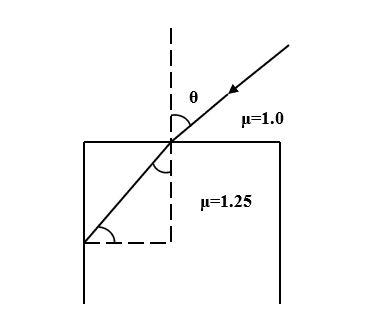
Consider the ray diagram for the refraction given. The maximum value of angle $\theta$ for which the light suffers total internal reflection at the vertical surface, is?
A. ${\cos}^{-1} \dfrac {3}{4}$
B. ${\sin}^{-1} \dfrac {3}{4}$
C. ${\tan}^{-1} \dfrac {4}{3}$
D. ${\cos}^{-1} \dfrac {4}{3}$
Answer
 Verified
577.5k+ views
Hint: To solve this problem, first find the critical angle at the vertical surface. Then, find the maximum angle that the refracted ray at the horizontal surface makes with the vertical surface. This can be calculated by subtracting the critical angle from 90°. Then, use the formula for Snell’s law. Substitute the values and calculate the value of $\theta$. This will be the maximum value of angle $\theta$ for which the light suffers total internal reflection at the vertical surface.
Formula used:
$\sin{{\theta}_{c}}= \dfrac {{\mu}_{1}}{{\mu}_{2}}$
${\mu}_{2}= \dfrac {\sin {{\theta}_{max}}}{\sin {{\theta}_{r}}}$
Complete answer:
Given: ${\mu}_{1}$= 1.0
${\mu}_{2}$= 1.25
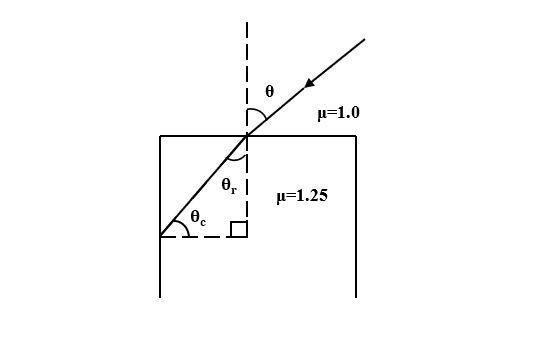
For total internal reflection to occur at the vertical surface, the formula for critical angle is given by,
$\sin{{\theta}_{c}}= \dfrac {{\mu}_{1}}{{\mu}_{2}}$
Substituting the values in above equation we get,
$\sin {{\theta}_{c}}= \dfrac {1.0}{1.25}$
$\Rightarrow {\theta}_{c} = {\sin}^{-1} \dfrac {1}{1.25}$
$\Rightarrow {\theta}_{c} =53.13°$
The maximum angle that the refracted ray at the horizontal surface makes with the vertical surface is given by,
${\theta}_{r}= 90°- {\theta}_{c}$
Substituting the value of $\theta$ in above equation we get,
${\theta}_{r}= 90°- 53.13°$
$\Rightarrow{\theta}_{r}=36.87°$
From Snell’s law we know,
${\mu}_{2}= \dfrac {\sin {{\theta}_{max}}}{\sin {{\theta}_{r}}}$
Substituting values in above equation we get,
$1.25= \dfrac {\sin {{\theta}_{max}}}{\sin {36.87°}}$
$\Rightarrow 1.25= \dfrac {\sin {{\theta}_{max}}}{0.60}$
$\Rightarrow \sin {{\theta}_{max}}= 1.25 \times 0.60$
$\Rightarrow \sin {{\theta}_{max}}= 0.75$
$\Rightarrow \sin {{\theta}_{max}}= \dfrac {3}{4}$
$\Rightarrow {\theta}_{max} = {\sin}^{-1} \dfrac {3}{4}$
Hence, the maximum value of angle $\theta$ for which the light suffers total internal reflection at the vertical surface, is ${\sin}^{-1} \dfrac {3}{4}$.
So, the correct answer is option B i.e. ${\sin}^{-1} \dfrac {3}{4}$.
Note:
Students must remember that there are few requirements for total internal reflection which are mentioned below:
1. The incident light should be travelling in a more optically denser medium and approaching a medium which is less dense. Water is optically denser as compared to air which is a rarer medium.
2. The angle of incidence should always be greater than the critical angle.
Formula used:
$\sin{{\theta}_{c}}= \dfrac {{\mu}_{1}}{{\mu}_{2}}$
${\mu}_{2}= \dfrac {\sin {{\theta}_{max}}}{\sin {{\theta}_{r}}}$
Complete answer:
Given: ${\mu}_{1}$= 1.0
${\mu}_{2}$= 1.25
For total internal reflection to occur at the vertical surface, the formula for critical angle is given by,
$\sin{{\theta}_{c}}= \dfrac {{\mu}_{1}}{{\mu}_{2}}$
Substituting the values in above equation we get,
$\sin {{\theta}_{c}}= \dfrac {1.0}{1.25}$
$\Rightarrow {\theta}_{c} = {\sin}^{-1} \dfrac {1}{1.25}$
$\Rightarrow {\theta}_{c} =53.13°$
The maximum angle that the refracted ray at the horizontal surface makes with the vertical surface is given by,
${\theta}_{r}= 90°- {\theta}_{c}$
Substituting the value of $\theta$ in above equation we get,
${\theta}_{r}= 90°- 53.13°$
$\Rightarrow{\theta}_{r}=36.87°$
From Snell’s law we know,
${\mu}_{2}= \dfrac {\sin {{\theta}_{max}}}{\sin {{\theta}_{r}}}$
Substituting values in above equation we get,
$1.25= \dfrac {\sin {{\theta}_{max}}}{\sin {36.87°}}$
$\Rightarrow 1.25= \dfrac {\sin {{\theta}_{max}}}{0.60}$
$\Rightarrow \sin {{\theta}_{max}}= 1.25 \times 0.60$
$\Rightarrow \sin {{\theta}_{max}}= 0.75$
$\Rightarrow \sin {{\theta}_{max}}= \dfrac {3}{4}$
$\Rightarrow {\theta}_{max} = {\sin}^{-1} \dfrac {3}{4}$
Hence, the maximum value of angle $\theta$ for which the light suffers total internal reflection at the vertical surface, is ${\sin}^{-1} \dfrac {3}{4}$.
So, the correct answer is option B i.e. ${\sin}^{-1} \dfrac {3}{4}$.
Note:
Students must remember that there are few requirements for total internal reflection which are mentioned below:
1. The incident light should be travelling in a more optically denser medium and approaching a medium which is less dense. Water is optically denser as compared to air which is a rarer medium.
2. The angle of incidence should always be greater than the critical angle.
Recently Updated Pages
Master Class 12 Economics: Engaging Questions & Answers for Success

Master Class 12 Physics: Engaging Questions & Answers for Success
Master Class 12 English: Engaging Questions & Answers for Success
Master Class 12 Social Science: Engaging Questions & Answers for Success
Master Class 12 Maths: Engaging Questions & Answers for Success
Master Class 12 Business Studies: Engaging Questions & Answers for Success
Trending doubts
Which are the Top 10 Largest Countries of the World?
What are the major means of transport Explain each class 12 social science CBSE
Draw a labelled sketch of the human eye class 12 physics CBSE
Why cannot DNA pass through cell membranes class 12 biology CBSE
Differentiate between insitu conservation and exsitu class 12 biology CBSE
Draw a neat and well labeled diagram of TS of ovary class 12 biology CBSE