




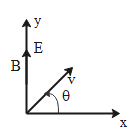
Consider the motion of a positive point charge in a region where there are simultaneous uniform electric and magnetic field $\overrightarrow E = {E_0}\widehat j$ and $\overrightarrow B = {B_0}\widehat j$. At time t = 0, this charge has velocity $\overrightarrow {\text{v}} $ in the x-y plane, making an angle $\theta $ with the x-axis. Which of the following option(s) is (are) correct for time $t > 0$?
This question has multiple correct options
A. If $\theta = 0^\circ $, the charge moves in a circular path in the x-z plane
B. If $\theta = 0^\circ $, the charge undergoes helical motion with constant pitch along the y-axis
C. If $\theta = 10^\circ $, the charge undergoes helical motion with pitch increasing with time, along the y-axis
D. If $\theta = 90^\circ $, the charge undergoes linear but accelerated motion along the y-axis.
Answer
 Verified
655.2k+ views
Hint: When a charged particle is placed in an electric field, it follows a parabolic trajectory. When a charged particle is placed in a magnetic field, it depends on the angle of projection that the particle will follow a circular or helical or straight trajectory.
Complete answer:
The motion of a charge particle in the presence of an external magnetic field as well as an electric field can be described by using the Lorentz force law. The Lorentz law gives information about the force exerted on a charge particle when it is placed in a region containing both electric and magnetic fields. The expression for Lorentz force is given as:
$\overrightarrow F = q\left( {\overrightarrow E + \overrightarrow {\text{v}} \times \overrightarrow B } \right)$
where F is the Lorentz force acting on the charged particle of charge q. E is the electric field vector , B is the magnetic field vector and v is the velocity of the charged particle.
When a particle moves in a region containing only an electric field, it moves in a parabolic trajectory.
When a particle moves in a region containing only magnetic field, depending on the angle of projection of the particle following cases are possible:
1.If direction of magnetic field is perpendicular to the direction of motion of particle then particle moves in a circular orbit.
2.If they are in same direction, no change occurs and linear trajectory is followed
3.At any other angle, the motion is helical in nature.
We are given a positive point charge which is moving in a region containing both electric and magnetic field in the y-direction given as
$\overrightarrow E = {E_0}\widehat j$
$\overrightarrow B = {B_0}\widehat j$
At time t = 0, this charge has velocity $\overrightarrow {\text{v}} $ in the x-y plane and makes an angle $\theta $ with the x-axis.
1.If $\theta = 0^\circ $, the charge is projected along the x-axis and is at right angles to the magnetic field. The charge will move in a circular orbit in the x-z plane. Therefore, option A is correct.
2.If $\theta = 10^\circ $, then the charge will move in a helical orbit due to the magnetic field acting on it and its pitch will increase due to the electric field which tries to move the charge in parabolic motion. Therefore, option C is also correct.
3.If $\theta = 90^\circ $, the direction of velocity of charge and that of fields is the same. Magnetic force acting on it is zero so the motion is linear but there is acceleration due to the electric field. So, option D is also correct.
Note:
1. The charge will undergo helical motion at every angle between 0 and 90$^\circ $
2. The $\overrightarrow {\text{v}} \times \overrightarrow B $ component of the Lorentz force provides the necessary centripetal force for the charge particle in order to move in circular or helical orbit.
Complete answer:
The motion of a charge particle in the presence of an external magnetic field as well as an electric field can be described by using the Lorentz force law. The Lorentz law gives information about the force exerted on a charge particle when it is placed in a region containing both electric and magnetic fields. The expression for Lorentz force is given as:
$\overrightarrow F = q\left( {\overrightarrow E + \overrightarrow {\text{v}} \times \overrightarrow B } \right)$
where F is the Lorentz force acting on the charged particle of charge q. E is the electric field vector , B is the magnetic field vector and v is the velocity of the charged particle.
When a particle moves in a region containing only an electric field, it moves in a parabolic trajectory.
When a particle moves in a region containing only magnetic field, depending on the angle of projection of the particle following cases are possible:
1.If direction of magnetic field is perpendicular to the direction of motion of particle then particle moves in a circular orbit.
2.If they are in same direction, no change occurs and linear trajectory is followed
3.At any other angle, the motion is helical in nature.
We are given a positive point charge which is moving in a region containing both electric and magnetic field in the y-direction given as
$\overrightarrow E = {E_0}\widehat j$
$\overrightarrow B = {B_0}\widehat j$
At time t = 0, this charge has velocity $\overrightarrow {\text{v}} $ in the x-y plane and makes an angle $\theta $ with the x-axis.
1.If $\theta = 0^\circ $, the charge is projected along the x-axis and is at right angles to the magnetic field. The charge will move in a circular orbit in the x-z plane. Therefore, option A is correct.
2.If $\theta = 10^\circ $, then the charge will move in a helical orbit due to the magnetic field acting on it and its pitch will increase due to the electric field which tries to move the charge in parabolic motion. Therefore, option C is also correct.
3.If $\theta = 90^\circ $, the direction of velocity of charge and that of fields is the same. Magnetic force acting on it is zero so the motion is linear but there is acceleration due to the electric field. So, option D is also correct.
Note:
1. The charge will undergo helical motion at every angle between 0 and 90$^\circ $
2. The $\overrightarrow {\text{v}} \times \overrightarrow B $ component of the Lorentz force provides the necessary centripetal force for the charge particle in order to move in circular or helical orbit.
Recently Updated Pages
Master Class 12 Economics: Engaging Questions & Answers for Success

Master Class 12 Social Science: Engaging Questions & Answers for Success
Master Class 12 English: Engaging Questions & Answers for Success
Master Class 12 Maths: Engaging Questions & Answers for Success
Master Class 12 Physics: Engaging Questions & Answers for Success
Master Class 12 Biology: Engaging Questions & Answers for Success
Trending doubts
Which is the correct genotypic ratio of mendel dihybrid class 12 biology CBSE
Differentiate between homogeneous and heterogeneous class 12 chemistry CBSE
Draw a ray diagram of compound microscope when the class 12 physics CBSE
Derive an expression for the electric field intensity class 12 physics CBSE
Ethylidene chloride and ethylene dichloride are A Chain class 12 chemistry CBSE
Calculate the equivalent resistance between a and b class 12 physics CBSE