




Consider the following trigonometric equation $ \cos 3x+\sin \left( 2x-\dfrac{7\pi }{6} \right)=-2 $ , then find the possible values of x.
(a) $ \dfrac{\pi }{3}\left( 6k+1 \right) $
(b) $ \dfrac{\pi }{3}\left( 6k-1 \right) $
(c) $ \dfrac{\pi }{3}\left( 2k+1 \right) $
(d) None of these
Answer
 Verified
661.5k+ views
Hint: Start by converting the sine term in the equation given in the question to convert it to cosine using the identity $ \sin x=\cos \left( \dfrac{\pi }{2}-x \right) $ . According to the resultant equation, the sum of two cosine terms is equal to -2 and we know that the minimum value of cosine function is -1, so the value of both terms is -1. So, equate the two terms to -1 separately and using the formula of general solution of cosine function find the possible values of x and take the intersection of the values of x for each term to get the answer.
Complete step-by-step answer:
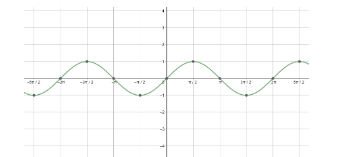
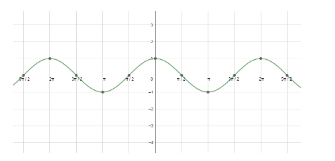
Before moving to the solution, let us discuss the sine and cosine function, which we would be using in the solution. All the trigonometric ratios, including sine and cosine, are periodic functions. We can better understand this using the graph of sine and cosine.
First, let us start with the graph of sinx.
Next, let us see the graph of cosx.
Similarly, we can draw the graphs of the other trigonometric ratios as well, and the graphs of the trigonometric ratios are very useful as well.
Now let us start the solution to the above question. The equation given to us is:
$ \cos 3x+\sin \left( 2x-\dfrac{7\pi }{6} \right)=-2 $
We know that $ \sin x=\cos \left( \dfrac{\pi }{2}-x \right) $ , so if we use this in the above equation, we get
$ \cos 3x+\cos \left( \dfrac{\pi }{2}-\left( 2x-\dfrac{7\pi }{6} \right) \right)=-2 $
$ \Rightarrow \cos 3x+\cos \left( \dfrac{10\pi }{6}-2x \right)=-2 $
$ \Rightarrow \cos 3x+\cos \left( 2\pi -\left( \dfrac{\pi }{3}+2x \right) \right)=-2 $
We also know that $ \cos \left( 2\pi -x \right)=\cos x $ . If we use this in our expression, we get
$ \Rightarrow \cos 3x+\cos \left( \dfrac{\pi }{3}+2x \right)=-2 $
According to the resultant equation, the sum of two cosine terms is equal to -2 and we know that the minimum value of cosine function is -1, so the value of both terms is -1. So, let us solve each term separately and take the intersection values of x for both the terms.
Let us start with the first term.
$ \cos 3x=-1 $
We know that $ \cos \pi =-1 $ . So, our equation becomes:
$ \cos 3x=\cos \pi $
We know that the general solution of cosx=cosy is $ x=2n\pi \pm y $ . So, we get
$ 3x=2n\pi \pm \pi $
$ \Rightarrow x=\dfrac{2n\pi }{3}\pm \dfrac{\pi }{3}=\dfrac{\pi }{3}\left( 2n\pm 1 \right) $
As n can be any integer, so, (2n-1) and (2n+1) will represent the same numbers, i.e., the numbers which leave remainder 1 when divided by 2.
$ x=\dfrac{\pi }{3}\left( 2n+1 \right)..............(i) $
Now, let us move to the next term $ \cos \left( \dfrac{\pi }{3}+2x \right) $ .
$ \cos \left( \dfrac{\pi }{3}+2x \right)=-1 $
$ \Rightarrow \cos \left( \dfrac{\pi }{3}+2x \right)=\cos \pi $
We again know that the general solution of cosx=cosy is $ x=2n\pi \pm y $ . So, we get
$ 2x+\dfrac{\pi }{3}=2n\pi \pm \pi $
$ \Rightarrow 2x=2n\pi \pm \pi -\dfrac{\pi }{3} $
$ \Rightarrow x=n\pi \pm \dfrac{\pi }{2}-\dfrac{\pi }{6} $
So, the possible values for this case is:
$ x=\left( n\pi +\dfrac{\pi }{2}-\dfrac{\pi }{6} \right)\cup \left( n\pi -\dfrac{\pi }{2}-\dfrac{\pi }{6} \right) $
\[\Rightarrow x=\left( n\pi +\dfrac{\pi }{3} \right)\cup \left( n\pi -\dfrac{2\pi }{3} \right)=\dfrac{\pi }{3}\left( 3n+1 \right)\cup \dfrac{\pi }{3}\left( 3n-2 \right)\]
As we saw for the first term, here also (3n+1) and (3n-2) are representing the same set of numbers. Those numbers which leave a remainder 1 when divided by 3.
\[x=\dfrac{\pi }{3}(3n+1)..........(ii)\]
The answer to the above question is the intersection of the values of x from (i) and (ii). The values from (i) are those multiples of $ \dfrac{\pi }{3} $ which leaves a remainder 1 when divided by 2, while the solutions from equation (ii) are those multiples of $ \dfrac{\pi }{3} $ which leaves 1 as the remainder when divided by 3. So, the intersection of the two are those multiples of $ \dfrac{\pi }{3} $ which will leave remainder 1 when divided by 6, i.e., the LCM of 2 and 3. So, the values of x are:
$ x=\dfrac{\pi }{3}\left( 6k+1 \right) $ , where k is an integer.
So, the correct answer is “Option A”.
Note: The key to the above question is figuring out the fact that both the terms of the equation must be equal to -1. The other thing is that you must have the knowledge of the number system, for example: (2n-1) and (2n+1) represent the same thing if n can be any integer, else it might be a difficult task to convert the results to the form which are present in the options.
Complete step-by-step answer:
Before moving to the solution, let us discuss the sine and cosine function, which we would be using in the solution. All the trigonometric ratios, including sine and cosine, are periodic functions. We can better understand this using the graph of sine and cosine.
First, let us start with the graph of sinx.
Next, let us see the graph of cosx.
Similarly, we can draw the graphs of the other trigonometric ratios as well, and the graphs of the trigonometric ratios are very useful as well.
Now let us start the solution to the above question. The equation given to us is:
$ \cos 3x+\sin \left( 2x-\dfrac{7\pi }{6} \right)=-2 $
We know that $ \sin x=\cos \left( \dfrac{\pi }{2}-x \right) $ , so if we use this in the above equation, we get
$ \cos 3x+\cos \left( \dfrac{\pi }{2}-\left( 2x-\dfrac{7\pi }{6} \right) \right)=-2 $
$ \Rightarrow \cos 3x+\cos \left( \dfrac{10\pi }{6}-2x \right)=-2 $
$ \Rightarrow \cos 3x+\cos \left( 2\pi -\left( \dfrac{\pi }{3}+2x \right) \right)=-2 $
We also know that $ \cos \left( 2\pi -x \right)=\cos x $ . If we use this in our expression, we get
$ \Rightarrow \cos 3x+\cos \left( \dfrac{\pi }{3}+2x \right)=-2 $
According to the resultant equation, the sum of two cosine terms is equal to -2 and we know that the minimum value of cosine function is -1, so the value of both terms is -1. So, let us solve each term separately and take the intersection values of x for both the terms.
Let us start with the first term.
$ \cos 3x=-1 $
We know that $ \cos \pi =-1 $ . So, our equation becomes:
$ \cos 3x=\cos \pi $
We know that the general solution of cosx=cosy is $ x=2n\pi \pm y $ . So, we get
$ 3x=2n\pi \pm \pi $
$ \Rightarrow x=\dfrac{2n\pi }{3}\pm \dfrac{\pi }{3}=\dfrac{\pi }{3}\left( 2n\pm 1 \right) $
As n can be any integer, so, (2n-1) and (2n+1) will represent the same numbers, i.e., the numbers which leave remainder 1 when divided by 2.
$ x=\dfrac{\pi }{3}\left( 2n+1 \right)..............(i) $
Now, let us move to the next term $ \cos \left( \dfrac{\pi }{3}+2x \right) $ .
$ \cos \left( \dfrac{\pi }{3}+2x \right)=-1 $
$ \Rightarrow \cos \left( \dfrac{\pi }{3}+2x \right)=\cos \pi $
We again know that the general solution of cosx=cosy is $ x=2n\pi \pm y $ . So, we get
$ 2x+\dfrac{\pi }{3}=2n\pi \pm \pi $
$ \Rightarrow 2x=2n\pi \pm \pi -\dfrac{\pi }{3} $
$ \Rightarrow x=n\pi \pm \dfrac{\pi }{2}-\dfrac{\pi }{6} $
So, the possible values for this case is:
$ x=\left( n\pi +\dfrac{\pi }{2}-\dfrac{\pi }{6} \right)\cup \left( n\pi -\dfrac{\pi }{2}-\dfrac{\pi }{6} \right) $
\[\Rightarrow x=\left( n\pi +\dfrac{\pi }{3} \right)\cup \left( n\pi -\dfrac{2\pi }{3} \right)=\dfrac{\pi }{3}\left( 3n+1 \right)\cup \dfrac{\pi }{3}\left( 3n-2 \right)\]
As we saw for the first term, here also (3n+1) and (3n-2) are representing the same set of numbers. Those numbers which leave a remainder 1 when divided by 3.
\[x=\dfrac{\pi }{3}(3n+1)..........(ii)\]
The answer to the above question is the intersection of the values of x from (i) and (ii). The values from (i) are those multiples of $ \dfrac{\pi }{3} $ which leaves a remainder 1 when divided by 2, while the solutions from equation (ii) are those multiples of $ \dfrac{\pi }{3} $ which leaves 1 as the remainder when divided by 3. So, the intersection of the two are those multiples of $ \dfrac{\pi }{3} $ which will leave remainder 1 when divided by 6, i.e., the LCM of 2 and 3. So, the values of x are:
$ x=\dfrac{\pi }{3}\left( 6k+1 \right) $ , where k is an integer.
So, the correct answer is “Option A”.
Note: The key to the above question is figuring out the fact that both the terms of the equation must be equal to -1. The other thing is that you must have the knowledge of the number system, for example: (2n-1) and (2n+1) represent the same thing if n can be any integer, else it might be a difficult task to convert the results to the form which are present in the options.
Recently Updated Pages
Which of the following graphs shows the variation of class 12 physics CBSE

Draw a labelled diagram of the human male reproductive class 12 biology CBSE
Describe the experiment to compare the emf of two cells class 12 physics CBSE
What is standard hydrogen electrode
What is conventional current and electric current class 12 physics CBSE
2Bromopentane is treated with an alcoholic KOH solution class 12 chemistry CBSE
Trending doubts
A member of Simon commission later became Prime Minister class 12 social science CBSE
Suicide bags of cells are aEndoplasmic reticulum bLysosome class 12 biology CBSE
Differentiate between lanthanoids and actinoids class 12 chemistry CBSE
Sketch and label the Malpighian body class 12 biology CBSE
State the principle of an ac generator and explain class 12 physics CBSE
Why is the cell called the structural and functional class 12 biology CBSE