




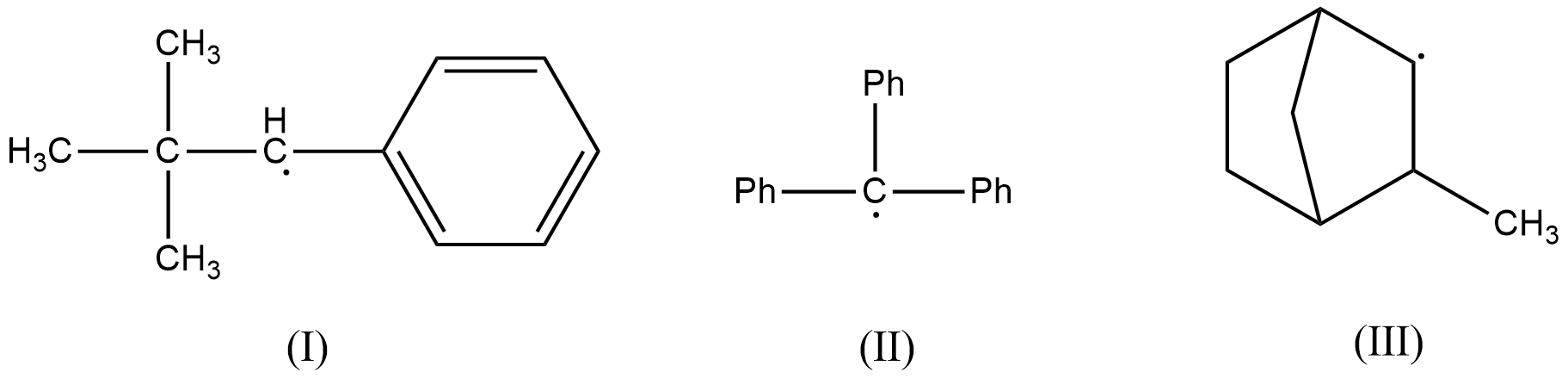
Consider the following compounds. Hyperconjugation occurs in:
(A) (III) only
(B) I and III
(C) I only
(D) II only
Answer
 Verified
577.1k+ views
Hint: Think about the concept of hyperconjugation with regards to free radical intermediates. There are three kinds of free radicals given in the question. Find out the type of electronic interaction taking place in each intermediate which is enhancing their stability. Then select the intermediate which is stabilized only by hyperconjugation effect.
Complete answer:
- Hyperconjugation is a stabilizing interaction in which there is interaction of the $\sigma $-electrons of a C-H bond with an adjacent empty non-bonding p-orbital or $\pi $-orbitals to form an extended molecular orbital that increases the stability of the system.
- Hyperconjugation effect is only seen in carbocation and free radical intermediates.
- Now, let’s see an example.
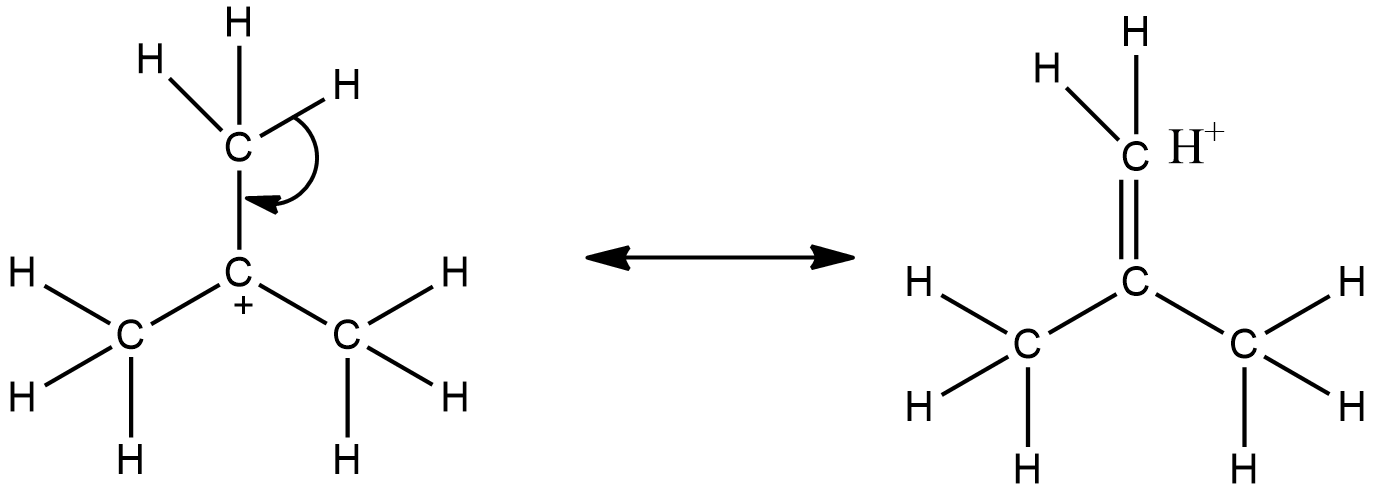
- This shows how a tertiary carbocation is stabilized by hyperconjugation. Here, there are nine possible hyperconjugation structures and so the carbocation is very stable. Similarly, a free radical is also stabilized by hyperconjugation.
- Their main criteria for any ion to get stabilized by hyperconjugation is the presence of an adjacent alkyl group having at least one free hydrogen atom ($\beta $-hydrogen atom) bonded to it.
- Now let’s identify whether the radicals given in the question have a $\beta $-hydrogen atom in them.
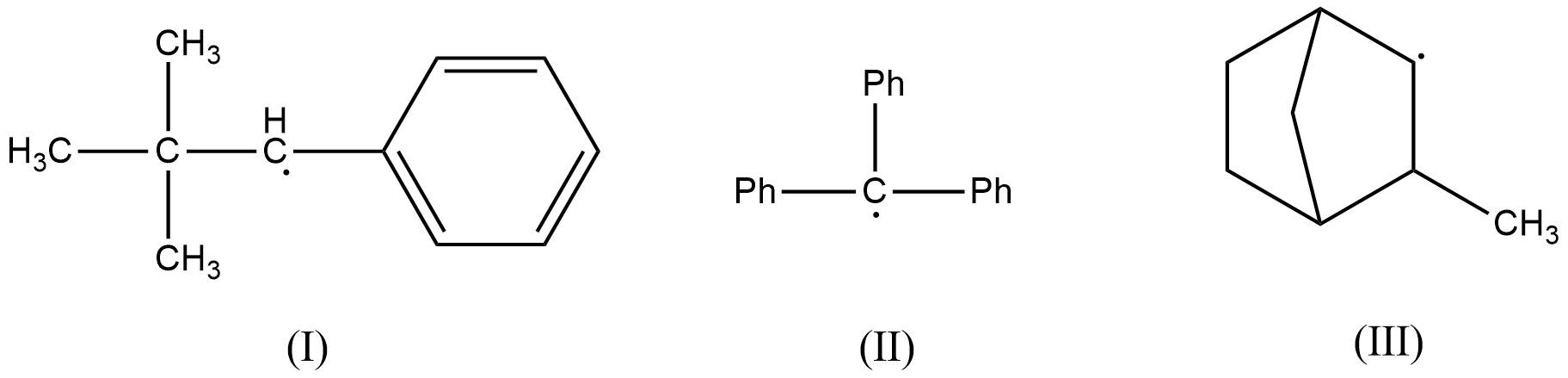
- In the first radical, there is no $\beta $-hydrogen atom present as the carbon radical is bonded to a phenyl ring and a tert-butyl group. Therefore, (I) doesn’t get stabilized by hyperconjugation. This radical is resonance stabilized.
- In the second radical also, there is no $\beta $-hydrogen atom present as the carbon radical is bonded to three phenyl rings. This radical is also resonance stabilized.
- In the third radical, there is a presence of two $\beta $-hydrogen atoms and therefore, this radical is stabilized by hyperconjugation effect.
- Therefore, hyperconjugation occurs in (III) only.
Therefore, the answer is option (A).
Note:
Remember, hyperconjugation effect is a stabilizing interaction which is only possible because of $\beta $-hydrogen atoms present in the structure. Hyperconjugation effects can stabilize carbocation and free radical intermediates only. If phenyl groups are bonded to positively charged carbon then it is resonance stabilized.
Complete answer:
- Hyperconjugation is a stabilizing interaction in which there is interaction of the $\sigma $-electrons of a C-H bond with an adjacent empty non-bonding p-orbital or $\pi $-orbitals to form an extended molecular orbital that increases the stability of the system.
- Hyperconjugation effect is only seen in carbocation and free radical intermediates.
- Now, let’s see an example.
- This shows how a tertiary carbocation is stabilized by hyperconjugation. Here, there are nine possible hyperconjugation structures and so the carbocation is very stable. Similarly, a free radical is also stabilized by hyperconjugation.
- Their main criteria for any ion to get stabilized by hyperconjugation is the presence of an adjacent alkyl group having at least one free hydrogen atom ($\beta $-hydrogen atom) bonded to it.
- Now let’s identify whether the radicals given in the question have a $\beta $-hydrogen atom in them.
- In the first radical, there is no $\beta $-hydrogen atom present as the carbon radical is bonded to a phenyl ring and a tert-butyl group. Therefore, (I) doesn’t get stabilized by hyperconjugation. This radical is resonance stabilized.
- In the second radical also, there is no $\beta $-hydrogen atom present as the carbon radical is bonded to three phenyl rings. This radical is also resonance stabilized.
- In the third radical, there is a presence of two $\beta $-hydrogen atoms and therefore, this radical is stabilized by hyperconjugation effect.
- Therefore, hyperconjugation occurs in (III) only.
Therefore, the answer is option (A).
Note:
Remember, hyperconjugation effect is a stabilizing interaction which is only possible because of $\beta $-hydrogen atoms present in the structure. Hyperconjugation effects can stabilize carbocation and free radical intermediates only. If phenyl groups are bonded to positively charged carbon then it is resonance stabilized.
Recently Updated Pages
Basicity of sulphurous acid and sulphuric acid are

Master Class 12 Economics: Engaging Questions & Answers for Success
Master Class 12 Biology: Engaging Questions & Answers for Success
Master Class 11 English: Engaging Questions & Answers for Success
Master Class 11 Physics: Engaging Questions & Answers for Success
Master Class 11 Computer Science: Engaging Questions & Answers for Success
Trending doubts
Draw a labelled sketch of the human eye class 12 physics CBSE
The chemical formula of tear gas is A CO Cl 2 B C 10 class 12 chemistry CBSE
Draw ray diagrams each showing i myopic eye and ii class 12 physics CBSE
Which are the Top 10 Largest Countries of the World?
Differentiate between homogeneous and heterogeneous class 12 chemistry CBSE
Which is the correct genotypic ratio of mendel dihybrid class 12 biology CBSE