




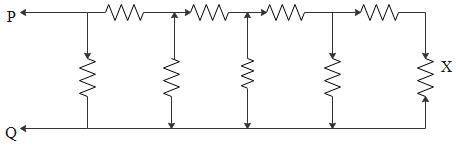
Consider the circuit below where all resistors are of $1k\Omega $. If a current of magnitude 1mA flows through the resistor marked X. What is the potential difference measured between points P and Q:-
(1) 21V
(2) 68V
(3) 55V
(4) 34V
Answer
 Verified
493.2k+ views
Hint: To calculate the potential difference between two points P and Q first we have to draw the equivalent circuit of the given circuit. Given that all the resistance are equal and are equal to R. Then calculate the current across each resistor and then by substituting the given value of current and resistor we will get the potential difference between P and Q.
Complete step-by-step solution:
Given that,
\[R=1k\Omega \]
$i=1mA=1\times {{10}^{-3}}A$
The given circuit is,
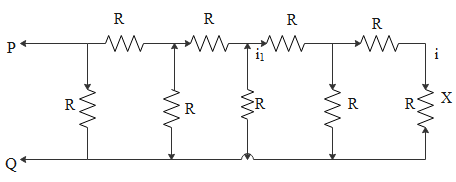
To calculate ‘i’ we should first consider the three resistors at the right hand side and thus the equivalent resistance will be 3R. Then analyse the current across the other branch.
Then the value of i can be calculated as,
$i=\dfrac{{{i}_{1}}\times R}{3R}=\dfrac{{{i}_{1}}}{3}$
$\therefore {{i}_{1}}=3i$
When the three resistors in the right side of the circuit is replaced by the equivalent circuit the circuit becomes,
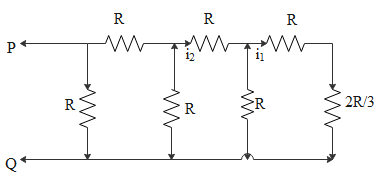
That is, in the above circuit the two resistors at the right side is in series and the third one is parallel to these two resistors. Thus here the three resistors are replaced by an equivalent resistor of $\dfrac{2R}{3}$.
Then calculate the current ${{i}_{1}}$. That is,
${{i}_{1}}={{i}_{2}}\times \dfrac{3}{8}$
${{i}_{2}}=\dfrac{8}{3}{{i}_{1}}$
$\begin{align}
& \Rightarrow {{i}_{2}}=\dfrac{8}{3}\times 3i \\
& \therefore {{i}_{2}}=8i \\
\end{align}$
Similarly again replace the resistors at the end by an equivalent resistor. Thus the circuit becomes,
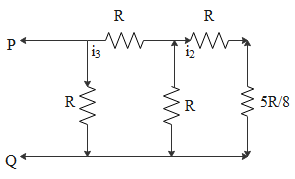
${{i}_{2}}={{i}_{3}}\times \dfrac{8}{21}$
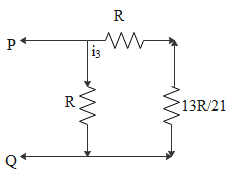
${{i}_{3}}=\dfrac{21}{8}{{i}_{2}}=\dfrac{21}{8}\times 8i=21i$
Then the potential difference,
${{V}_{P}}-{{V}_{Q}}={{i}_{3}}\times \left[ R+\dfrac{13R}{21} \right]$
$={{i}_{3}}\times \dfrac{34R}{21}$
Substituting the value of ${{i}_{3}}$equation becomes,
${{V}_{P}}-{{V}_{Q}}=21i\times \left[ \dfrac{34R}{21} \right]$
$=34iR$
Given the value of i and R. That is,
$i=1mA=1\times {{10}^{-3}}A$
\[R=1k\Omega \]
Thus,
$\begin{align}
& {{V}_{P}}-{{V}_{Q}}=34\times 1\times {{10}^{-3}}\times 1\times {{10}^{3}} \\
& \\
\end{align}$
$=34volt$
Therefore option (D) is correct.
Note:The potential difference between any two points can be otherwise called the voltage. And if the distance between these two points is infinite, then the resultant potential difference or voltage is equal to zero. The SI unit of potential difference is volts.
Complete step-by-step solution:
Given that,
\[R=1k\Omega \]
$i=1mA=1\times {{10}^{-3}}A$
The given circuit is,
To calculate ‘i’ we should first consider the three resistors at the right hand side and thus the equivalent resistance will be 3R. Then analyse the current across the other branch.
Then the value of i can be calculated as,
$i=\dfrac{{{i}_{1}}\times R}{3R}=\dfrac{{{i}_{1}}}{3}$
$\therefore {{i}_{1}}=3i$
When the three resistors in the right side of the circuit is replaced by the equivalent circuit the circuit becomes,
That is, in the above circuit the two resistors at the right side is in series and the third one is parallel to these two resistors. Thus here the three resistors are replaced by an equivalent resistor of $\dfrac{2R}{3}$.
Then calculate the current ${{i}_{1}}$. That is,
${{i}_{1}}={{i}_{2}}\times \dfrac{3}{8}$
${{i}_{2}}=\dfrac{8}{3}{{i}_{1}}$
$\begin{align}
& \Rightarrow {{i}_{2}}=\dfrac{8}{3}\times 3i \\
& \therefore {{i}_{2}}=8i \\
\end{align}$
Similarly again replace the resistors at the end by an equivalent resistor. Thus the circuit becomes,
${{i}_{2}}={{i}_{3}}\times \dfrac{8}{21}$
${{i}_{3}}=\dfrac{21}{8}{{i}_{2}}=\dfrac{21}{8}\times 8i=21i$
Then the potential difference,
${{V}_{P}}-{{V}_{Q}}={{i}_{3}}\times \left[ R+\dfrac{13R}{21} \right]$
$={{i}_{3}}\times \dfrac{34R}{21}$
Substituting the value of ${{i}_{3}}$equation becomes,
${{V}_{P}}-{{V}_{Q}}=21i\times \left[ \dfrac{34R}{21} \right]$
$=34iR$
Given the value of i and R. That is,
$i=1mA=1\times {{10}^{-3}}A$
\[R=1k\Omega \]
Thus,
$\begin{align}
& {{V}_{P}}-{{V}_{Q}}=34\times 1\times {{10}^{-3}}\times 1\times {{10}^{3}} \\
& \\
\end{align}$
$=34volt$
Therefore option (D) is correct.
Note:The potential difference between any two points can be otherwise called the voltage. And if the distance between these two points is infinite, then the resultant potential difference or voltage is equal to zero. The SI unit of potential difference is volts.
Recently Updated Pages
Master Class 12 Economics: Engaging Questions & Answers for Success

Master Class 12 Physics: Engaging Questions & Answers for Success
Master Class 12 English: Engaging Questions & Answers for Success
Master Class 12 Social Science: Engaging Questions & Answers for Success
Master Class 12 Maths: Engaging Questions & Answers for Success
Master Class 12 Business Studies: Engaging Questions & Answers for Success
Trending doubts
Which are the Top 10 Largest Countries of the World?
What are the major means of transport Explain each class 12 social science CBSE
Draw a labelled sketch of the human eye class 12 physics CBSE
Why cannot DNA pass through cell membranes class 12 biology CBSE
Differentiate between insitu conservation and exsitu class 12 biology CBSE
Draw a neat and well labeled diagram of TS of ovary class 12 biology CBSE