




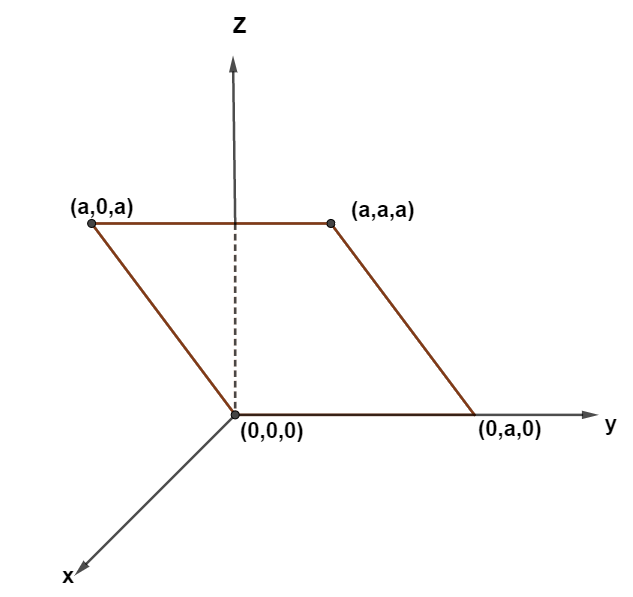
Consider an electric field $ \vec E = {E_ \circ }\hat x,{\text{ where }}{E_ \circ } $ is a constant. The flux through the shaded area ( as shown in the figure) due to this field is:
A. $ 2{{E}_{\circ }}{{a}^{2}} $
B. $ \sqrt{2}{{E}_{\circ }}{{a}^{2}} $
C. $ {{E}_{\circ }}{{a}^{2}} $
D. $ \dfrac{{{E}_{\circ }}{{a}^{2}}}{\sqrt{2}} $
Answer
 Verified
666k+ views
Hint: The electric flux through a given area held inside an electric field is the measure of the total number of electric lines of force passing through that area. Mathematically, it can be defined as the product of the normal component of the electric field and the surface area.
Formula Used:
Electric flux, $ \Delta {{\phi }_{E}}=E\Delta S\cos \theta =\vec{E}.\Delta \vec{S} $
where
$ \begin{align}
& E\text{ is the magnitude of electric field} \\
& \Delta \text{S is the surface area} \\
& \theta \text{ is the angle between the Electric field and the normal component of Surface}\text{.} \\
\end{align} $
Complete step-by-step answer:
The term flux implies some kind of flow. Flux is the property of any vector field. The electric flux is the property of the electric field. The electric flux through a given area held inside an electric field is the measure of the total number of electric lines of force passing through that area.
It is a scalar quantity, i.e., it only has magnitude associated with it and not direction. Its SI unit is $ N{{m}^{2}}{{C}^{-1}} $ .
Given that:
$ \vec{E}={{E}_{\circ }}\hat{x},\text{ where }{{E}_{\circ }} $ is constant.
Each side of the shaded region = a
So, $ \Delta S=\sqrt{2}{{a}^{2}} $
Additionally, it is clear from the diagram that the angle between the area vector and electric field will be $ {{45}^{\circ }} $
$ \Rightarrow \theta ={{45}^{\circ }} $
Substituting the values of the above in the formula for electric flux we get:
Electric flux,
$ \Delta {\phi _E} = \vec E.\Delta \vec S = E\Delta S\cos \theta $
$ \eqalign{
& E\Delta S\cos \theta = {E_ \circ }\left( {\sqrt 2 {a^2}} \right)\cos {45^ \circ } \cr
& \Rightarrow \Delta {\phi _E} = {E_ \circ }\left( {\sqrt 2 {a^2}} \right)\left( {\dfrac{1}{{\sqrt 2 }}} \right) \cr
& \Rightarrow \Delta {\phi _E} = {E_ \circ }{a^2}N{m^2}{C^{ - 1}} \cr} $
Therefore, the correct option is C. i.e., Electric flux through the shaded portion in the diagram is $ \Delta {\phi _E} = {E_ \circ }{a^2}N{m^2}{C^{ - 1}} $ .
Additional Information:
i. Gauss’s theorem states that the total flux through a closed surface is $ \dfrac{1}{{{\varepsilon _0}}} $ times the net charge enclosed by the surface.
ii. Gauss’s law is based on the inverse square dependence on distance contained in Coulomb's law. It will not hold in case of any departure from inverse square law.
Note: The net flux through a closed surface due to a charge lying outside the enclosed surface is always zero. Additionally, if the net charge enclosed by a surface is zero $ \left( {q = 0} \right) $ , then the flux through it is also zero.
Formula Used:
Electric flux, $ \Delta {{\phi }_{E}}=E\Delta S\cos \theta =\vec{E}.\Delta \vec{S} $
where
$ \begin{align}
& E\text{ is the magnitude of electric field} \\
& \Delta \text{S is the surface area} \\
& \theta \text{ is the angle between the Electric field and the normal component of Surface}\text{.} \\
\end{align} $
Complete step-by-step answer:
The term flux implies some kind of flow. Flux is the property of any vector field. The electric flux is the property of the electric field. The electric flux through a given area held inside an electric field is the measure of the total number of electric lines of force passing through that area.
It is a scalar quantity, i.e., it only has magnitude associated with it and not direction. Its SI unit is $ N{{m}^{2}}{{C}^{-1}} $ .
Given that:
$ \vec{E}={{E}_{\circ }}\hat{x},\text{ where }{{E}_{\circ }} $ is constant.
Each side of the shaded region = a
So, $ \Delta S=\sqrt{2}{{a}^{2}} $
Additionally, it is clear from the diagram that the angle between the area vector and electric field will be $ {{45}^{\circ }} $
$ \Rightarrow \theta ={{45}^{\circ }} $
Substituting the values of the above in the formula for electric flux we get:
Electric flux,
$ \Delta {\phi _E} = \vec E.\Delta \vec S = E\Delta S\cos \theta $
$ \eqalign{
& E\Delta S\cos \theta = {E_ \circ }\left( {\sqrt 2 {a^2}} \right)\cos {45^ \circ } \cr
& \Rightarrow \Delta {\phi _E} = {E_ \circ }\left( {\sqrt 2 {a^2}} \right)\left( {\dfrac{1}{{\sqrt 2 }}} \right) \cr
& \Rightarrow \Delta {\phi _E} = {E_ \circ }{a^2}N{m^2}{C^{ - 1}} \cr} $
Therefore, the correct option is C. i.e., Electric flux through the shaded portion in the diagram is $ \Delta {\phi _E} = {E_ \circ }{a^2}N{m^2}{C^{ - 1}} $ .
Additional Information:
i. Gauss’s theorem states that the total flux through a closed surface is $ \dfrac{1}{{{\varepsilon _0}}} $ times the net charge enclosed by the surface.
ii. Gauss’s law is based on the inverse square dependence on distance contained in Coulomb's law. It will not hold in case of any departure from inverse square law.
Note: The net flux through a closed surface due to a charge lying outside the enclosed surface is always zero. Additionally, if the net charge enclosed by a surface is zero $ \left( {q = 0} \right) $ , then the flux through it is also zero.
Recently Updated Pages
Which of the following graphs shows the variation of class 12 physics CBSE

Draw a labelled diagram of the human male reproductive class 12 biology CBSE
Describe the experiment to compare the emf of two cells class 12 physics CBSE
What is standard hydrogen electrode
What is conventional current and electric current class 12 physics CBSE
2Bromopentane is treated with an alcoholic KOH solution class 12 chemistry CBSE
Trending doubts
Draw a labelled sketch of the human eye class 12 physics CBSE
Which are the Top 10 Largest Countries of the World?
Differentiate between homogeneous and heterogeneous class 12 chemistry CBSE
Draw ray diagrams each showing i myopic eye and ii class 12 physics CBSE
Which is the correct genotypic ratio of mendel dihybrid class 12 biology CBSE
What is the Full Form of PVC, PET, HDPE, LDPE, PP and PS ?