




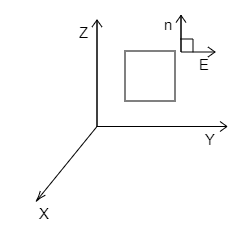
Consider a uniform electric field $E = 3 \times {10^3}\,\hat iN{C^{ - 1}}$.
(a) What is the flux of this field through a square off $10\,cm$ on a side whose plane is parallel to the $yz$ plane?
(b) What is the flux through the same square if the normal to its plane makes an ${60^ \circ }$ angle with the $x$ axis?
Answer
 Verified
578.7k+ views
Hint: Find the area of the square from the given length of one side. Use the formula of the electric flux, and substitute the known values in it to find the electric flux through the square parallel to the $yz$ plane and ${60^ \circ }$ from the $x$ axis by substituting the angles in the formula.
Formula used:
The formula of the electric flux is given by
$\Phi = EA\cos \theta $
Where $\Phi $ is the electric flux, $E$ is the electric field, $A$ is the area and $\theta $ is the angle of the normal with the coordinate axis.
Complete step by step solution:
It is given that the
The uniform electric field, $E = 3 \times {10^3}\,\hat iN{C^{ - 1}}$
Side of the square, $a = 10\,cm$
The angle between the normal to the plane and the horizontal axis, $\theta = {60^ \circ }$
From the given side of the square, let us calculate the area of the square.
$A = 0.1 \times 0.1 = 0.01\,{m^2}$
(a) Let us use the formula of the electric flux,
$\Phi = EA\cos \theta $
Substitute the angle as the ${0^ \circ }$ since the plane is considered parallel to the $yz$ plane that is parallel to the $x$ axis, we get
$\Phi = 3 \times {10^3}\, \times 0.01 \times \cos {0^ \circ }$
By simplifying the above equation, we get
$\Phi = 30\,N{m^2}{C^{ - 1}}$
(b) Substitute the angle of ${60^ \circ }$ in the formula of the electric flux to find the flux through the same square which is at the angle ${60^ \circ }$ with the horizontal $x$ axis.
$\Phi = EA\cos \theta $
$\Phi = 3 \times {10^3}\, \times 0.01 \times \cos {60^ \circ }$
By further simplification, we get
$\Phi = 15\,N{m^2}{C^{ - 1}}$
Hence the electric flux through the square at an angle ${60^ \circ }$ from the $x$ axis is $15\,N{m^2}{C^{ - 1}}$ .
Note: Electric flux measures the electric field in the region of the square. It depends on the electric field, area and the angle of the normal of the plane made with the horizontal. In the above solution, the square parallel to $yz$ plane is taken as ${0^ \circ }$ . This is because this square passes vertically in the horizontal and parallel to the $yz$ axis. Hence the normal to the horizontal is ${0^ \circ }$.
Formula used:
The formula of the electric flux is given by
$\Phi = EA\cos \theta $
Where $\Phi $ is the electric flux, $E$ is the electric field, $A$ is the area and $\theta $ is the angle of the normal with the coordinate axis.
Complete step by step solution:
It is given that the
The uniform electric field, $E = 3 \times {10^3}\,\hat iN{C^{ - 1}}$
Side of the square, $a = 10\,cm$
The angle between the normal to the plane and the horizontal axis, $\theta = {60^ \circ }$
From the given side of the square, let us calculate the area of the square.
$A = 0.1 \times 0.1 = 0.01\,{m^2}$
(a) Let us use the formula of the electric flux,
$\Phi = EA\cos \theta $
Substitute the angle as the ${0^ \circ }$ since the plane is considered parallel to the $yz$ plane that is parallel to the $x$ axis, we get
$\Phi = 3 \times {10^3}\, \times 0.01 \times \cos {0^ \circ }$
By simplifying the above equation, we get
$\Phi = 30\,N{m^2}{C^{ - 1}}$
(b) Substitute the angle of ${60^ \circ }$ in the formula of the electric flux to find the flux through the same square which is at the angle ${60^ \circ }$ with the horizontal $x$ axis.
$\Phi = EA\cos \theta $
$\Phi = 3 \times {10^3}\, \times 0.01 \times \cos {60^ \circ }$
By further simplification, we get
$\Phi = 15\,N{m^2}{C^{ - 1}}$
Hence the electric flux through the square at an angle ${60^ \circ }$ from the $x$ axis is $15\,N{m^2}{C^{ - 1}}$ .
Note: Electric flux measures the electric field in the region of the square. It depends on the electric field, area and the angle of the normal of the plane made with the horizontal. In the above solution, the square parallel to $yz$ plane is taken as ${0^ \circ }$ . This is because this square passes vertically in the horizontal and parallel to the $yz$ axis. Hence the normal to the horizontal is ${0^ \circ }$.
Recently Updated Pages
Master Class 12 Business Studies: Engaging Questions & Answers for Success

Master Class 12 Biology: Engaging Questions & Answers for Success
Master Class 12 Chemistry: Engaging Questions & Answers for Success
Class 12 Question and Answer - Your Ultimate Solutions Guide
Master Class 11 Social Science: Engaging Questions & Answers for Success
Master Class 11 English: Engaging Questions & Answers for Success
Trending doubts
Which is more stable and why class 12 chemistry CBSE
Which are the Top 10 Largest Countries of the World?
Draw a labelled sketch of the human eye class 12 physics CBSE
Differentiate between homogeneous and heterogeneous class 12 chemistry CBSE
What are the major means of transport Explain each class 12 social science CBSE
Sulphuric acid is known as the king of acids State class 12 chemistry CBSE