




Consider a tank made of glass (refractive index $ 1.5 $ ) with a thick bottom. It is filled with a liquid of refractive index $ \mu $ . A student finds that, irrespective of what the incident angle $ i $ (see figure) is for a beam of light entering the liquid, the light reflected from the liquid glass interface is never completely polarized. For this to happen, the minimum value of μ is
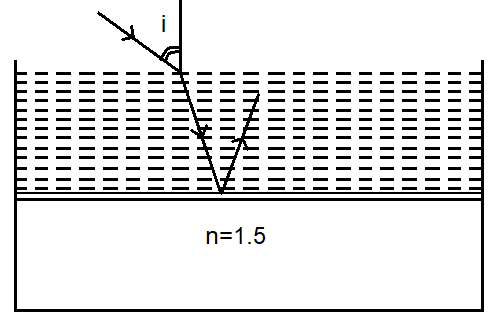
(A) $ \dfrac{3}{{\sqrt 5 }} $
(B) $ \dfrac{5}{{\sqrt 3 }} $
(C) $ \sqrt {\dfrac{5}{3}} $
(D) $ \dfrac{4}{3} $
Answer
 Verified
634.8k+ views
Hint: For finding out the minimum value of the refractive index, we need to use the relation between Brewster angle and the critical angle which is given as $ sin{\text{ }}c < sin{\text{ }}{i_{b\;}} $ . Brewster angle is an angle of incidence at which light with a particular polarization is perfectly transmitted through a transparent dielectric surface, with no reflection.
Formula used:
$ sin{\text{ c}} < sin{\text{ }}{i_{b\;}} $
$ \
sin90 = \mu \sin c \\
\Rightarrow sinc = \dfrac{1}{\mu } \\
$
Where, the critical angle be $ {\text{ c}} $ , the Brewster angle be $ {\text{ }}{i_{b\;}} $ , $ {\text{ }}\mu $ is the refractive index.
Complete step by step solution:
Let us consider the critical angle be c, the Brewster angle be ib.
The relation comes between the critical angle and the Brewster angle is,
$ sin{\text{ }}c < sin{\text{ }}{i_{b\;}} $
For the ray travelling from air to liquid,
$ sin90 = \mu \sin c $
Now the value of $ sin90 $ is 1 so we get
$ sinc = \dfrac{1}{\mu } $
Since, we know that,
$ \tan {i_b} = {\mu _{{0_{rel}}}} $
And,
$ sin{\text{ }}c < sin{\text{ }}{i_{b\;}} $
Then substituting the values in the equation we get,
$ \Rightarrow \dfrac{1}{\mu } < \dfrac{{1.5}}{{\sqrt {{\mu ^2} + {{(1.5)}^2}} }} $
Thus, after simplification, we get,
$ \Rightarrow \mu < \dfrac{3}{{\sqrt 5 }} $
Hence, the correct answer is option A.
Note:
There are numerous applications of Brewster angle in real life. It includes,
-Polarized sunglasses use the principle of Brewster's angle to reduce glare from the sun reflecting off horizontal surfaces such as water or road.
-Photographers use the same principle to remove reflections from water so that they can photograph objects beneath the surface.
-Brewster angle prisms are used in laser physics. The polarized laser light enters the prism at Brewster's angle without any reflective losses.
-In surface science, Brewster angle microscopes are used in imaging layers of particles or molecules at air-liquid interfaces.
Formula used:
$ sin{\text{ c}} < sin{\text{ }}{i_{b\;}} $
$ \
sin90 = \mu \sin c \\
\Rightarrow sinc = \dfrac{1}{\mu } \\
$
Where, the critical angle be $ {\text{ c}} $ , the Brewster angle be $ {\text{ }}{i_{b\;}} $ , $ {\text{ }}\mu $ is the refractive index.
Complete step by step solution:
Let us consider the critical angle be c, the Brewster angle be ib.
The relation comes between the critical angle and the Brewster angle is,
$ sin{\text{ }}c < sin{\text{ }}{i_{b\;}} $
For the ray travelling from air to liquid,
$ sin90 = \mu \sin c $
Now the value of $ sin90 $ is 1 so we get
$ sinc = \dfrac{1}{\mu } $
Since, we know that,
$ \tan {i_b} = {\mu _{{0_{rel}}}} $
And,
$ sin{\text{ }}c < sin{\text{ }}{i_{b\;}} $
Then substituting the values in the equation we get,
$ \Rightarrow \dfrac{1}{\mu } < \dfrac{{1.5}}{{\sqrt {{\mu ^2} + {{(1.5)}^2}} }} $
Thus, after simplification, we get,
$ \Rightarrow \mu < \dfrac{3}{{\sqrt 5 }} $
Hence, the correct answer is option A.
Note:
There are numerous applications of Brewster angle in real life. It includes,
-Polarized sunglasses use the principle of Brewster's angle to reduce glare from the sun reflecting off horizontal surfaces such as water or road.
-Photographers use the same principle to remove reflections from water so that they can photograph objects beneath the surface.
-Brewster angle prisms are used in laser physics. The polarized laser light enters the prism at Brewster's angle without any reflective losses.
-In surface science, Brewster angle microscopes are used in imaging layers of particles or molecules at air-liquid interfaces.
Recently Updated Pages
Which of the following graphs shows the variation of class 12 physics CBSE

Draw a labelled diagram of the human male reproductive class 12 biology CBSE
Describe the experiment to compare the emf of two cells class 12 physics CBSE
What is standard hydrogen electrode
What is conventional current and electric current class 12 physics CBSE
2Bromopentane is treated with an alcoholic KOH solution class 12 chemistry CBSE
Trending doubts
Draw a labelled sketch of the human eye class 12 physics CBSE
Which are the Top 10 Largest Countries of the World?
Differentiate between homogeneous and heterogeneous class 12 chemistry CBSE
Draw ray diagrams each showing i myopic eye and ii class 12 physics CBSE
Which is the correct genotypic ratio of mendel dihybrid class 12 biology CBSE
What is the Full Form of PVC, PET, HDPE, LDPE, PP and PS ?