




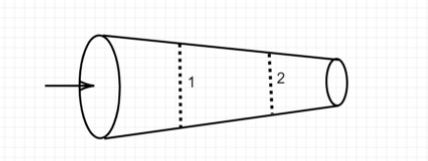
Consider a conductor of variable cross-section in which current is flowing from section 1 to 2. Then, which of these are true?
A. current passing through both the cross sections is the same.
B. current passing through 1 is less than that through 2
C. drift velocity of electrons at 1 is less than that at 2
D. drift velocity is same at both the cross sections
Answer
 Verified
598.2k+ views
Hint:
1. Kirchhoff’s Law of current flow: It states that charges are conserved at any junction. It means that at any time, within any cross-section area the same no. of charge leaves the section while the same amount enters into it.
2. Kirchhoff’s law also tells about continuity or steady current flow through the conductor.
3. Drift velocity of the charge depends upon the cross-section of the conductor.
Formula Used:
Current flow through any conductor with cross-section area $A$, no. of electrons $n$ and drift velocity of electrons be ${v_d}$, is given by $I = neA{v_d}$. …… (a)
Complete step by step answer:
Given at position-1 area be ${A_1}$ and at position-2 area be ${A_2}$
Step 1 of 5:
Here, the given conductor is a single one-way conductor.
Hence by using Kirchhoff’s law at any cross section current flowing into the area is equal to current leaving. $ \Rightarrow n$ and $e$ are same at both positions …… (1)
Step 2 of 5:
Using Kirchhoff’s law for single wire with variable thickness we can say A is true.
Step 3 of 5:
Since, current flow is the same for every cross-section area.
$\therefore {I_1} = {I_2}$ for cross section position 1 and 2 …… (2)
Step 4 of 5:
Using equation (1), (2) and (a) we get
${I_1} = {I_2}$
$ \Rightarrow ne{A_1}{v_{1,d}} = ne{A_2}{v_{2,d}}$
$ \Rightarrow {A_1}{v_{1,d}} = {A_2}{v_{2,d}}$ ……. (3)
Step 5 of 5:
By analyzing equation (3), it says the product is constant.
$ \Rightarrow A \propto \dfrac{1}{{{v_d}}}$ ……. (4)
Therefore, C is also true
Correct Answer:
A. current passing through both the cross sections is the same.
C. drift velocity of electrons at 1 is less than that at 2.
Note: Equation (4) is similar to continuity equation of fluid flow. So, we can solve current flow circuits by analogy with fluid flow dynamics if interactions among charges are negligible.
1. Kirchhoff’s Law of current flow: It states that charges are conserved at any junction. It means that at any time, within any cross-section area the same no. of charge leaves the section while the same amount enters into it.
2. Kirchhoff’s law also tells about continuity or steady current flow through the conductor.
3. Drift velocity of the charge depends upon the cross-section of the conductor.
Formula Used:
Current flow through any conductor with cross-section area $A$, no. of electrons $n$ and drift velocity of electrons be ${v_d}$, is given by $I = neA{v_d}$. …… (a)
Complete step by step answer:
Given at position-1 area be ${A_1}$ and at position-2 area be ${A_2}$
Step 1 of 5:
Here, the given conductor is a single one-way conductor.
Hence by using Kirchhoff’s law at any cross section current flowing into the area is equal to current leaving. $ \Rightarrow n$ and $e$ are same at both positions …… (1)
Step 2 of 5:
Using Kirchhoff’s law for single wire with variable thickness we can say A is true.
Step 3 of 5:
Since, current flow is the same for every cross-section area.
$\therefore {I_1} = {I_2}$ for cross section position 1 and 2 …… (2)
Step 4 of 5:
Using equation (1), (2) and (a) we get
${I_1} = {I_2}$
$ \Rightarrow ne{A_1}{v_{1,d}} = ne{A_2}{v_{2,d}}$
$ \Rightarrow {A_1}{v_{1,d}} = {A_2}{v_{2,d}}$ ……. (3)
Step 5 of 5:
By analyzing equation (3), it says the product is constant.
$ \Rightarrow A \propto \dfrac{1}{{{v_d}}}$ ……. (4)
Therefore, C is also true
Correct Answer:
A. current passing through both the cross sections is the same.
C. drift velocity of electrons at 1 is less than that at 2.
Note: Equation (4) is similar to continuity equation of fluid flow. So, we can solve current flow circuits by analogy with fluid flow dynamics if interactions among charges are negligible.
Recently Updated Pages
Master Class 12 Economics: Engaging Questions & Answers for Success

Master Class 12 Physics: Engaging Questions & Answers for Success
Master Class 12 English: Engaging Questions & Answers for Success
Master Class 12 Social Science: Engaging Questions & Answers for Success
Master Class 12 Maths: Engaging Questions & Answers for Success
Master Class 12 Business Studies: Engaging Questions & Answers for Success
Trending doubts
Which are the Top 10 Largest Countries of the World?
What are the major means of transport Explain each class 12 social science CBSE
Draw a labelled sketch of the human eye class 12 physics CBSE
Why cannot DNA pass through cell membranes class 12 biology CBSE
Differentiate between insitu conservation and exsitu class 12 biology CBSE
Draw a neat and well labeled diagram of TS of ovary class 12 biology CBSE