




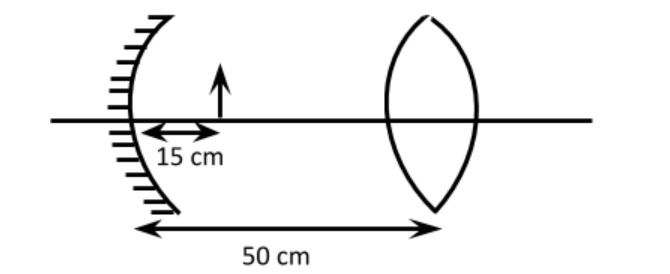
Consider a concave mirror and a convex lens (refractive index $ = 1.5$) of focal length $10{\text{cm}}$ each, separated by a distance of \[50{\text{cm}}\] in air (refractive index \[ = 1\]) as shown in the figure. An object is placed at a distance of \[15{\text{cm}}\] from the mirror. Its erect image formed by this combination has magnification \[{{\text{M}}_{\text{1}}}\]. When the set-up is kept in a medium of refractive index \[\dfrac{7}{6}\], the magnification becomes \[{{\text{M}}_{\text{2}}}\]. The magnitude \[\left| {\dfrac{{{M_2}}}{{{M_1}}}} \right|\] is
Answer
 Verified
634.5k+ views
Hint: The first image from reflection by a spherical concave mirror can be found from mirror formula.
Formula used:
$
\dfrac{1}{v} + \dfrac{1}{u} = \dfrac{1}{f} \\
\dfrac{1}{v} - \dfrac{1}{u} = \dfrac{1}{f} \\
m = \dfrac{v}{u} \\
M = {m_1} \times {m_2} \\
$
Complete step by step solution:
Given data,
For concave mirror
$u = - 15cm,{\text{ f}} = - 10cm$
As we know,
$\dfrac{1}{v} + \dfrac{1}{u} = \dfrac{1}{f}$
$
\therefore \dfrac{1}{v} + \dfrac{1}{{ - 15}} = \dfrac{1}{{ - 10}} \\
\Rightarrow \dfrac{1}{v} = \dfrac{{ - 1}}{{10}} + \dfrac{1}{{15}} = \dfrac{{10 - 15}}{{150}} \\
\Rightarrow v = - 30cm \\
$
Dividing (1) by (2)
$
\dfrac{{{f_{liquid}}}}{{{f_{air}}}} = \dfrac{{\dfrac{1}{2}}}{{\dfrac{3}{2} \times \dfrac{6}{7} - 1}} \\
= \dfrac{7}{4} \\
$
$
{f_{liquid}} = \dfrac{7}{4} \times 10 \\
= \dfrac{{70}}{4}cm \\
$
The first image will act as an object for lens and its position can be found using lens formula,
$\dfrac{1}{v} - \dfrac{1}{u} = \dfrac{1}{f}$
Given:
$
u = - 20cm, {\text{ f}} = \dfrac{{70}}{4}cm \\
\\
$
$\therefore \dfrac{1}{v} - \dfrac{1}{{ - 20}} = \dfrac{1}{{\dfrac{{70}}{4}}}$
$ \Rightarrow \dfrac{1}{v} \times \dfrac{4}{{70}} = \dfrac{{80 - 70}}{{1400}}$
$ \Rightarrow v = 140cm$
Magnification is given by $m' = \dfrac{v}{u} = \dfrac{{140}}{{ - 20}} = - 7$
Total magnification ${m_2} = - 2 \times - 7 = 14$
Hence, $\left| {\dfrac{{{m_2}}}{{{m_1}}}} \right| = \dfrac{{14}}{2} = 7$
Note: Focal length of lens depends on the medium in which the whole experiment is done. Students must be careful while taking sign convention.
Formula used:
$
\dfrac{1}{v} + \dfrac{1}{u} = \dfrac{1}{f} \\
\dfrac{1}{v} - \dfrac{1}{u} = \dfrac{1}{f} \\
m = \dfrac{v}{u} \\
M = {m_1} \times {m_2} \\
$
Complete step by step solution:
Given data,
For concave mirror
$u = - 15cm,{\text{ f}} = - 10cm$
As we know,
$\dfrac{1}{v} + \dfrac{1}{u} = \dfrac{1}{f}$
$
\therefore \dfrac{1}{v} + \dfrac{1}{{ - 15}} = \dfrac{1}{{ - 10}} \\
\Rightarrow \dfrac{1}{v} = \dfrac{{ - 1}}{{10}} + \dfrac{1}{{15}} = \dfrac{{10 - 15}}{{150}} \\
\Rightarrow v = - 30cm \\
$
Dividing (1) by (2)
$
\dfrac{{{f_{liquid}}}}{{{f_{air}}}} = \dfrac{{\dfrac{1}{2}}}{{\dfrac{3}{2} \times \dfrac{6}{7} - 1}} \\
= \dfrac{7}{4} \\
$
$
{f_{liquid}} = \dfrac{7}{4} \times 10 \\
= \dfrac{{70}}{4}cm \\
$
The first image will act as an object for lens and its position can be found using lens formula,
$\dfrac{1}{v} - \dfrac{1}{u} = \dfrac{1}{f}$
Given:
$
u = - 20cm, {\text{ f}} = \dfrac{{70}}{4}cm \\
\\
$
$\therefore \dfrac{1}{v} - \dfrac{1}{{ - 20}} = \dfrac{1}{{\dfrac{{70}}{4}}}$
$ \Rightarrow \dfrac{1}{v} \times \dfrac{4}{{70}} = \dfrac{{80 - 70}}{{1400}}$
$ \Rightarrow v = 140cm$
Magnification is given by $m' = \dfrac{v}{u} = \dfrac{{140}}{{ - 20}} = - 7$
Total magnification ${m_2} = - 2 \times - 7 = 14$
Hence, $\left| {\dfrac{{{m_2}}}{{{m_1}}}} \right| = \dfrac{{14}}{2} = 7$
Note: Focal length of lens depends on the medium in which the whole experiment is done. Students must be careful while taking sign convention.
Recently Updated Pages
Master Class 12 Business Studies: Engaging Questions & Answers for Success

Master Class 12 Chemistry: Engaging Questions & Answers for Success
Master Class 12 Biology: Engaging Questions & Answers for Success
Class 12 Question and Answer - Your Ultimate Solutions Guide
Master Class 11 English: Engaging Questions & Answers for Success
Master Class 11 Social Science: Engaging Questions & Answers for Success
Trending doubts
Which are the Top 10 Largest Countries of the World?
Draw a labelled sketch of the human eye class 12 physics CBSE
Differentiate between homogeneous and heterogeneous class 12 chemistry CBSE
Differentiate between Pyramid of energy and pyramid class 12 biology CBSE
Why is the cell called the structural and functional class 12 biology CBSE
Draw the diagram of the pyramid of energy Explain In class 12 biology CBSE