




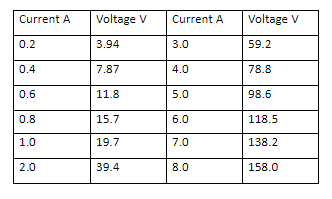
What conclusion can you draw from the following observations on a resistor made of alloy manganin?
Answer
 Verified
603.3k+ views
Hint: try to analyse what is given to us in the question. We are given the values of current and voltages and try to obtain a relationship between them. Find the relation and then we can give a conclusion about the table.
Complete step by step solution:
In the question we are given certain values or current in ampere and voltages in volt respectively against each other.
Relation between the current and voltage is given by the ohm’s law. Ohm’s law can be defined as, at constant temperature the voltage difference between two points in a conductor is directly proportional to the current flowing through the conductor.
Mathematically we can express it as,
$V\propto I$
We put an equal sign in this equation by introducing a proportional constant.
$V=IR$
Where, R is the proportionality constant called the resistance.
Now we can mathematically get the value of resistance as,
$R=\dfrac{V}{I}$
With the help of the above equation we can find out the value of resistance for each case.
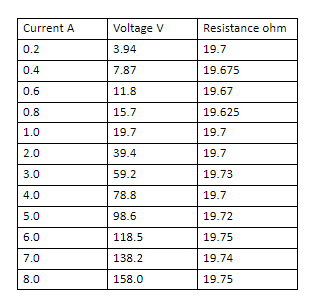
We can see that with the increase in the value of current the value of voltage is also increasing with the value of the resistance constant.
From the above measurements we can conclude that the ohm's law is valid for the alloy manganin to a very high accuracy.
Note: we can obtain the above result in another way also if we put the values of the current and voltages in a graph with voltage in the x- axis and current in the y-axis we will get a straight line, which means that the current and voltages are linearly dependent on each other. Which proves that the alloy follows the Ohm’s law.
Complete step by step solution:
In the question we are given certain values or current in ampere and voltages in volt respectively against each other.
Relation between the current and voltage is given by the ohm’s law. Ohm’s law can be defined as, at constant temperature the voltage difference between two points in a conductor is directly proportional to the current flowing through the conductor.
Mathematically we can express it as,
$V\propto I$
We put an equal sign in this equation by introducing a proportional constant.
$V=IR$
Where, R is the proportionality constant called the resistance.
Now we can mathematically get the value of resistance as,
$R=\dfrac{V}{I}$
With the help of the above equation we can find out the value of resistance for each case.
We can see that with the increase in the value of current the value of voltage is also increasing with the value of the resistance constant.
From the above measurements we can conclude that the ohm's law is valid for the alloy manganin to a very high accuracy.
Note: we can obtain the above result in another way also if we put the values of the current and voltages in a graph with voltage in the x- axis and current in the y-axis we will get a straight line, which means that the current and voltages are linearly dependent on each other. Which proves that the alloy follows the Ohm’s law.
Recently Updated Pages
Master Class 12 Economics: Engaging Questions & Answers for Success

Master Class 12 Physics: Engaging Questions & Answers for Success
Master Class 12 English: Engaging Questions & Answers for Success
Master Class 12 Social Science: Engaging Questions & Answers for Success
Master Class 12 Maths: Engaging Questions & Answers for Success
Master Class 12 Business Studies: Engaging Questions & Answers for Success
Trending doubts
Which are the Top 10 Largest Countries of the World?
What are the major means of transport Explain each class 12 social science CBSE
Draw a labelled sketch of the human eye class 12 physics CBSE
Why cannot DNA pass through cell membranes class 12 biology CBSE
Differentiate between insitu conservation and exsitu class 12 biology CBSE
Draw a neat and well labeled diagram of TS of ovary class 12 biology CBSE