




Compound ‘X’ having molecular formula\[\text{ }{{\text{C}}_{\text{4}}}{{\text{H}}_{\text{8}}}{{\text{O}}_{\text{3}}}\text{ }\]. It evolves$\text{ C}{{\text{O}}_{\text{2}}}\text{ }$, with$\text{ NaHC}{{\text{O}}_{\text{3}}}\text{ }$’ X’ on reaction with $\text{ LiAl}{{\text{H}}_{\text{4}}}\text{ }$gives achiral compound ‘X’ is /are:
A)
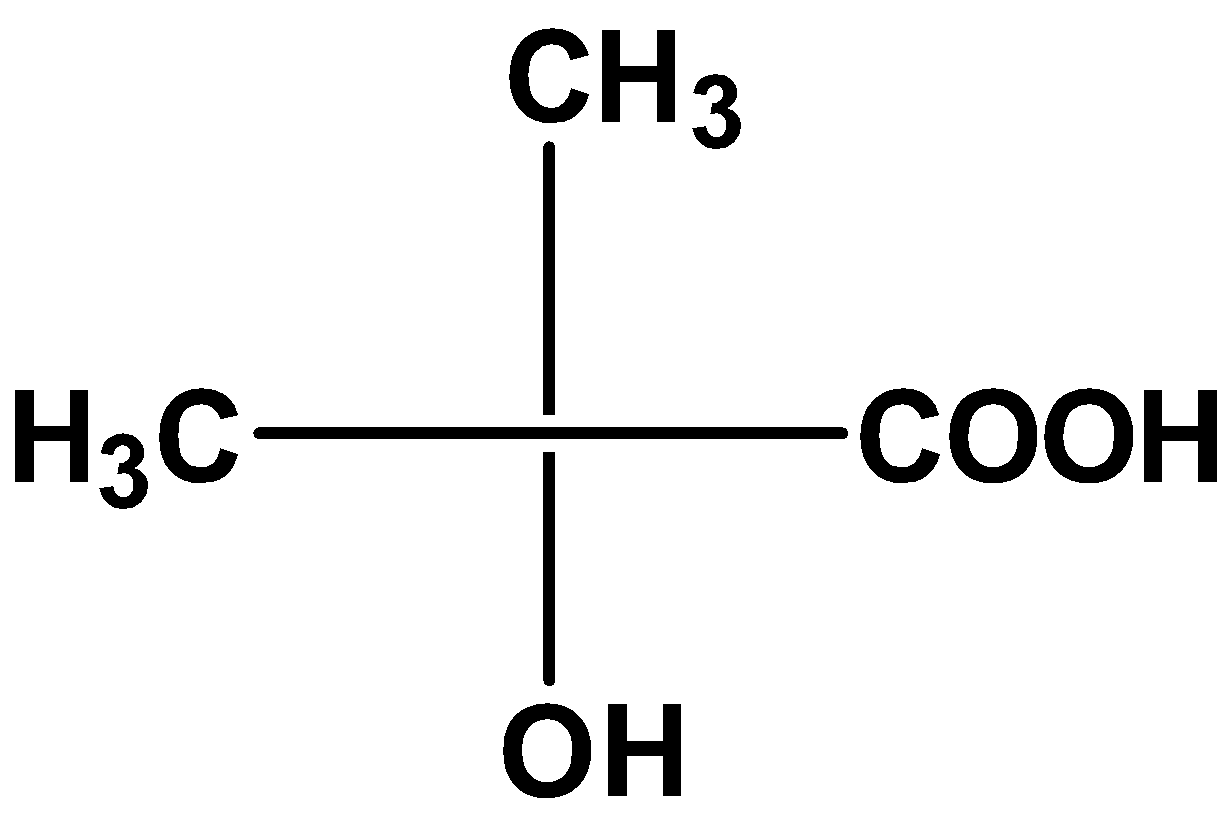
B)

C)

D)

| A) |
|
| B) |
|
| C) |
|
| D) |
|
Answer
 Verified
614.4k+ views
Hint: Carboxylic acid reacts with the carbonate or the bicarbonate. The reaction results in the evolution of carbon dioxide. The reducing agent like lithium aluminium hydride (LAH) adds the hydrogen atom across the compound. The carbonyl group in the compound is reduced to the hydroxyl group. Here, the compound on reduction with LAH forms an achiral compound.
Complete answer:
We have given that the compound ‘X’ which have the molecular formula \[\text{ }{{\text{C}}_{\text{4}}}{{\text{H}}_{\text{8}}}{{\text{O}}_{\text{3}}}\text{ }\] . When it is reacted with $\text{ NaHC}{{\text{O}}_{\text{3}}}\text{ }$evolves$\text{ C}{{\text{O}}_{\text{2}}}\text{ }$. The general reaction can be written as,
$\text{ X }\xrightarrow{\text{NaHC}{{\text{O}}_{\text{3}}}}\text{ C}{{\text{O}}_{\text{2}}}\text{ }$
The compound ‘X’ also reacts with lithium aluminium hydride$\text{ LiAl}{{\text{H}}_{\text{4}}}\text{ }$.
Carboxylic acid reacts with the carbonates or the bicarbonates .The reaction of the carboxylic acid with aqueous sodium bicarbonate leads to the evolution of carbon dioxide producing brisk effervesces.
It may be noted that the carboxylic acid with the $\text{ N}{{\text{a}}_{\text{2}}}\text{C}{{\text{O}}_{\text{3}}}\text{ }$ or$\text{ NaHC}{{\text{O}}_{\text{3}}}\text{ }$, the carbon dioxide comes from the $\text{ N}{{\text{a}}_{\text{2}}}\text{C}{{\text{O}}_{\text{3}}}\text{ }$or $\text{ NaHC}{{\text{O}}_{\text{3}}}\text{ }$and not from the carboxyl groups. The general reaction of the carboxylic acid with the sodium bicarbonate is given as follows,
$\text{ RCOOH + NaHC}{{\text{O}}_{\text{3}}}\text{ }\to \text{ RCOONa + C}{{\text{O}}_{\text{2}}}\text{ + }{{\text{H}}_{\text{2}}}\text{O }$
The compound \[\text{ }{{\text{C}}_{\text{4}}}{{\text{H}}_{\text{8}}}{{\text{O}}_{\text{3}}}\text{ }\]contains three oxygen atoms. Thus, the compound includes carboxylic acid groups and aldehydic groups or carboxylic acid groups and hydroxyl groups.
However, the 4 carbon atom compound with the aldehydic group and carboxylic acid group has the molecular formula equal to\[\text{ }{{\text{C}}_{\text{4}}}{{\text{H}}_{\text{8}}}{{\text{O}}_{\text{3}}}\text{ }\].
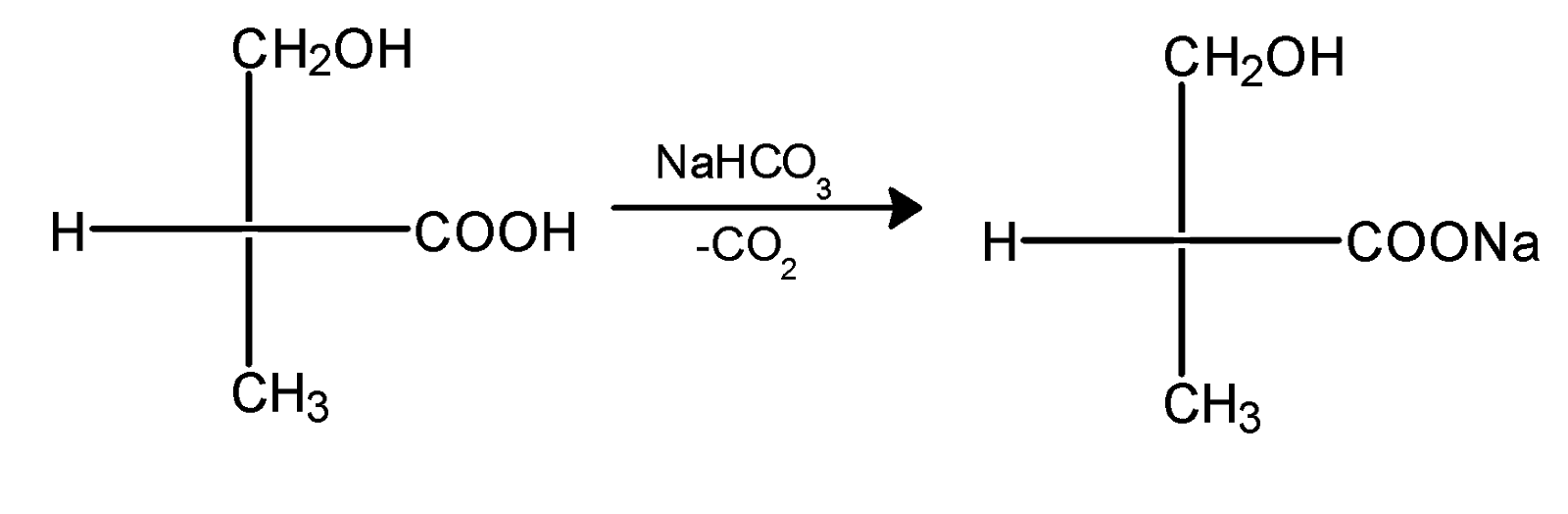
The reaction between the $\text{ NaHC}{{\text{O}}_{\text{3}}}\text{ }$and compound X is given as,
Lithium aluminium hydride is a reducing agent. It provides the hydrogen atom to the organic molecule. The acids can be reduced by lithium aluminium hydride. The carboxylic acid can be converted into the primary alcohol .T
The reaction of compound X with the LAH is as follows,
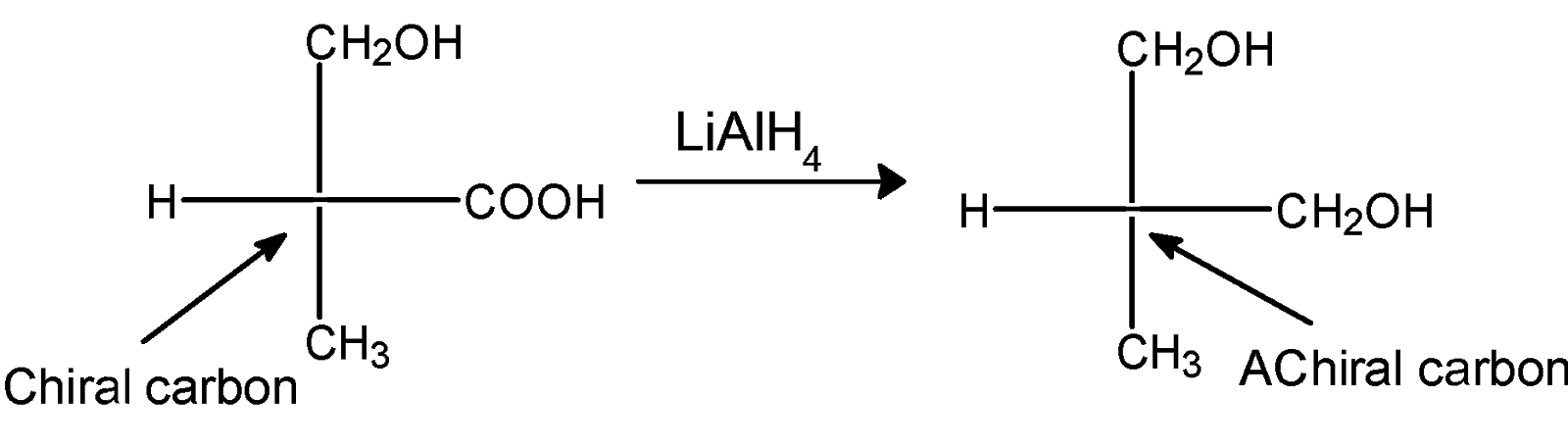
Thus, compound X from the option is,

Hence, (C) is the correct option.
Note:
Note that, the reduction of acid or ester to the alcohol is easily carried out in presence of lithium aluminium hydride, but the reduction is not easily carried out by the sodium borohydride $\text{ NaB}{{\text{H}}_{\text{4}}}\text{ }$ . This is because $\text{ NaB}{{\text{H}}_{\text{4}}}\text{ }$is a mild and selective reducing agent. The phenols do not produces effervescence when reacted with the bicarbonate, thus reaction with bicarbonate is used to distinguish between the phenol and carboxylic acid
Complete answer:
We have given that the compound ‘X’ which have the molecular formula \[\text{ }{{\text{C}}_{\text{4}}}{{\text{H}}_{\text{8}}}{{\text{O}}_{\text{3}}}\text{ }\] . When it is reacted with $\text{ NaHC}{{\text{O}}_{\text{3}}}\text{ }$evolves$\text{ C}{{\text{O}}_{\text{2}}}\text{ }$. The general reaction can be written as,
$\text{ X }\xrightarrow{\text{NaHC}{{\text{O}}_{\text{3}}}}\text{ C}{{\text{O}}_{\text{2}}}\text{ }$
The compound ‘X’ also reacts with lithium aluminium hydride$\text{ LiAl}{{\text{H}}_{\text{4}}}\text{ }$.
Carboxylic acid reacts with the carbonates or the bicarbonates .The reaction of the carboxylic acid with aqueous sodium bicarbonate leads to the evolution of carbon dioxide producing brisk effervesces.
It may be noted that the carboxylic acid with the $\text{ N}{{\text{a}}_{\text{2}}}\text{C}{{\text{O}}_{\text{3}}}\text{ }$ or$\text{ NaHC}{{\text{O}}_{\text{3}}}\text{ }$, the carbon dioxide comes from the $\text{ N}{{\text{a}}_{\text{2}}}\text{C}{{\text{O}}_{\text{3}}}\text{ }$or $\text{ NaHC}{{\text{O}}_{\text{3}}}\text{ }$and not from the carboxyl groups. The general reaction of the carboxylic acid with the sodium bicarbonate is given as follows,
$\text{ RCOOH + NaHC}{{\text{O}}_{\text{3}}}\text{ }\to \text{ RCOONa + C}{{\text{O}}_{\text{2}}}\text{ + }{{\text{H}}_{\text{2}}}\text{O }$
The compound \[\text{ }{{\text{C}}_{\text{4}}}{{\text{H}}_{\text{8}}}{{\text{O}}_{\text{3}}}\text{ }\]contains three oxygen atoms. Thus, the compound includes carboxylic acid groups and aldehydic groups or carboxylic acid groups and hydroxyl groups.
However, the 4 carbon atom compound with the aldehydic group and carboxylic acid group has the molecular formula equal to\[\text{ }{{\text{C}}_{\text{4}}}{{\text{H}}_{\text{8}}}{{\text{O}}_{\text{3}}}\text{ }\].
The reaction between the $\text{ NaHC}{{\text{O}}_{\text{3}}}\text{ }$and compound X is given as,
Lithium aluminium hydride is a reducing agent. It provides the hydrogen atom to the organic molecule. The acids can be reduced by lithium aluminium hydride. The carboxylic acid can be converted into the primary alcohol .T
The reaction of compound X with the LAH is as follows,
Thus, compound X from the option is,
Hence, (C) is the correct option.
Note:
Note that, the reduction of acid or ester to the alcohol is easily carried out in presence of lithium aluminium hydride, but the reduction is not easily carried out by the sodium borohydride $\text{ NaB}{{\text{H}}_{\text{4}}}\text{ }$ . This is because $\text{ NaB}{{\text{H}}_{\text{4}}}\text{ }$is a mild and selective reducing agent. The phenols do not produces effervescence when reacted with the bicarbonate, thus reaction with bicarbonate is used to distinguish between the phenol and carboxylic acid
Recently Updated Pages
Master Class 12 Business Studies: Engaging Questions & Answers for Success

Master Class 12 Chemistry: Engaging Questions & Answers for Success
Master Class 12 Biology: Engaging Questions & Answers for Success
Class 12 Question and Answer - Your Ultimate Solutions Guide
Master Class 11 English: Engaging Questions & Answers for Success
Master Class 11 Social Science: Engaging Questions & Answers for Success
Trending doubts
Which are the Top 10 Largest Countries of the World?
Draw a labelled sketch of the human eye class 12 physics CBSE
Differentiate between homogeneous and heterogeneous class 12 chemistry CBSE
In order to find out the different types of gametes class 12 biology NEET_UG
Why is the cell called the structural and functional class 12 biology CBSE
Draw ray diagrams each showing i myopic eye and ii class 12 physics CBSE