




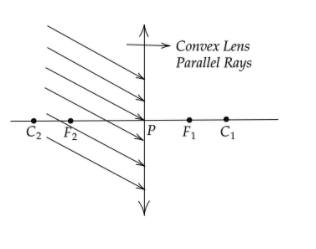
Complete the picture.
Answer
 Verified
538.5k+ views
Hint: We first need to know the nature and image formation of convex lenses. In case of convex lenses when a parallel line comes from infinity incidents on the lens reflected back and converge at a point that is the focus at the principal axis.
Complete step by step solution:
Convex Lens:
It is a lens that converges the rays of light that convey the parallel rays to its principal axis which is respectively thick across the middle and the thin at the lower and upper edges. Also the edges are conversed outward.
Focal length:
It is the distance between the centers of a convex lens where the parallel rays converge.
Principle Axis:
It is defined as the line that passes through the center of the surface of the convex lens and through the center of the curvature of all the segments of the lens.
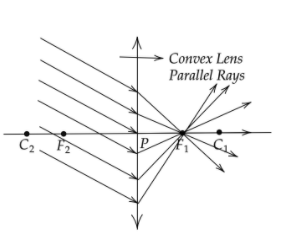
As per the figure given in the problem the light rays come from infinity and are parallel to each other so after conversion it will get converse at a point on the principle axis.
Now the complete picture will look like,
The formula of the convex lens is defined as the,
$\dfrac{1}{f} = \dfrac{1}{v} + \dfrac{1}{u}$
Where,
Focal length of the lens = f
Final value of the image = v
Initial value of the image = u
Note:
Remember that the convex lenses are used in the microscopes, magnification glasses and the eyeglasses. And with the help of this example we can signify how these lenses are used to crest real images. Another important point to remember is that in eyeglasses the convex lenses remain closer to the eye creating a virtual image.
Complete step by step solution:
Convex Lens:
It is a lens that converges the rays of light that convey the parallel rays to its principal axis which is respectively thick across the middle and the thin at the lower and upper edges. Also the edges are conversed outward.
Focal length:
It is the distance between the centers of a convex lens where the parallel rays converge.
Principle Axis:
It is defined as the line that passes through the center of the surface of the convex lens and through the center of the curvature of all the segments of the lens.
As per the figure given in the problem the light rays come from infinity and are parallel to each other so after conversion it will get converse at a point on the principle axis.
Now the complete picture will look like,
The formula of the convex lens is defined as the,
$\dfrac{1}{f} = \dfrac{1}{v} + \dfrac{1}{u}$
Where,
Focal length of the lens = f
Final value of the image = v
Initial value of the image = u
Note:
Remember that the convex lenses are used in the microscopes, magnification glasses and the eyeglasses. And with the help of this example we can signify how these lenses are used to crest real images. Another important point to remember is that in eyeglasses the convex lenses remain closer to the eye creating a virtual image.
Recently Updated Pages
Basicity of sulphurous acid and sulphuric acid are

Master Class 12 Economics: Engaging Questions & Answers for Success
Master Class 12 Biology: Engaging Questions & Answers for Success
Master Class 11 English: Engaging Questions & Answers for Success
Master Class 11 Physics: Engaging Questions & Answers for Success
Master Class 11 Computer Science: Engaging Questions & Answers for Success
Trending doubts
Draw a labelled sketch of the human eye class 12 physics CBSE
The chemical formula of tear gas is A CO Cl 2 B C 10 class 12 chemistry CBSE
Draw ray diagrams each showing i myopic eye and ii class 12 physics CBSE
Which are the Top 10 Largest Countries of the World?
Differentiate between homogeneous and heterogeneous class 12 chemistry CBSE
Which is the correct genotypic ratio of mendel dihybrid class 12 biology CBSE