




Compare the basic strengths of the compounds given:
(I) $E{{t}_{3}}N$
(II)
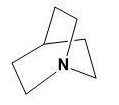
(III)
(A) (I) > (II) > (III)
(B) (II) > (I) > (III)
(C) (II) > (III) > (I)
(D) (III) > (II) > (I)
Answer
 Verified
607.5k+ views
Hint: Basicity of any compound depends upon many factors as the ability to donate electron, show +I effect, not to show -I effect, etc.
Here, depending upon some factors we will discuss and give the order of basicity.
Complete step by step answer:
Let us see the required parameters to solve the given illustration,
Electron withdrawing group-
The presence of EWG shows that the group can withdraw electrons from the system i.e. represents -I effect.
Electron donating group-
The presence of EDG shows that the group can donate electrons to the system i.e. represents +I effect,
Inductive effect plays a very important role in deciding the acidity and basicity of the molecule. We can represent that easily by,
$Basicity\propto +I$ and $Basicity\propto \frac{1}{-I}$ .
Also, basicity, in general, is the ability to donate electrons to the system.
Keeping these points in mind let us move towards the illustration;
We have,
1.$E{{t}_{3}}N$-
Here, Et represents the ethyl group i.e. $C{{H}_{3}}-C{{H}_{2}}-$ group which is the electron donating group showing +I effect. And as from above basicity is directly proportional to the +I effect thus, we can say that $E{{t}_{3}}N$ is highly basic.
2.
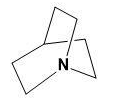
Here, the lone pair present on N can be donated to ${{H}^{+}}$ forming $R-{{N}^{+}}{{H}_{3}}$ which is highly unstable. Thus, this will be less basic.
3.
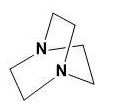
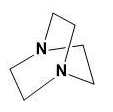
Here, the two N atoms are forming a bridge and both will show -I effect which from the above explanation shows the least basicity.
Therefore, the basicity order will be (I) > (II) > (III).
Hence, option (A) is correct.
Note: Do note that the basicity is dependent on different factors for every different compound but those factors end up to one common thing which is empirical i.e. the ability to donate electrons (basicity).
Here, depending upon some factors we will discuss and give the order of basicity.
Complete step by step answer:
Let us see the required parameters to solve the given illustration,
Electron withdrawing group-
The presence of EWG shows that the group can withdraw electrons from the system i.e. represents -I effect.
Electron donating group-
The presence of EDG shows that the group can donate electrons to the system i.e. represents +I effect,
Inductive effect plays a very important role in deciding the acidity and basicity of the molecule. We can represent that easily by,
$Basicity\propto +I$ and $Basicity\propto \frac{1}{-I}$ .
Also, basicity, in general, is the ability to donate electrons to the system.
Keeping these points in mind let us move towards the illustration;
We have,
1.$E{{t}_{3}}N$-
Here, Et represents the ethyl group i.e. $C{{H}_{3}}-C{{H}_{2}}-$ group which is the electron donating group showing +I effect. And as from above basicity is directly proportional to the +I effect thus, we can say that $E{{t}_{3}}N$ is highly basic.
2.
Here, the lone pair present on N can be donated to ${{H}^{+}}$ forming $R-{{N}^{+}}{{H}_{3}}$ which is highly unstable. Thus, this will be less basic.
3.
Here, the two N atoms are forming a bridge and both will show -I effect which from the above explanation shows the least basicity.
Therefore, the basicity order will be (I) > (II) > (III).
Hence, option (A) is correct.
Note: Do note that the basicity is dependent on different factors for every different compound but those factors end up to one common thing which is empirical i.e. the ability to donate electrons (basicity).
Recently Updated Pages
Master Class 12 Business Studies: Engaging Questions & Answers for Success

Master Class 12 Chemistry: Engaging Questions & Answers for Success
Master Class 12 Biology: Engaging Questions & Answers for Success
Class 12 Question and Answer - Your Ultimate Solutions Guide
Master Class 11 English: Engaging Questions & Answers for Success
Master Class 11 Social Science: Engaging Questions & Answers for Success
Trending doubts
Differentiate between Pyramid of energy and pyramid class 12 biology CBSE
Draw the diagram of the pyramid of energy Explain In class 12 biology CBSE
What is the Full Form of PVC, PET, HDPE, LDPE, PP and PS ?
The first microscope was invented by A Leeuwenhoek class 12 biology CBSE
Suicide bags of cells are aEndoplasmic reticulum bLysosome class 12 biology CBSE
Loss of upper fertile layer of soil is known as APedogenesis class 12 biology CBSE