




How do combinations relate to Pascal’s triangle?
Answer
 Verified
601.2k+ views
Hint: Now we know that the Pascal’s triangle is obtained by adding the adjoining terms in the previous row. Hence first we will form a Pascal’s triangle. Now we know that the formula for combination is $^{n}{{C}_{r}}=\dfrac{n!}{r!\left( n-r \right)!}$ . Hence we will check the relation of the values of combinations and try to relate it with Pascal’s triangle.
Complete step-by-step answer:
Now let us understand the concept of Pascal’s triangle.
Pascal triangle is a triangle of numbers in which the numbers in each row are obtained by adding the adjacent numbers in previous rows. The end of each row in Pascal’s triangle is 1.
Hence we have the first row with just 1 number which is 1.
The second row with 1-1.
Now in the second row we have 1-1 Hence adding we get, 1 + 1 = 2.
Hence the third row consists of 121.
Now similarly the fourth row will have 1331.
Hence we go on to create Pascal’s triangle.
Let us create a Pascal’s triangle with 5 rows for example.
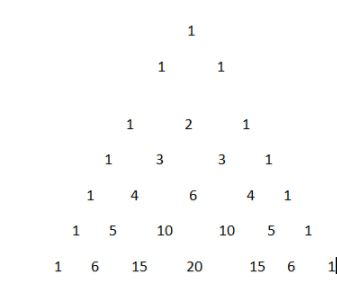
Now let us understand the meaning of n!.
Now n! read as n factorial is nothing but multiplication of all the numbers les than or equal to n.
Hence we have, $n!-n\times \left( n-1 \right)\times ...\times 3\times 2\times 1$ .
Now using this factorial we define the term of combinations $^{n}{{C}_{r}}$. Now the number $^{n}{{C}_{r}}$ gives us the number of combinations we can make from n objects choosing r objects. Now the value of $^{n}{{C}_{r}}$ is given by formula $\dfrac{n!}{r!\left( n-r \right)!}$ .
Now there the relation of the combination and the Pascal’s triangle is that the term $^{n}{{C}_{r}}$ gives us ${{\left( r \right)}^{th}}$ entry of the ${{n}^{th}}$ row on Pascal’s triangle. Note that the first entry in the row is taken as ${{0}^{th}}$ entry. Hence let us say we want to find ${{2}^{nd}}$ entry of ${{4}^{th}}$ row then we have $^{4}{{C}_{2}}=\dfrac{4!}{2!2!}=\dfrac{4\times 3\times 2!}{2!\times 2}=6$ .
Note: Now note that Pascal’s triangle have many interesting facts about numbers. The triangle is symmetrical on the left and right. The horizontal sum of each rows is the respective power of 2. Each line is also the power of 11. Hence if we want to find entries of row 3 then we have ${{11}^{3}}=1331$ .
Complete step-by-step answer:
Now let us understand the concept of Pascal’s triangle.
Pascal triangle is a triangle of numbers in which the numbers in each row are obtained by adding the adjacent numbers in previous rows. The end of each row in Pascal’s triangle is 1.
Hence we have the first row with just 1 number which is 1.
The second row with 1-1.
Now in the second row we have 1-1 Hence adding we get, 1 + 1 = 2.
Hence the third row consists of 121.
Now similarly the fourth row will have 1331.
Hence we go on to create Pascal’s triangle.
Let us create a Pascal’s triangle with 5 rows for example.
Now let us understand the meaning of n!.
Now n! read as n factorial is nothing but multiplication of all the numbers les than or equal to n.
Hence we have, $n!-n\times \left( n-1 \right)\times ...\times 3\times 2\times 1$ .
Now using this factorial we define the term of combinations $^{n}{{C}_{r}}$. Now the number $^{n}{{C}_{r}}$ gives us the number of combinations we can make from n objects choosing r objects. Now the value of $^{n}{{C}_{r}}$ is given by formula $\dfrac{n!}{r!\left( n-r \right)!}$ .
Now there the relation of the combination and the Pascal’s triangle is that the term $^{n}{{C}_{r}}$ gives us ${{\left( r \right)}^{th}}$ entry of the ${{n}^{th}}$ row on Pascal’s triangle. Note that the first entry in the row is taken as ${{0}^{th}}$ entry. Hence let us say we want to find ${{2}^{nd}}$ entry of ${{4}^{th}}$ row then we have $^{4}{{C}_{2}}=\dfrac{4!}{2!2!}=\dfrac{4\times 3\times 2!}{2!\times 2}=6$ .
Note: Now note that Pascal’s triangle have many interesting facts about numbers. The triangle is symmetrical on the left and right. The horizontal sum of each rows is the respective power of 2. Each line is also the power of 11. Hence if we want to find entries of row 3 then we have ${{11}^{3}}=1331$ .
Recently Updated Pages
Which of the following graphs shows the variation of class 12 physics CBSE

Draw a labelled diagram of the human male reproductive class 12 biology CBSE
Describe the experiment to compare the emf of two cells class 12 physics CBSE
What is standard hydrogen electrode
What is conventional current and electric current class 12 physics CBSE
2Bromopentane is treated with an alcoholic KOH solution class 12 chemistry CBSE
Trending doubts
Draw a labelled sketch of the human eye class 12 physics CBSE
Which are the Top 10 Largest Countries of the World?
Differentiate between homogeneous and heterogeneous class 12 chemistry CBSE
Draw ray diagrams each showing i myopic eye and ii class 12 physics CBSE
Which is the correct genotypic ratio of mendel dihybrid class 12 biology CBSE
What is the Full Form of PVC, PET, HDPE, LDPE, PP and PS ?