




Claw is found in the petals of
A. Cruciferae
B. Fabaceae
C. Liliaceae
D. Solanaceae
Answer
 Verified
606.6k+ views
Hint: The petals of different flowers have different variations. Some petals are round or some are pinned. The type of petals found in the flower tells a lot about the classification of the flower. In petals the lower part is usually thin or sharp, this is called a claw. Brassicaceae commonly including the mustard or cabbage family have claw-shaped petals.
Complete step by step answer: A flower is the reproductive part of a plant that contains both the sexual units of a plant. The flower consists of petals that are varied in shape, size, and color in different plants. The petals are the characteristics of the classification of plants. Usually, the petals are round or sharp ended. Some plants have flowers with petals having their bottoms being sharp and thin with a hairy appearance. This is seen majorly in the family of Brassicaceae or Cruciferae.
-The mustard family consists of herbs ranging from annual to perennial types. They lack stipules on their leaves that are arranged alternatively. The stems are composed of hairs having fork or star-shapes. 4 separate petals are contained in the calyx and the corolla separately.
-The petals are separable at the base into narrow claws having broader upper portions. The androecium consists of 6 stamens in a tetradynamous arrangement having 4 long stamens and 2 short stamens.
-On the other hand, the gynoecium is syncarpous and is made of 2 united carpels. The gynoecium contains the ovules that are borne along the ovary wall.
-The ovary partition goes across the carpels making a false partition. The fruit has a special name called silique or a silicle. It is short and squat and is strikingly modified. Thus, the Cruciferae are the ones that contain clawed petals.
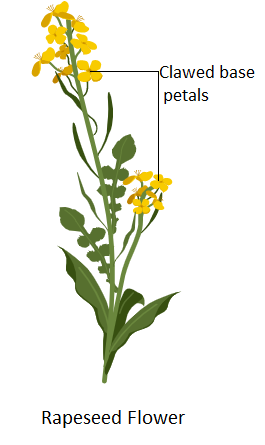
Fabaceae, Solanaceae, and Liliaceae do not contain petals with thin bottoms and thus lack claw in petals.
Thus, the right answer is option A.
Note: The Brassicaceae family consists of cruciferous vegetables including broccoli, cabbage, cauliflower, turnip, radish, rapeseed, etc. these all contain claw in their petals.
Complete step by step answer: A flower is the reproductive part of a plant that contains both the sexual units of a plant. The flower consists of petals that are varied in shape, size, and color in different plants. The petals are the characteristics of the classification of plants. Usually, the petals are round or sharp ended. Some plants have flowers with petals having their bottoms being sharp and thin with a hairy appearance. This is seen majorly in the family of Brassicaceae or Cruciferae.
-The mustard family consists of herbs ranging from annual to perennial types. They lack stipules on their leaves that are arranged alternatively. The stems are composed of hairs having fork or star-shapes. 4 separate petals are contained in the calyx and the corolla separately.
-The petals are separable at the base into narrow claws having broader upper portions. The androecium consists of 6 stamens in a tetradynamous arrangement having 4 long stamens and 2 short stamens.
-On the other hand, the gynoecium is syncarpous and is made of 2 united carpels. The gynoecium contains the ovules that are borne along the ovary wall.
-The ovary partition goes across the carpels making a false partition. The fruit has a special name called silique or a silicle. It is short and squat and is strikingly modified. Thus, the Cruciferae are the ones that contain clawed petals.
Fabaceae, Solanaceae, and Liliaceae do not contain petals with thin bottoms and thus lack claw in petals.
Thus, the right answer is option A.
Note: The Brassicaceae family consists of cruciferous vegetables including broccoli, cabbage, cauliflower, turnip, radish, rapeseed, etc. these all contain claw in their petals.
Recently Updated Pages
Master Class 11 Social Science: Engaging Questions & Answers for Success

Master Class 11 Chemistry: Engaging Questions & Answers for Success
Master Class 9 General Knowledge: Engaging Questions & Answers for Success
Master Class 9 Maths: Engaging Questions & Answers for Success
Master Class 9 Science: Engaging Questions & Answers for Success
Master Class 9 English: Engaging Questions & Answers for Success
Trending doubts
Explain zero factorial class 11 maths CBSE
Draw a diagram of a plant cell and label at least eight class 11 biology CBSE
What is the atomic mass of Sodium a 22 gmol b 23 gmol class 11 chemistry CBSE
Draw a diagram of nephron and explain its structur class 11 biology CBSE
How do I get the molar mass of urea class 11 chemistry CBSE
What organs are located on the left side of your body class 11 biology CBSE