




Circle has the equation ${{x}^{2}}+{{y}^{2}}+2x-2y-14=0$. How do you graph the circle using the center $\left( h,k \right)$ and radius,$r$?
Answer
 Verified
563.7k+ views
Hint: Generally the equation of a circle comes in two forms:
1. The standard form:${{\left( x-h \right)}^{2}}+{{\left( y-k \right)}^{2}}={{r}^{2}}$
2. The general form:${{x}^{2}}+{{y}^{2}}+dx+sy+f=0,$ where d, s, f are constants.
If the equation of a circle is in the standard form, we can easily identify the center of the circle,$\left( h,k \right)$, and radius,$r$. But if we have an equation in general form then we have to simplify it by using a few steps.
Complete step by step solution:
Here we have the equation in general form${{x}^{2}}+{{y}^{2}}+2x-2y-14=0$ . To draw the circle we have to find the center, $\left( h,k \right)$and radius, $r$. For we will simplify our given equation${{x}^{2}}+{{y}^{2}}+2x-2y-14=0$ by these steps:
1. Write the equation in this form: $\left( {{x}^{2}}+2x+{{?}_{1}} \right)+\left( {{y}^{2}}-2y+{{?}_{2}} \right)=14+{{?}_{1}}+{{?}_{2}}$ . In the first parenthesis, we group the $x$-terms and in the second the$y$-terms. The constant is moved on the right hand side. Here we have to apply, on both sides of the equation.
2. Now take the coefficient of $x$ and divide it by$2$, $\left( \dfrac{2}{2} \right)$ , and then square it, we get ${{\left( \dfrac{2}{2} \right)}^{2}}=1$ and replace the ${{?}_{1}}$ by $1$.
3. Take coefficient of $y$ and divide it by$2$,$\left( -\dfrac{2}{2} \right)$, and the square it, we get${{\left( -\dfrac{2}{2} \right)}^{2}}=1$ and replace the ${{?}_{2}}$ by$1$.
Putting steps 1-3 together we have the following:
$\begin{align}
& \Rightarrow \left( {{x}^{2}}+2x+{{?}_{1}} \right)+\left( {{y}^{2}}-2y+{{?}_{2}} \right)=14+{{?}_{1}}+{{?}_{2}} \\
& \Rightarrow \left( {{x}^{2}}+2x+1 \right)+\left( {{y}^{2}}-2y+1 \right)=14+1+1 \\
& \Rightarrow {{\left( x+1 \right)}^{2}}+{{\left( y-1 \right)}^{2}}={{4}^{2}} \\
\end{align}$
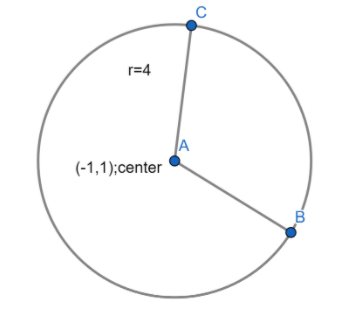
Now the equation becomes in standard form. The center, $\left( h,k \right)$are -1, 1 and radius, $r$is 4.
The graph of the circle is:
Note:
A common mistake we sometimes made is to take $h=1$, and $k=-1$. In equation, if the sign preceding $h$, and $k$ , $\left( h,k \right)$are negative, then $h$ and $k$ are positive. That is,$h=-1$, and $k=1$ . Always change the general form of the equation into standard form.
1. The standard form:${{\left( x-h \right)}^{2}}+{{\left( y-k \right)}^{2}}={{r}^{2}}$
2. The general form:${{x}^{2}}+{{y}^{2}}+dx+sy+f=0,$ where d, s, f are constants.
If the equation of a circle is in the standard form, we can easily identify the center of the circle,$\left( h,k \right)$, and radius,$r$. But if we have an equation in general form then we have to simplify it by using a few steps.
Complete step by step solution:
Here we have the equation in general form${{x}^{2}}+{{y}^{2}}+2x-2y-14=0$ . To draw the circle we have to find the center, $\left( h,k \right)$and radius, $r$. For we will simplify our given equation${{x}^{2}}+{{y}^{2}}+2x-2y-14=0$ by these steps:
1. Write the equation in this form: $\left( {{x}^{2}}+2x+{{?}_{1}} \right)+\left( {{y}^{2}}-2y+{{?}_{2}} \right)=14+{{?}_{1}}+{{?}_{2}}$ . In the first parenthesis, we group the $x$-terms and in the second the$y$-terms. The constant is moved on the right hand side. Here we have to apply, on both sides of the equation.
2. Now take the coefficient of $x$ and divide it by$2$, $\left( \dfrac{2}{2} \right)$ , and then square it, we get ${{\left( \dfrac{2}{2} \right)}^{2}}=1$ and replace the ${{?}_{1}}$ by $1$.
3. Take coefficient of $y$ and divide it by$2$,$\left( -\dfrac{2}{2} \right)$, and the square it, we get${{\left( -\dfrac{2}{2} \right)}^{2}}=1$ and replace the ${{?}_{2}}$ by$1$.
Putting steps 1-3 together we have the following:
$\begin{align}
& \Rightarrow \left( {{x}^{2}}+2x+{{?}_{1}} \right)+\left( {{y}^{2}}-2y+{{?}_{2}} \right)=14+{{?}_{1}}+{{?}_{2}} \\
& \Rightarrow \left( {{x}^{2}}+2x+1 \right)+\left( {{y}^{2}}-2y+1 \right)=14+1+1 \\
& \Rightarrow {{\left( x+1 \right)}^{2}}+{{\left( y-1 \right)}^{2}}={{4}^{2}} \\
\end{align}$
Now the equation becomes in standard form. The center, $\left( h,k \right)$are -1, 1 and radius, $r$is 4.
The graph of the circle is:
Note:
A common mistake we sometimes made is to take $h=1$, and $k=-1$. In equation, if the sign preceding $h$, and $k$ , $\left( h,k \right)$are negative, then $h$ and $k$ are positive. That is,$h=-1$, and $k=1$ . Always change the general form of the equation into standard form.
Recently Updated Pages
Master Class 12 Social Science: Engaging Questions & Answers for Success

Master Class 12 Physics: Engaging Questions & Answers for Success
Master Class 12 Maths: Engaging Questions & Answers for Success
Master Class 12 Economics: Engaging Questions & Answers for Success
Master Class 12 Chemistry: Engaging Questions & Answers for Success
Master Class 12 Business Studies: Engaging Questions & Answers for Success
Trending doubts
Which are the Top 10 Largest Countries of the World?
Draw a labelled sketch of the human eye class 12 physics CBSE
Explain the structure of megasporangium class 12 biology CBSE
What are the major means of transport Explain each class 12 social science CBSE
How many chromosomes are found in human ovum a 46 b class 12 biology CBSE
The diagram of the section of a maize grain is given class 12 biology CBSE