




Chromosome duplication without nuclear division refers to
(a) Meiosis
(b) Mitosis
(c) Androgenesis
(d) Endomitosis
Answer
 Verified
599.1k+ views
Hint: This is often found in insects and tissues of some vertebrates, which form cells with a polyploid nucleus. Polytene chromosomes (huge chromosomes) are also formed as a result of this process.
Complete Step by Step Answer:
Endomitosis is the process of chromosome divides or doubles without nuclear division which leads to the formation of a polyploidy nucleus where one nucleus will have multiple sets of chromosomes.
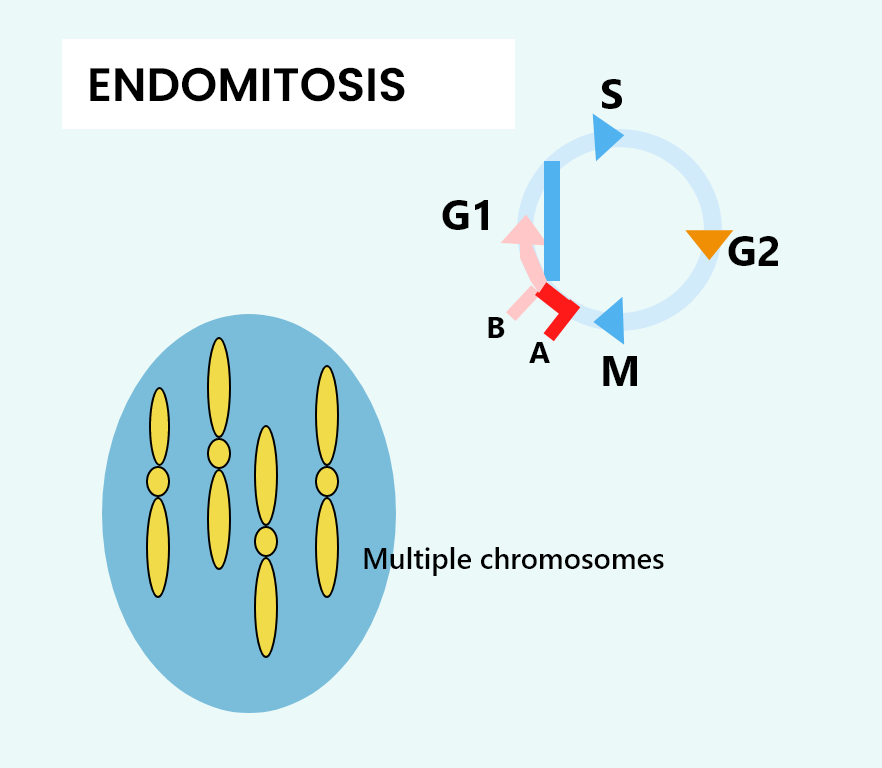
So, the correct answer is ‘Endomitosis’.
Additional Information:
- In- plant cells endomitosis is commonly found in tapetum where the nuclear membrane does not disappear, but the chromosomes are condensed more than that of normal mitosis during the metaphase.
Meiosis: A process where a single cell produces four daughter cells by replicating twice, where each cell contains half of the original amount of genetic material from the parent cell.
- Gametes (sex cells – egg in females and sperm in males) are produced by meiosis. The process of meiosis is divided into two major stages known as meiosis I and meiosis II.
Mitosis: A process where a single parent cell divides or replicates into two identical daughter cells, which is commonly known as cell replication or binary division.
- Mitosis occurs in our normal cells by which the cells increase their number and also replaces dead cells.
- Mitosis is divided into 5 stages, which are Interphase, prophase, metaphase, anaphase, and telophase.
Androgenesis: The process of formation of embryos without the genetic material from oocytes.
- In androgenesis, there is no participation by the female reproductive cell in the process of reproduction.
Note:
- In mitosis, the daughter cells are genetically identical, wherein meiosis the daughter cells are not genetically identical and result in the formation of haploid daughter cells.
- Diploid cells have two sets of chromosomes in which one set is obtained from each parent, where haploid cells have just a single copy of each chromosome.
Complete Step by Step Answer:
Endomitosis is the process of chromosome divides or doubles without nuclear division which leads to the formation of a polyploidy nucleus where one nucleus will have multiple sets of chromosomes.
So, the correct answer is ‘Endomitosis’.
Additional Information:
- In- plant cells endomitosis is commonly found in tapetum where the nuclear membrane does not disappear, but the chromosomes are condensed more than that of normal mitosis during the metaphase.
Meiosis: A process where a single cell produces four daughter cells by replicating twice, where each cell contains half of the original amount of genetic material from the parent cell.
- Gametes (sex cells – egg in females and sperm in males) are produced by meiosis. The process of meiosis is divided into two major stages known as meiosis I and meiosis II.
Mitosis: A process where a single parent cell divides or replicates into two identical daughter cells, which is commonly known as cell replication or binary division.
- Mitosis occurs in our normal cells by which the cells increase their number and also replaces dead cells.
- Mitosis is divided into 5 stages, which are Interphase, prophase, metaphase, anaphase, and telophase.
Androgenesis: The process of formation of embryos without the genetic material from oocytes.
- In androgenesis, there is no participation by the female reproductive cell in the process of reproduction.
Note:
- In mitosis, the daughter cells are genetically identical, wherein meiosis the daughter cells are not genetically identical and result in the formation of haploid daughter cells.
- Diploid cells have two sets of chromosomes in which one set is obtained from each parent, where haploid cells have just a single copy of each chromosome.
Recently Updated Pages
Three beakers labelled as A B and C each containing 25 mL of water were taken A small amount of NaOH anhydrous CuSO4 and NaCl were added to the beakers A B and C respectively It was observed that there was an increase in the temperature of the solutions contained in beakers A and B whereas in case of beaker C the temperature of the solution falls Which one of the following statements isarecorrect i In beakers A and B exothermic process has occurred ii In beakers A and B endothermic process has occurred iii In beaker C exothermic process has occurred iv In beaker C endothermic process has occurred

Master Class 11 Social Science: Engaging Questions & Answers for Success
Master Class 11 Physics: Engaging Questions & Answers for Success
Master Class 11 Maths: Engaging Questions & Answers for Success
Master Class 11 Economics: Engaging Questions & Answers for Success
Master Class 11 Computer Science: Engaging Questions & Answers for Success
Three beakers labelled as A B and C each containing 25 mL of water were taken A small amount of NaOH anhydrous CuSO4 and NaCl were added to the beakers A B and C respectively It was observed that there was an increase in the temperature of the solutions contained in beakers A and B whereas in case of beaker C the temperature of the solution falls Which one of the following statements isarecorrect i In beakers A and B exothermic process has occurred ii In beakers A and B endothermic process has occurred iii In beaker C exothermic process has occurred iv In beaker C endothermic process has occurred
Master Class 11 Social Science: Engaging Questions & Answers for Success
Master Class 11 Physics: Engaging Questions & Answers for Success
Trending doubts
One Metric ton is equal to kg A 10000 B 1000 C 100 class 11 physics CBSE
There are 720 permutations of the digits 1 2 3 4 5 class 11 maths CBSE
State and prove Bernoullis theorem class 11 physics CBSE
Draw a diagram of a plant cell and label at least eight class 11 biology CBSE
Difference Between Prokaryotic Cells and Eukaryotic Cells
1 Quintal is equal to a 110 kg b 10 kg c 100kg d 1000 class 11 physics CBSE